



All places where metal parts slide against each other must be constantly supplied with oil. Such parts include, for example, pistons, cylinder running surfaces, crankshaft and camshaft bearings. Without lubrication, the engine would be destroyed within a few minutes.
To do its job, the oil in the cylinder block flows through a system of pipes and small holes and gets to where it is needed.
The oil pump plays an important role in the circulation of oil. The oil pump sucks engine oil from the sump through the oil intake pipe and pumps it into the pipelines. Before this, the oil passes through the oil filter, which is installed in the main line. The filter filters out various contaminants, such as soot, metal abrasion products and dust.
There is a relief valve on the discharge side of the pump. If the pressure is too high, this valve opens and some of the oil flows back into the oil pan.
The filtered oil flows directly into the pressure lubrication line via the filter cartridge centre line. The pressure lubrication line has a pressure-type oil switch which warns the driver via a warning light on the instrument panel that the oil pressure is too low.
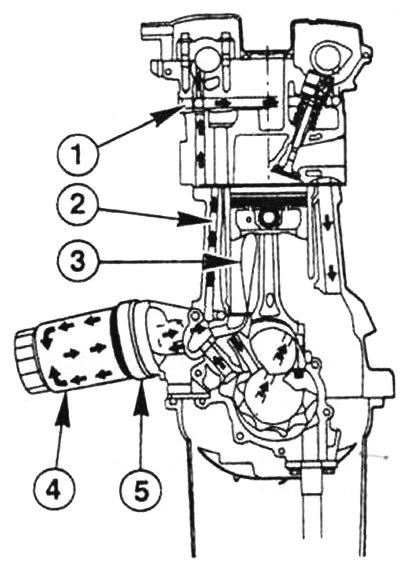
The oil circulation diagram shows that in addition to the crankshaft bearings, the oil lubricates a number of other parts: 1 - cylinder head lubrication channel, 2 - pressure line, 3 - oil splash for piston cooling, 4 - main oil filter, 5 - oil radiator
Change the oil filter in a timely manner
The oil filter only performs its functions until it is clogged. Therefore, the filter must be changed every time the oil is changed. If the filter is not changed in a timely manner, the safety valve is triggered. The valve opens, and the engine oil bypasses the filter. This ensures that the engine is supplied with oil, but unfiltered oil causes significant wear on the bearing areas.
From the filter, the oil flows through openings in the cylinder block to the lubrication points of the crankshaft and connecting rods. From the plain bearings of the crankshaft, the oil is squeezed into the cylinder head and to the bearing areas of the camshaft, as well as to the rocker arms of the valve drive. From there, the oil drains through return channels into the oil pan, where it is sucked in again by the pump.
(Text provided by the online resource audimanual.ru)