
Repair Chevrolet Repair Toyota Repair Honda Repair AvtoVAZ Repair Mercedes-Benz Repair BMW Repair Opel
Home  |  Contacts  |  Sitemap  |    
English Русский
Български
Беларускі
Український
Српски
Hrvatski
Română
Polski
Slovenský
Magyar
AudiManual.ru


  • AUDI 80
  • AUDI 100
  • AUDI A3
  • AUDI A4
  • AUDI A6
  • AUDI A8
  • AUDI Q
  • OTHER
  • ARTICLES
C5 Allroad (1999-2005) C5 (1997-2004) C4 (1994-1997)

Engine cooling system — design description (Audi A6 C5)

  • Home
  • Audi A6
  • C5 Allroad (1999-2005)
  • Power unit
  • Cooling and heating system
  • Engine cooling system — design description
            0
Coolant is constantly circulating in the circuit, forced by the water pump. Until the engine is warmed up, coolant circulates only in the cylinder head, in the cylinder block and in the heater radiator. As the temperature increases, the thermostat of the liquid cooling system opens the large circuit and directs the flow of coolant to the radiator. The coolant moves through the radiator, while being cooled by the air passing near the radiator fins (see illustrations 1.0-1.0b).

For additional cooling of the liquid, a radiator blower is installed. At low temperatures, a viscous coupling on the fan rotor hub reduces its rotation speed. With an increase in the coolant temperature to a certain value, the coupling turns on the fan and it operates at an increased speed.

Depending on the configuration, for example, an air conditioner, an electric radiator fan is additionally installed. This fan is controlled by a two-stage thermal relay, which is screwed into the radiator at the bottom left or is located in the lower coolant circulation hose. When the coolant reaches a temperature of +92-97°C, the thermal relay turns on the electric fan, which operates at the first rotation stage. With an increase in the coolant temperature to +99-105°C, the electric fan operates at full power.

Since the electric radiator fan does not operate continuously and the coolant circulation is regulated by a thermostat, the engine warms up to operating temperature faster. Fuel consumption is reduced.

Caution! The electric fan may automatically turn on when the ignition is off due to heat accumulating in the engine compartment. It is recommended to disconnect the electric fan power plug before performing work in the engine compartment, especially near the radiator fan.


Caution! When working on the cooling system, do not allow coolant to come into contact with the timing belt. Ethylene glycol, which is part of the coolant, can damage the base of the belt so much that it will break after a while. This, in turn, is fraught with serious damage to the engine.
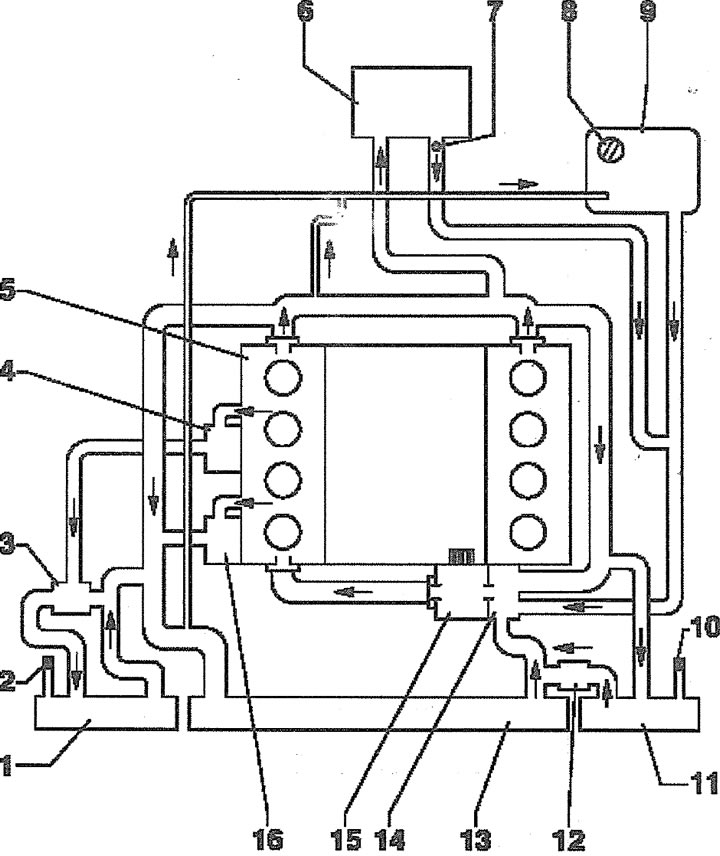

1.0. Coolant circulation. Cars with gasoline engines:

1.0. Coolant circulation. Cars with gasoline engines:
1 - right additional radiator
2 - Ventilation hole plug
3 - thermostat
4 - oil radiator
5 - cylinder head
6 - heater radiator
7 - ventilation hole
8 - coolant expansion tank cap
9 - coolant expansion tank
10 - Ventilation hole plug
11 - left additional radiator
12 - check valve
13 - radiator
14 - thermostat
15 - water pump
16 - generator
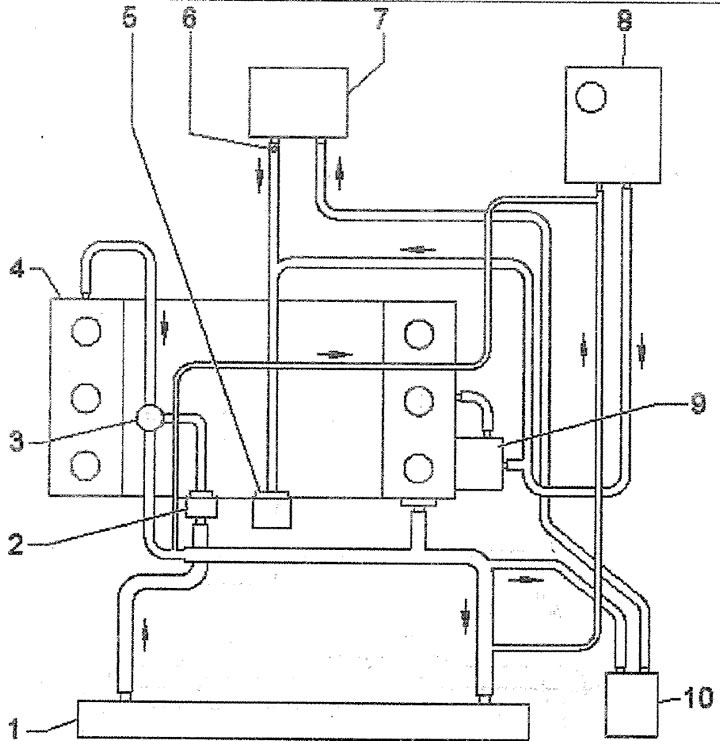

1.0a. Coolant circulation. Vehicles with diesel engine and parking heater:

1.0a. Coolant circulation. Vehicles with diesel engine and parking heater:
1 - radiator
2 - thermostat
3 - coolant temperature sensor
4 - cylinder head
5 - water pump
6 - ventilation hole
7 - heater radiator
8 - coolant expansion tank
9 - oil radiator
10 - parking heater
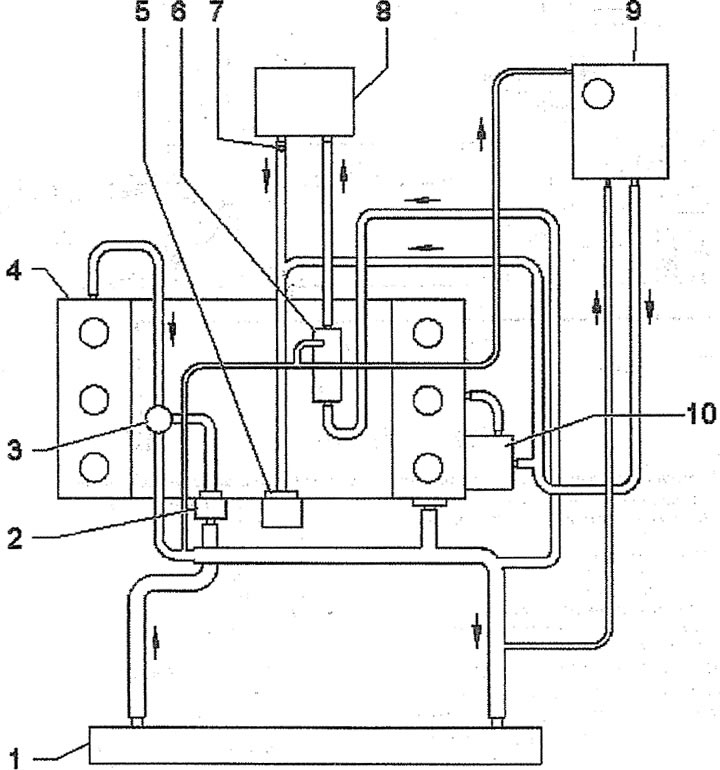


1.0b. Coolant circulation. Vehicles with a diesel engine and a radiator for cooling exhaust gases…

1.0b. Coolant circulation. Vehicles with a diesel engine and a radiator for cooling exhaust gases diverted for afterburning:
1 - radiator
2 - thermostat
3 - coolant temperature sensor
4 - cylinder head
5 - water pump
6 - radiator for cooling exhaust gases diverted for afterburning
7 - ventilation hole
8 - heater radiator
9 - coolant expansion tank
10 - oil radiator
The article was checked by auto expert Alexey Ivanov
This article is available at russian, bulgarian, belarusian, ukrainian, serbian, croatian, romanian, polish, slovak, hungarian

Share information:
Previous articles
Audi A6 C5 Allroad: Cooling and heating system
Next articles

Coolant — draining and filling
Water pump — design description
Water pump — removal and installation
Thermostat — Removal, Installation and Checking


Similar articles on other Audi car models:
General description of the cooling system Audi 80 B3 (1986-1991, petrol)
Crankcase Gas Relief System — General Description Audi 100 C3 (1982-1990, diesel)
Engine cooling system device Audi A3 Type 8L (1996-2003)
Engine cooling system — design description Audi A4 B6 (2000-2006, petrol)
Central section of the cooling system pipe of a 2.5L diesel… Audi A8 D2 (1994-2002)
Removal and installation of sensors and some lines of the engine… Audi Q7 Typ 4L (2005-2015, diesel)
Cooling system pump — design description Audi A2 (1999-2005)
Link to this page in different formats


Visitor comments

No comments yet


How much will 12 + 46 =


A6(C5 AR, 1999-2005) 
  • General information
  • User manual
  • Maintenance
  • Troubleshooting
  • Power unit
  • V6 petrol engines
  • V8 petrol engines
  • Diesel engines
  • Cooling and heating system
  • Injection system (gasoline)
  • Fuel system (diesel)
  • Supply system
  • Exhaust system
  • Ignition system
  • Transmission
  • Clutch
  • Mechanical gearbox
  • Automatic gearbox
  • Chassis
  • Brake system
  • Car suspension
  • Steering
  • Body
  • Body elements
  • Doors, locks and windows
  • Electrical equipment
  • Equipment and devices
  • Power devices
  • Electrical circuits
  • Schemes (petrol engine 2.7 l)
  • Schemes (petrol engine 4.2 l)
  • Schemes (diesel engine 2.5 l)
 
A6(C5, 1997-2004) 
  • General information
  • User manual
  • Maintenance
  • Power unit
  • Engine repair
  • Cooling system
  • Fuel system
  • Engine management
  • Fuel system (diesel)
  • Exhaust system
  • Transmission
  • Clutch
  • Car gearbox
  • Chassis
  • Front suspension
  • Rear suspension
  • Steering
  • Wheels and tires
  • Brake system
  • Body
  • Exterior
  • Interior
  • Electrical equipment
  • Air conditioner
  • Equipment and devices
  • Electrical circuits
 
A6(C4, 1994-1997) 
  • General information
  • User manual
  • Maintenance (gasoline)
  • Maintenance (Diesel)
  • Gasoline engines
  • 4 cylinder engines
  • 5 cylinder engines
  • 6 cylinder engines
  • Diesel engines
  • 4 cylinder engines
  • 5 cylinder engines
  • Engine repair
  • Removal and reassembly
  • Cooling system
  • Single point injection system
  • Multipoint injection system
  • MPI/MPFI injection system
  • Fuel system (diesel)
  • Exhaust system
  • Ignition system
  • Transmission
  • Clutch
  • Manual transmission
  • Automatic transmission
  • Drive shafts
  • Chassis
  • Brake system
  • Front suspension
  • Rear suspension
  • Steering
  • Body
  • Exterior (external elements)
  • Interior (internal elements)
  • Electrical equipment
  • Power devices
  • Lighting and appliances
  • Electrical circuits
 
AudiManual.ru © 2017-2026 · Mobile version · Feedback · Sitemap: EN BG BY UA RS HR RO PL SK HU · Site search · News and articles
80 B2 · 80 B3 petrol · 80 B3 · 80 B4 · 100 C3 diesel · 100 C3 petrol · 100 C3 · 100 C4 petrol · 100 C4 · A3 Type 8L · A4 B5 petrol · A4 B5 · A4 B6 petrol · A4 B6 · A4 B7 · A4 B8 · A6 C4 · A6 C5 · A6 C5 Allroad · A8 D2 · Q5 Type 8R · Q7 Typ 4L · Audi A2 ·
This site uses cookies 🍪. Click the button to accept this fact.