



Table of contents: Shunted circulation circuit ↓ Cooling at operating temperature ↓ Overpressure and fan ↓
The cooling system ensures the proper operating temperature of the engine. This system consists of a number of units, including a radiator, thermostat, pipes and a network of small, precisely calculated channels in the cylinder block and the cylinders themselves, in which the coolant circulates. This creates a water jacket, which, with the help of hoses, removes the heat generated during combustion of the fuel-air mixture to the radiator. The path that the coolant takes in the cooling system depends on the engine temperature.
Shunted circulation circuit
After a cold start, the coolant circulates in a small circuit, which is limited by the engine and the heater. In this so-called bypass circuit, the flow to the radiator is kept closed by a thermostat. The coolant is diverted directly back to the engine. This heats the liquid faster, and therefore the engine warms up faster. The radiator only starts working after the coolant temperature reaches a certain value. The thermostat opens, and the cold water from the radiator mixes with the heated water from the small circuit. This gradual mixing of cold water prevents the so-called cold shock.
Cooling at operating temperature
As the water temperature rises, the thermostat increases the flow of water from the radiator and simultaneously closes the bypass circuit. At operating temperature, the coolant flows through the lower hose to the pump, the pump drives the liquid into the cylinder block and the cylinder head. After that, most of the liquid flows through the open thermostat to the radiator, and the rest to the heat exchanger of the heating system. Cold water, which falls to the bottom of the radiator, displaces hot water to the top of the radiator. As it passes the radiator fins, the hot water cools. If, while driving, the water temperature drops below the operating temperature, the thermostat again closes the flow to the radiator, this flow does not open until the coolant heats up again.
Overpressure and fan
The cooling system is under excess pressure, which at operating temperature is from 1.2 to 1.5 bar. Due to this, as well as the use of additives, the boiling point of the coolant increases from 100 to 120°C. A higher boiling point ensures a more economical engine operation, and therefore fuel savings. If the coolant pressure exceeds 1.5 bar when the engine is hot, the safety valve on the expansion tank is triggered. The valve opens and, in order to equalize the pressure, some steam is released. Despite this, sometimes, for example when driving within the city limits, the coolant can overheat. In this case, the radiator is additionally cooled by a fan.
When the coolant temperature is from 92 to 97°C, the first stage is activated (half speed). If the temperature rises to 99-105°, the thermostat switches the fan to the second stage, and the fan rotates at full speed. Due to the regulation of the coolant flow by the thermostat, as well as the fact that the fan does not operate constantly, the operating temperature is reached faster and fuel consumption is reduced.
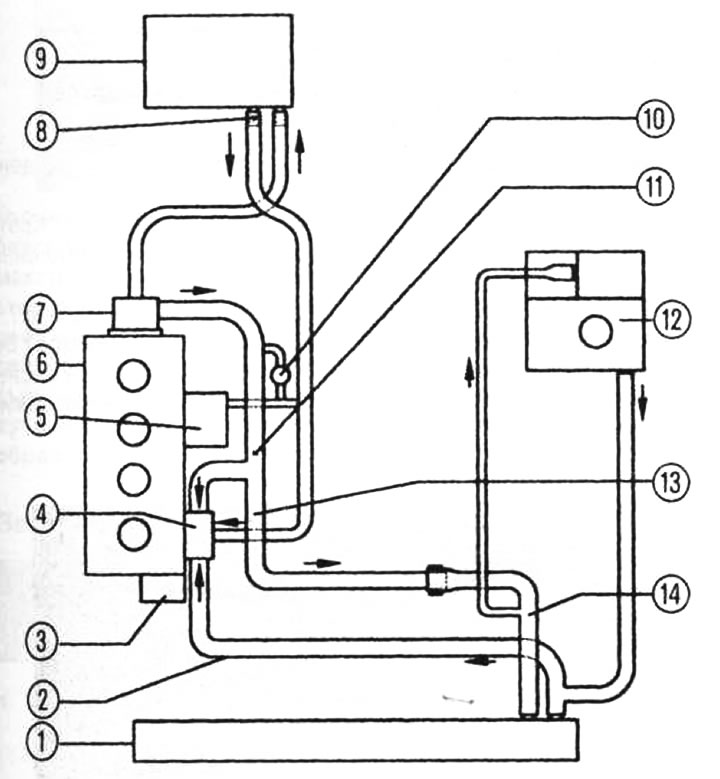
Cooling system of a four-cylinder engine: 1 - radiator, 2 - lower hose, 3 - pump, 4 - thermostat, 5 - oil radiator, 6 - cylinder head and cylinder block, 7 - connecting pipe, 8 - ventilation hole, 9 - heater heat exchanger, 10 - throttle valve heater, 11 - air valve 20 Nm, 12 - expansion tank, 13 - upper pipe, 14 - upper hose
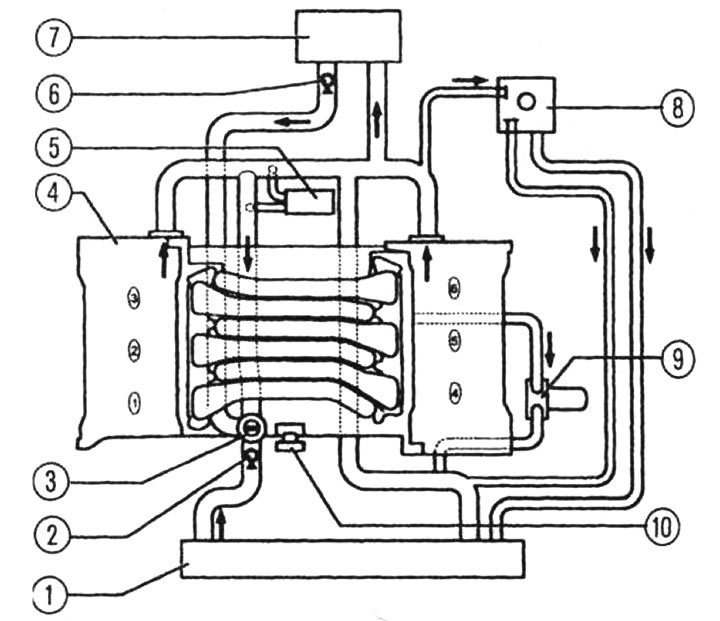
Cooling system of a six-cylinder engine: 1 - radiator, 2 - air valve 15 Nm, 3 - upper pipe, 4 - cylinder head and cylinder block, 5 - throttle control device, 6 - ventilation hole, 7 - heater heat exchanger, 8 - expansion tank, 9 - oil radiator, 10 - pump.
(Content source: the specified website: Audimanual.ru)