



2. Remove the soundproof cover at the bottom of the engine. Prepare a container to collect the liquid. Never drain the coolant directly onto the ground.
3. Remove spring clip 1 of coolant temperature sensor 2. Then pull the sensor out of the pipe and drain the water.
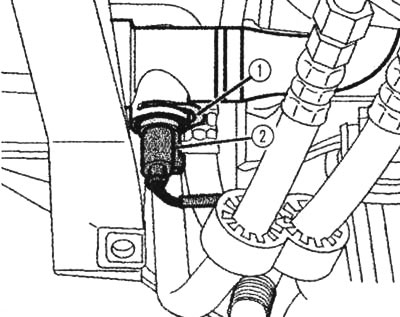
In order to drain the coolant, you need to remove the coolant temperature sensor from the pipe
4. Also remove the hose on the oil radiator (arrow) and drain the remaining fluid.
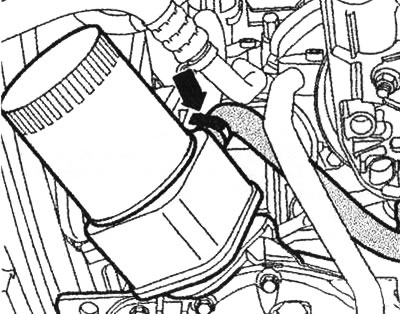
The remaining coolant can only be drained if the hose is removed from the oil radiator
5. Dispose of collected liquid in an environmentally friendly manner.
6. Before filling the coolant, insert the temperature sensor 2 with a new sealing ring into the pipe and secure it with a spring clip /. In addition, connect the hose to the oil radiator.
7. Now pour in coolant until it comes out of the vent in the pipe. After screwing in the air valve, continue pouring in coolant until it comes out of the vent in the hose that goes to the heating system heat exchanger. Then push the hose onto the branch pipe and secure it with a spring band clamp.
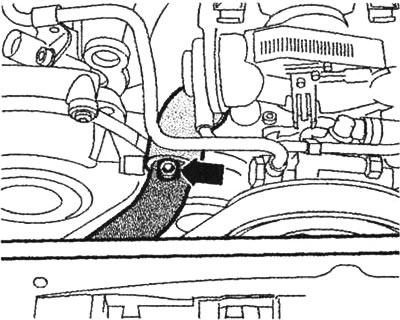
The air valve (arrow) in the top pipe of a six-cylinder engine can only be accessed after removing the front engine cover
8 Close the expansion tank.
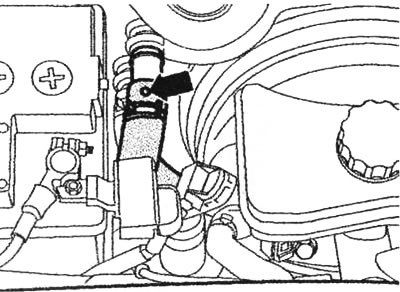
The ventilation hole (arrow) on the hose that goes to the heating system heat exchanger can only be seen if you pull the hose back so far that the hole is no longer covered by the connecting pipe. Before doing this, you still need to remove the battery compartment cover. The cover can be removed by pulling it forward after removing the rubber seals.
9. Start the engine and the engine should run for approximately 3 minutes at 2000 rpm. Then the engine should run idle until the lower radiator hose heats up.
10. Check the coolant level. When the engine is warmed up to operating temperature, the liquid should reach the maximum mark; when the engine is cold, the liquid level should be between the minimum and maximum marks.