



It is necessary to replace the coolant after any work on the cooling system components with draining the coolant. If the cylinder head, cylinder head gaskets, radiator or oil heat exchanger were replaced during repairs, fresh coolant must be added to the cooling system. This is due to the fact that the anti-corrosion additive in the coolant precipitates during engine operation and creates anti-corrosion protection. In previously used coolant, the anti-corrosion additives are less active in order to form a protective layer on newly installed parts.
The drained coolant must be collected and disposed of.
Warning: When opening the expansion tank cap on a hot engine, care must be taken as escaping vapors can cause severe burns. To do this, cover the expansion tank cap with a thick layer of cloth and slowly unscrew it until a hissing sound is heard. After the hissing stops, slowly unscrew and remove the cap from the expansion tank.
Raise the front of the vehicle and support it on jack stands. Remove the expansion tank cap.
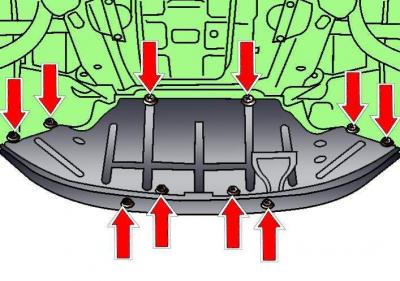
Fig. 3.1–1. Location of the engine compartment lower mudguard mounting fasteners
Release the fasteners and remove the lower engine compartment splash guard (see Fig. 3.1–1).
Install a VAG 1306 coolant collection pan under the engine.
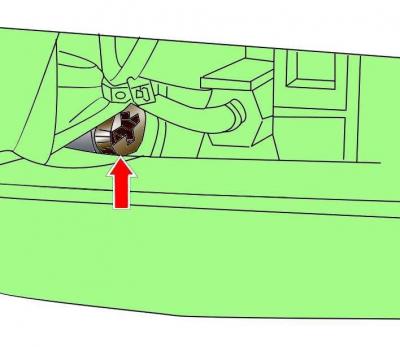
Fig. 7–5. Location of the radiator drain plug
Unscrew the threaded plug from the radiator (Fig. 7-5) and drain the coolant. To prevent the coolant from spilling, insert a hose instead of the threaded plug.
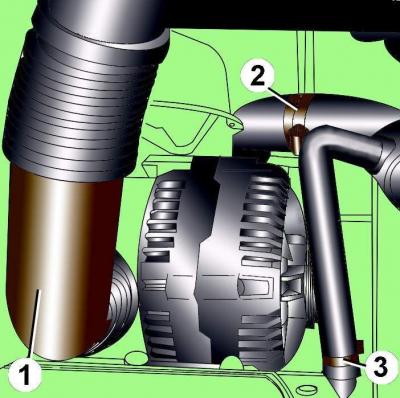
Fig. 3.1–3. Location of the air duct (1) and clamps (2 and 3) for fastening the cooling system hoses
Loosen the clamp, remove hose 3 (see Fig. 3.1–3) and drain the coolant into the pan.
Loosen the clamp, remove the hose, move it down and drain the coolant from the radiator.
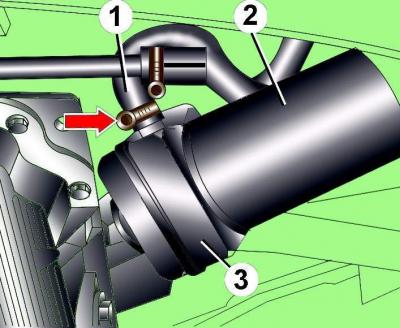
Fig. 3.1–4. Location of oil filter and oil heat exchanger: 1 – hose; 2 – oil filter; 3 – oil heat exchanger
Disconnect the additional coolant hose at the bottom of the oil cooler and drain the coolant into a drain pan (see Fig. 3.1–4).
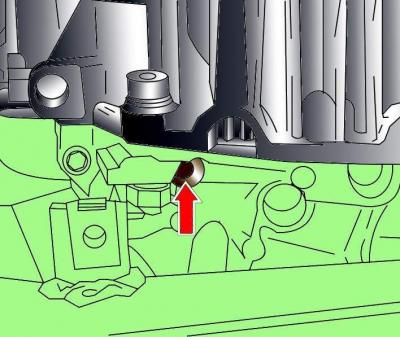
Fig. 3.1–5. Location of the coolant drain plug from the engine cylinder block
Unscrew the coolant drain plug from the engine cylinder block (see Fig. 3.1–5).
When installing the plug, a new sealing ring must be used.
To drain the coolant more completely, apply air under pressure through the expansion tank cap.
If the coolant is heavily contaminated, flush the cooling system. Since it is impossible to drain the coolant completely from the cooling system, it is recommended to flush the cooling system each time the coolant is drained.
Screw the coolant drain plug with a new sealing ring into the water pump housing and tighten it to a torque of 20 N·m.
Install the lower engine splash shield and lower the vehicle to the ground.
Move the heating system temperature control to the maximum temperature position.
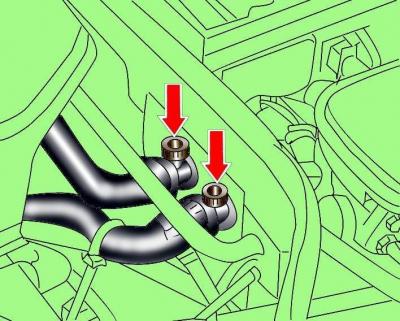
Fig. 7–6. Location of air bleed plugs for the cooling system of a 2.8 L gasoline engine
Unscrew the two air bleed plugs located on the cooling system pipes near the expansion tank (Fig. 7–6).
Instead of the expansion tank cap, screw in the VAG 1274/1 threaded adapter with a 42 mm diameter, 100 mm high tube. This is necessary to completely fill the engine cooling system with coolant and remove air from it. If you don't have a special device, you can make one yourself. Alternatively, you can unscrew the expansion tank from the bracket, lift it with the connected hoses to a height of 10 cm and secure it in this position.
Fill the expansion tank with coolant until it flows out through the bleed screw plugs. Tighten the plugs to a torque of 20 Nm.
Remove the device that was installed instead of the cap from the expansion tank and screw the cap onto the expansion tank.
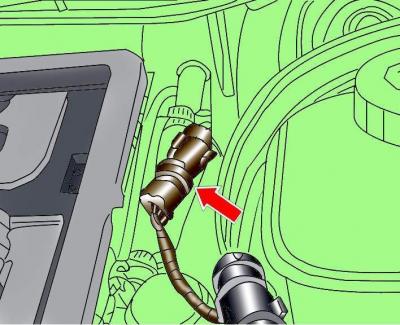
Fig. 7-7. Location of the electrical connector of the 2.8L gasoline engine valves
Disconnect the electrical connector (Fig. 7-7) from the valves.
Set the heater temperature switch to the minimum temperature position.
Start the engine and let it run for 3 minutes at 2000 мин⁻¹.
Check the coolant level and top it up if necessary.
On a hot engine, the coolant level should be at the max mark, on a cold engine between the marks max and min.
Coolant composition
It is not recommended to use the previously used mixture of antifreeze and anticorrosive agent G11, which is green. It is prohibited to mix anticorrosive agents G11 and G12, as this can cause serious damage to the engine.
If the cooling system was filled with a coolant not recommended by the manufacturer, drain it from the cooling system. Fill the cooling system with clean water, start the engine and let it idle for 2 minutes. Drain the water from the cooling system and blow compressed air through the expansion tank. Fill with fresh coolant recommended by the manufacturer.