



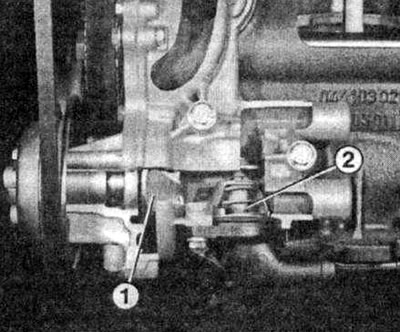
This section of a four-cylinder engine clearly shows the internal parts of the water pump 1. The thermostat 2 is located nearby.
Radiator. Each of the radiator parts (right and left) consists of a plastic tank. Between them are thin-walled tubes that are connected to each other by means of a frame consisting of plates. The area past which the air flow passes is several square meters. The radiator is mounted on a bracket in two places: at the top and at the bottom.
Thermostat. Maintains a constant water temperature. The thermostat opens at approximately 87°C, allowing water to flow to the radiator or back into the engine. Inside the thermostat is a special wax-filled sleeve and a disc valve. The hotter the coolant, the more the wax liquefies. The wax expands more and more, thereby opening the valve wider and wider, which controls the flow of water from the radiator. At operating temperature, the valve opens completely, and the short-circuited circuit closes completely. If the water cools down, the spring presses on the valve disc and blocks the flow of coolant through the radiator until it warms up to the appropriate temperature again.
Expansion tank. If the pressure is too high, water vapor escapes through the safety valve, which is placed in the tank cap. All engines use a split tank, on the outside of the tank there is a coolant level indicator. The tank is located on the left side of the engine compartment (if you look in the direction of travel).
Cooling system fan. The radiator is equipped with a fan. This fan prevents the coolant from overheating.
(The original source of the article can be found on the website: audimanual.ru)