



The basis of the automatic transmission is the so-called planetary rows, consisting of a gear around which three other gears rotate. A set of two gears forms its own small two-stage transmission. The gear ratio is changed by holding or releasing the parts of the planetary transmission, which is provided by hydraulics. The multi-stage nature of the automatic transmission is ensured by the sequential inclusion of three planetary rows.
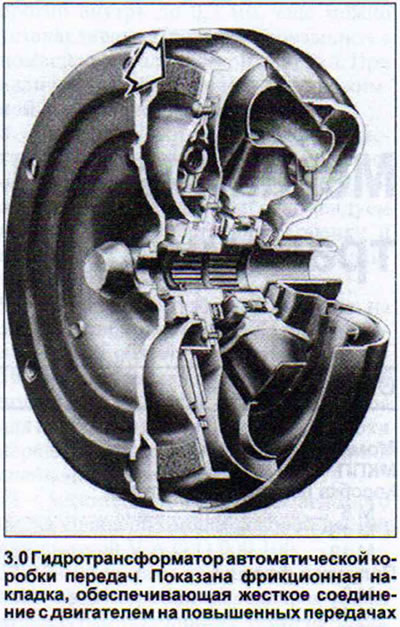
The engine torque is transmitted to the gearbox via fluid. The engine drives the impeller of the pump in the torque converter (hydraulic transformer). From the torque converter pump, the automatic transmission fluid goes to the turbine wheel connected to the gearbox, setting it in motion. The pump impeller and the turbine wheel rotate at different speeds. When starting off, this difference in the number of revolutions is maximum, and as the speed increases, the difference becomes minimal. At the same time, conventional automatic transmissions are characterized by a certain slippage. Automatic transmissions installed on AUDI 80 cars have a clutch for locking the torque converter, which provides a rigid connection between the engine and the gearbox in 3rd and 4th gears. At the same time, this helps reduce fuel consumption (see illustration 3.0).
This publication is borrowed from the resource: AudiManual