



- a) Gearbox control lever with multi-function switch. The position of the gearbox control lever affects the switching on of the reversing lights, the locking of the starter when the gear is engaged, and the operation of the speed control device (see illustration 4.0).
- b) Driving mode switch.
- c) Throttle angle potentiometer. The information from this sensor is used to calculate the gear ratio.
- d) The speed sensor installed on the gearbox is also designed to determine the gear ratio. If this sensor fails, the control unit uses the engine speed received from the Hall sensor, which is part of the ignition system, as an emergency program.
- d) Kickdown switch on the gas cable. It is activated if the accelerator pedal is pressed all the way. The gearbox either remains in a lower gear position longer, or switches from a higher to a lower gear.
- g) The brake light switch releases the gearshift lever lock. Only when the brake pedal is depressed can the automatic gearshift lever be moved from the "P" or "N" position to the gear position to continue driving.
- h) Automatic transmission fluid temperature sensor. A significant difference in engine and gearbox speed can cause the fluid temperature to rise significantly. When the electronic control unit receives information about the fluid temperature rising, the transmission shifts up more slowly.
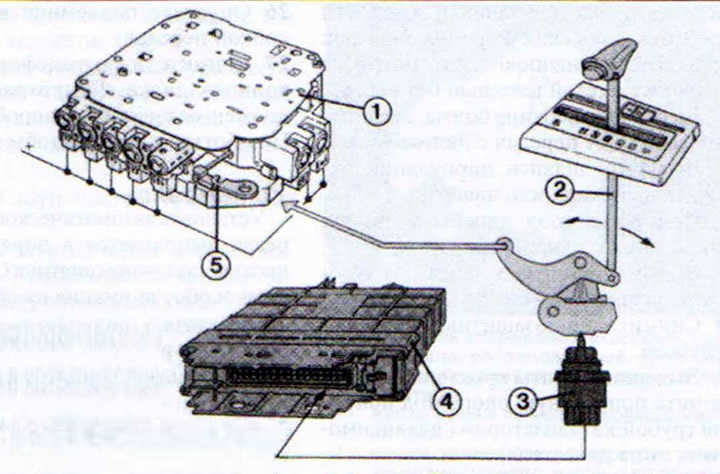
4.0 Automatic transmission operation diagram
1 - gear shift unit
2 - Automatic transmission control lever
3 - Multi-function switch
4 - electronic control unit
5 - pusher
The electronic control unit recognizes and registers faults and malfunctions in the automatic transmission. The self-diagnostic program monitors the input and output signals of almost all sensors or components of the transmission or their electrical circuits. Reading and printing of faults is only possible in a workshop with the appropriate device.
As soon as the electronic control unit has detected a malfunction that significantly affects the operation of the automatic transmission, or if the unit itself fails, the so-called emergency program is executed, consisting of two subroutines:
- a) A subroutine for automatic upshifting or downshifting, which ensures that the gearbox operates in the previous mode. When this program is executed, jerks will be felt in the gearbox.
- b) A subroutine that excludes automatic upshifting or downshifting. When this program is executed, only 3rd gear will operate when the control lever is in positions D, 3 and 2. And only in lever positions 1 or R will the gearbox continue to operate.
When performing an emergency program, it is recommended to immediately contact the nearest workshop, where they will first conduct a survey of the self-diagnostic system.
The range of work that a car owner can perform on an automatic transmission independently is limited. However, targeted checks can help in identifying faults, which is very important for used cars. In case of any failure of the transmission, the fluid level in the transmission should be checked first. If a burning smell is felt when removing the dipstick, then there is a very complex defect in the disc brake of the automatic transmission.
During a test drive, you can check the gear shifting. When shifting to a higher gear with the accelerator pedal partially depressed, the gear change is barely noticeable. When the pedal is in the "Full Accelerator" position or when the "Kickdown" mode is engaged, the gear change is perceived more clearly, but the transition is smooth. A sharp increase in revolutions when shifting from one gear to a higher one indicates a defect that should be identified.
When shifting from higher to lower gears, the transition is almost imperceptible, especially if the speed was not very high. A jerk when pressing the accelerator pedal to increase speed is a normal phenomenon. Shifting with the gearbox control lever occurs when the accelerator pedal is not pressed for 1 - 2 seconds, and when pressed - immediately.
Attention! The AUDI 80 with automatic transmission cannot be towed under its own power for more than 50 km. This is due to the lubrication of the gearbox. The maximum towing speed should also not exceed 50 km/h. It is recommended to transport such vehicles by loading.