



Table of contents: Front wheel drive cars ↓ Installation ↓
Front wheel drive cars
Removal
1. Place the vehicle on jack stands to ensure free access to the engine compartment and unimpeded work under the vehicle. The gearbox is removed downwards.
2. Disconnect the negative (-) battery terminal.
3. Remove the three upper bolts securing the gearbox to the engine.
4. Disconnect the ground (-) wire from the gearbox.
5. Disconnect the speedometer and reverse light switch connectors.
6. Remove the wiring harness clamps and disconnect the lambda probe plug.
7. Remove the engine splash guard.
8. Disconnect the exhaust pipe from the intake manifold, and also the catalytic converter from the additional muffler.
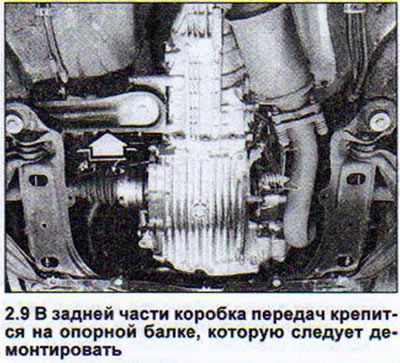
9. Disconnect the rear transmission support beam (see illustration).
10. Disconnect the gear shift fork rod from the gearbox.
11. Disconnect the procon-ten safety system cables from the gearbox.
12. Remove the axle shaft covers.
13. Disconnect the right and left half-shafts from the gearbox, first securing them so that they do not fall. Turn the steering wheel all the way to the left.
14. Remove the clutch slave cylinder. Do not disconnect the hydraulic hose.
15. Disconnect the gear shift bracket from above.
16. Place a support under the engine to prevent it from tipping forward or backward.
17. Place a lift under the gearbox.
18. Disconnect the left gearbox support bracket and the front engine mount.
19. Remove the lower bolt securing the gearbox to the engine.
20. Use a crowbar to pry the gearbox away from the engine.
21. Lower the lift with the gearbox lying on it.
Installation
22. Before installing the gearbox, clean the splines of the gearbox input shaft and lubricate them with molybdenum paste or VAG G000 100 grease.
23. Make sure that the thrust sleeves for centering the gearbox on the engine are in place.
24. Check the operation of the gear shift mechanism after installing the gearbox in place. Adjust the mechanism if necessary.
25. Six-cylinder cars. Finish the crankcase on the left side from above with a chamfer at an angle of 30°. Otherwise, the intake manifold will rest against it.
Over time, noise may appear in the operation of the gearbox. In this case, the first thing to check is the oil level in the gearbox.
If, when engaging one of the gears, a howling sound appears, changing depending on the position of the accelerator pedal, then the cause may be wear on the teeth of the pair of gears corresponding to this gear.
Noises in all gears are caused by a defect in the main gear or axle bearings.
The sound similar to the operation of millstones, which appears when the engine is heated to operating temperature, is a consequence of the beating of the synchronizer locking rings. As a result of the oil liquefaction under the influence of temperature, it is pushed out by the locking rings.
Attention! Workshops rarely agree to repair or overhaul the gearbox. When the gearbox fails, workshops offer a corresponding unit from the exchange fund. In most cases, costs can be reduced by installing a used gearbox, which can be purchased at car recycling centers. In this case, make sure that the marking of the used gearbox, stamped at the top of the body, matches yours.