
Repair Chevrolet Repair Toyota Repair Honda Repair AvtoVAZ Repair Mercedes-Benz Repair BMW Repair Opel
Home  |  Contacts  |  Sitemap  |    
English Русский
Български
Беларускі
Український
Српски
Hrvatski
Română
Polski
Slovenský
Magyar
AudiManual.ru


  • AUDI 80
  • AUDI 100
  • AUDI A3
  • AUDI A4
  • AUDI A6
  • AUDI A8
  • AUDI Q
  • OTHER
  • ARTICLES
B4 (1991-1996) B3 (1986-1991) B3 (1986-1991, petrol) B2 (1979-1986)

Fuel filter (Audi 80 B4)

  • Home
  • Audi 80
  • B4 (1991-1996)
  • Power unit
  • Fuel system
  • Fuel filter
            0
Table of contents: Fuel filter for cars with gasoline… ↓ Fuel filter for cars with diesel… ↓ Condensate - drain ↓ Fuel filter - replacement ↓

Fuel filter for cars with gasoline engines


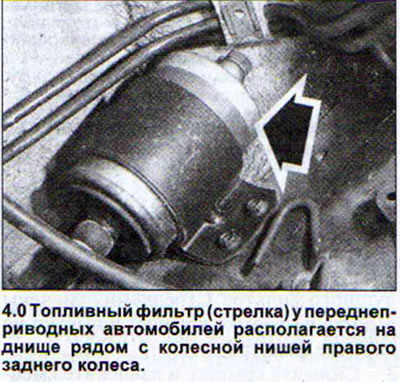
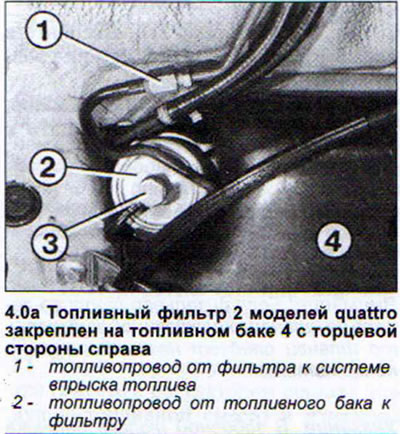
The design of the fuel filter of AUDI 80 cars with a petrol engine is such that it does not need to be changed throughout the entire service life of the engine. This has its advantages, because to remove the fuel filter in quattro models, it is also necessary to dismantle the fuel tank. And this in turn is possible only after dismantling the rear axle. For this reason, we recommend changing the fuel filter only if necessary due to a malfunction of the fuel system.

Fuel filter for cars with diesel engine


The distribution fuel injection pump of diesel engines is very sensitive to fuel contamination, especially water. As a rule, fuel contaminants clog the connecting pipe of the return hose and the fuel injection pump overheats. Water gets into diesel fuel during refueling or accumulates as a result of its condensation. For this reason, the fuel must be cleaned of liquid and solid impurities before it gets into the fuel injection pump. This function is performed by the fuel filter, the replaceable filter element of which retains all solid impurities, and condensate, which is heavier than fuel, collects at the bottom of the filter.

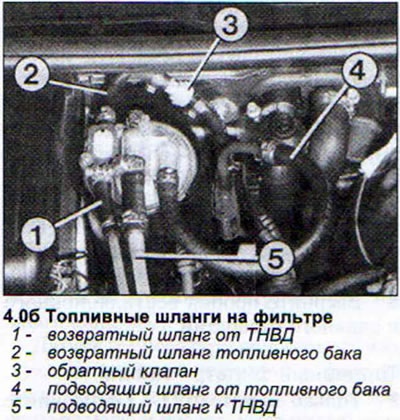
TDI engines have a condensate level sensor, which is located at the bottom of the filter instead of the threaded plug of the condensate drain hole. This sensor works on a simple principle. Power is supplied to the two electrodes of the fuel filter. As soon as the condensate level reaches the electrodes, the resistance in the circuit changes, which in turn is recognized by the control unit (see illustration 4.0b).


TDI engines have a condensate level sensor, which is located at the bottom of the filter instead of…


Condensate - drain


1. Unscrew the vent plug at the top of the filter.

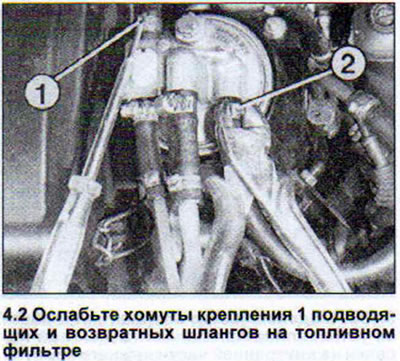
2. Loosen the clamps securing the inlet and return hoses to the fuel filter. The clamps can be loosened with a small screwdriver by widening the eye. The same clamps can be reused by squeezing the eye with side cutters (see illustration). We recommend installing new clamps.
2. Loosen the clamps securing the inlet and return hoses to the fuel filter. The clamps can be…


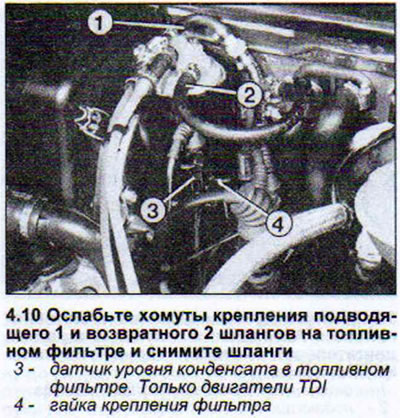
3. Unscrew the filter mounting nut (see illustration 4.10).

4. Pull the filter out of the holder by pushing it upwards. For TDI engines, disconnect the condensate level sensor plug to do this.

5. Place a container under the fuel filter to collect condensate.

6. Unscrew the threaded plug of the condensate drain hole at the bottom of the fuel filter by hand. Be careful. The threaded plug is quite fragile. TDI engines have a condensate level sensor screwed in instead of a plug.


7. Drain the condensate (it's about 100 cm³). Continue this procedure until clean fuel begins to flow from the drain hole.

8. Screw in the vent and drain plugs.

Fuel filter - replacement


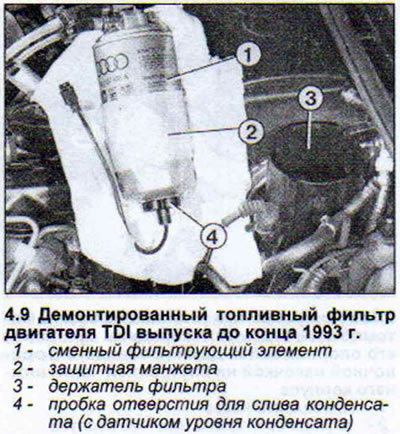
9. TDI engines only: Disconnect the condensate level sensor plug and remove the plug from the bracket (see illustration).
9. TDI engines only: Disconnect the condensate level sensor plug and remove the plug from the…


10. Loosen the clamps securing the inlet and return hoses to the fuel filter and remove the hoses (see illustration).
10. Loosen the clamps securing the inlet and return hoses to the fuel filter and remove the hoses…


11. Unscrew the filter mounting nut and remove the filter (see illustration 4.10).

12. Remove the protective foil from the fuel filter.

13. Disconnect the fuel filter from the mounting flange.

14. Drain any remaining fuel from the fuel filter into a suitable container.

15. Install a new fuel filter.


16. TDI engines only: Screw the condensate level sensor into the new fuel filter.

17. Operate the starter until fuel begins to flow to the high-pressure fuel pump.

Attention! Do not throw away the old fuel filter together with household waste. It is subject to recycling.


Caution: If diesel fuel gets on the coolant hoses, the hoses should be cleaned immediately.


Note: There is a sieve in the fuel gauge sensor intake cradle. To clean it, the fuel gauge sensor must be removed.
Note: There is a sieve in the fuel gauge sensor intake cradle. To clean it, the fuel gauge sensor…


Note: There is a sieve in the fuel gauge sensor intake cradle. To clean it, the fuel gauge sensor…
The article was checked by auto expert Timur Bazhenov
This article is available at russian, bulgarian, belarusian, ukrainian, serbian, croatian, romanian, polish, slovak, hungarian

Share information:
Previous articles
Audi 80 B4: Fuel system
Next articles

Fuel pump — checking, removal and installation
Fuel gauge sensor
General Provisions
Fuel System Specifications
Air filter (petrol models) — removal, cleaning, replacement
Intake air heating
Intake manifold — heating
Intake manifold with variable internal cavity configuration


Similar articles on other Audi car models:
Fuel filter Audi 100 C4 (1990-1994)
Replacing the fuel filter of a diesel engine Audi A3 Type 8L (1996-2003)
Replacing the fuel filter Audi A4 B5 (1994-2001, petrol)
Fuel filter Audi A6 C5 (1997-2004)
Draining water from the fuel filter of a V6 TDI diesel engine Audi A8 D2 (1994-2002)
Fuel filter Audi Q5 Type 8R (2008-2017)
Fuel filter — replacement Audi A2 (1999-2005)
Link to this page in different formats


Visitor comments

No comments yet


How much will 11 + 44 =


80(B4, 1991-1996) 
  • General information
  • User manual
  • Maintenance
  • Troubleshooting
  • Power unit
  • Engine
  • Cooling system
  • Heating and ventilation
  • Petrol injection
  • Diesel fuel system
  • Fuel system
  • Exhaust systems
  • Ignition system
  • Transmission
  • Clutch
  • Car gearbox
  • Chassis
  • Brake system
  • Suspension and steering wheel
  • Body
  • Body and trim
  • Electrical equipment
  • Electrical system
  • Electrical circuits
 
80(B3, 1986-1991) 
  • General information
  • Repair characteristics
  • Maintenance
  • Power unit
  • Gasoline engine
  • Diesel engine
  • Engine lubrication system
  • Fuel system (gasoline)
  • Injection system (gasoline)
  • Fuel system (diesel)
  • Ignition system
  • Cooling system
  • Heater
  • Exhaust system
  • Transmission
  • Clutch and gearbox
  • Chassis
  • Steering
  • Brake system
  • Car suspension
  • Body
  • Body elements
  • Electrical equipment
  • Power devices
  • Lighting and appliances
  • Electrical circuits
 
80(B3, 1986-1991, petrol) 
  • General information
  • User manual
  • Maintenance
  • Power unit
  • Engine 4-cylinder
  • Engine 5-cylinder
  • Cooling system
  • Fuel and exhaust systems
  • Ignition system
  • Transmission
  • Clutch
  • Mechanical transmission
  • Automatic transmission
  • Drive shafts
  • Chassis
  • Brake system
  • Suspension
  • Steering
  • Body
  • Exterior
  • Interior
  • Electrical equipment
  • Equipment and devices
  • Electrical circuits
 
80(B2, 1979-1986) 
  • General information
  • User manual
  • Power unit
  • Engine FZ
  • Engine EP, YP, YZ, DT, DS, DZ
  • Transmission
  • Clutch
  • 4 speed gearbox
  • 5 speed gearbox
  • Front wheel drive
  • Chassis
  • Front suspension
  • Rear suspension
  • Steering
  • Brake system
  • Electrical equipment
  • Equipment and devices
  • Electrical circuits
 
AudiManual.ru © 2017-2026 · Mobile version · Feedback · Sitemap: EN BG BY UA RS HR RO PL SK HU · Site search · News and articles
80 B2 · 80 B3 petrol · 80 B3 · 80 B4 · 100 C3 diesel · 100 C3 petrol · 100 C3 · 100 C4 petrol · 100 C4 · A3 Type 8L · A4 B5 petrol · A4 B5 · A4 B6 petrol · A4 B6 · A4 B7 · A4 B8 · A6 C4 · A6 C5 · A6 C5 Allroad · A8 D2 · Q5 Type 8R · Q7 Typ 4L · Audi A2 ·
This site uses cookies 🍪. Click the button to accept this fact.