
Repair Chevrolet Repair Toyota Repair Honda Repair AvtoVAZ Repair Mercedes-Benz Repair BMW Repair Opel
Home  |  Contacts  |  Sitemap  |    
English Русский
Български
Беларускі
Український
Српски
Hrvatski
Română
Polski
Slovenský
Magyar
AudiManual.ru


  • AUDI 80
  • AUDI 100
  • AUDI A3
  • AUDI A4
  • AUDI A6
  • AUDI A8
  • AUDI Q
  • OTHER
  • ARTICLES
B4 (1991-1996) B3 (1986-1991) B3 (1986-1991, petrol) B2 (1979-1986)

Intake manifold — heating (Audi 80 B4)

  • Home
  • Audi 80
  • B4 (1991-1996)
  • Power unit
  • Fuel system
  • Intake manifold — heating
            0
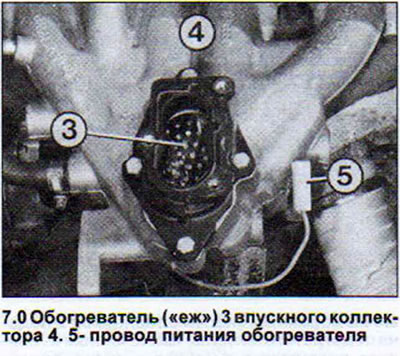
From the Mono-Motronic fuel injection unit, the air-fuel mixture enters the intake manifold and from there — into the combustion chamber of the cylinder. If the intake manifold pipes are cold, then a significant part of the mixture settles on their inner walls in the form of condensate. This leads to increased fuel consumption. This can be avoided by heating the intake manifold, which is switched on when starting a cold engine. The intake manifold heater, installed on cars with four-cylinder engines, has the shape of a "hedgehog", which is placed in the intake manifold (see illustration 7.0).

From the Mono-Motronic fuel injection unit, the air-fuel mixture enters the intake manifold and…


This shape of the heater was not chosen by chance. It allows to keep the dimensions small, but to increase the heating area. The intake manifold heater operates until the coolant temperature reaches approximately 65°C, and then switches off. The thermal switch, designated in the electrical diagrams as the coolant temperature sensor G62, informs the fuel injection control unit of the coolant temperature. Depending on the coolant temperature, the control unit supplies power to the intake manifold heater via a relay on the additional relay block under the instrument panel. As the coolant temperature increases, the intake manifold is heated by the coolant circulating through the outlet channel in the intake manifold.


Intake Manifold Heater - Check


1. Disconnect the heater power cable plug. The engine must be cold.

2. Connect one wire of the ohmmeter to the heater power wire, and the other to the "ground" (-). The ohmmeter should show 0.25 - 0.50 Ohm. This means that the "hedgehog" is normal. If you do not have an ohmmeter at hand to check the heater, you can check the heater as follows.

3. Remove the fuel injection unit. The engine must be cold.

4. Turn on the ignition and make sure that the "hedgehog" heats up. If the heater resistance is normal, but it does not work, then the relay may be faulty.
The article was checked by auto expert Timur Bazhenov
This article is available at russian, bulgarian, belarusian, ukrainian, serbian, croatian, romanian, polish, slovak, hungarian

Share information:
Previous articles
Audi 80 B4: Fuel system
Next articles

Intake air heating
Air filter (petrol models) — removal, cleaning, replacement
Fuel filter
Fuel pump — checking, removal and installation
Intake manifold with variable internal cavity configuration
Diesel engines — fuel heating


Similar articles on other Audi car models:
Intake manifold heating Audi 100 C4 (1990-1994, petrol)
Ventilation, heating and air conditioning of the passenger… Audi A3 Type 8L (1996-2003)
Switchable intake manifold Audi A4 B5 (1994-2001, petrol)
Intake manifold Audi A6 C4 (1994-1997)
Intake manifold Audi A8 D2 (1994-2002)
Upper part of the intake manifold Audi Q5 Type 8R (2008-2017)
Removal and installation the intake manifold Audi A2 (1999-2005)
Link to this page in different formats


Visitor comments

No comments yet


How much will 35 + 35 =


80(B4, 1991-1996) 
  • General information
  • User manual
  • Maintenance
  • Troubleshooting
  • Power unit
  • Engine
  • Cooling system
  • Heating and ventilation
  • Petrol injection
  • Diesel fuel system
  • Fuel system
  • Exhaust systems
  • Ignition system
  • Transmission
  • Clutch
  • Car gearbox
  • Chassis
  • Brake system
  • Suspension and steering wheel
  • Body
  • Body and trim
  • Electrical equipment
  • Electrical system
  • Electrical circuits
 
80(B3, 1986-1991) 
  • General information
  • Repair characteristics
  • Maintenance
  • Power unit
  • Gasoline engine
  • Diesel engine
  • Engine lubrication system
  • Fuel system (gasoline)
  • Injection system (gasoline)
  • Fuel system (diesel)
  • Ignition system
  • Cooling system
  • Heater
  • Exhaust system
  • Transmission
  • Clutch and gearbox
  • Chassis
  • Steering
  • Brake system
  • Car suspension
  • Body
  • Body elements
  • Electrical equipment
  • Power devices
  • Lighting and appliances
  • Electrical circuits
 
80(B3, 1986-1991, petrol) 
  • General information
  • User manual
  • Maintenance
  • Power unit
  • Engine 4-cylinder
  • Engine 5-cylinder
  • Cooling system
  • Fuel and exhaust systems
  • Ignition system
  • Transmission
  • Clutch
  • Mechanical transmission
  • Automatic transmission
  • Drive shafts
  • Chassis
  • Brake system
  • Suspension
  • Steering
  • Body
  • Exterior
  • Interior
  • Electrical equipment
  • Equipment and devices
  • Electrical circuits
 
80(B2, 1979-1986) 
  • General information
  • User manual
  • Power unit
  • Engine FZ
  • Engine EP, YP, YZ, DT, DS, DZ
  • Transmission
  • Clutch
  • 4 speed gearbox
  • 5 speed gearbox
  • Front wheel drive
  • Chassis
  • Front suspension
  • Rear suspension
  • Steering
  • Brake system
  • Electrical equipment
  • Equipment and devices
  • Electrical circuits
 
AudiManual.ru © 2017-2026 · Mobile version · Feedback · Sitemap: EN BG BY UA RS HR RO PL SK HU · Site search · News and articles
80 B2 · 80 B3 petrol · 80 B3 · 80 B4 · 100 C3 diesel · 100 C3 petrol · 100 C3 · 100 C4 petrol · 100 C4 · A3 Type 8L · A4 B5 petrol · A4 B5 · A4 B6 petrol · A4 B6 · A4 B7 · A4 B8 · A6 C4 · A6 C5 · A6 C5 Allroad · A8 D2 · Q5 Type 8R · Q7 Typ 4L · Audi A2 ·
This site uses cookies 🍪. Click the button to accept this fact.