



Table of contents: Air outlet channels ↓ Ventilation and heating controls ↓ Recommendations for setting up ↓ General Provisions ↓ Air Conditioner Controls ↓
Air outlet channels
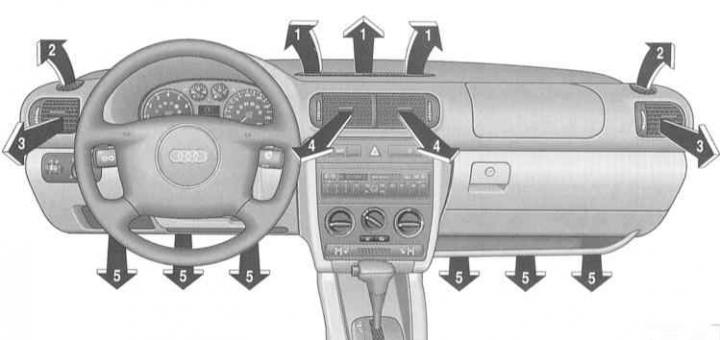
The air supply through the channels intended for this purpose is regulated depending on the selected control mode - automatically or manually.
The illustration shows the air supply points located on the instrument panel.
Heated, unheated or cooled fresh air can enter through any of the channels.
Air distribution is controlled by the multi-position switch C (heater) or the air conditioner keys.
Supply air deflectors 3 and 4 can be closed or opened separately using the knurled handles located on the sides.
The direction of air supply through the supply deflectors can be adjusted both vertically and horizontally.
The air conditioner automatically maintains a uniform microclimate throughout the entire interior space.
To do this, the temperature of the air coming through the supply channels, as well as its mass flow, is automatically changed (quantity) and air flow distribution. Manual adjustments can be made to this automatic process if necessary.
The display of the air conditioner control panel, installed on the center console, shows the programmed temperature and fan speed. On the left side of the display is the temperature control button, and on the right is the fan speed control button. Temperature and fan speed are controlled by pressing the "+" or "-" buttons.
Ventilation and heating controls
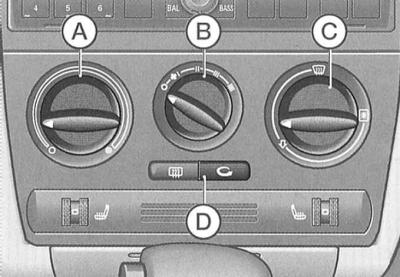
And the temperature controller
The temperature can be gradually increased by turning the regulator clockwise.
Into the fan
Four-stage air flow regulation is possible.
Position 0 corresponds to the cessation of air supply.
With air distributor
Directing air flow to the footwell

Supply channels 5 are open.
To direct the entire air flow to the feet, the supply deflectors 3 must be closed.
Direction of air flow to the windshield

In this position, the air circulation mode (key D) will not be activated.
Warm air can also be supplied to the side windows via deflectors 3.
Deflectors 1 and 2 are open.
Direction of air flow through deflectors

Supply channels 1, 2 and 5 are closed. Air is supplied through deflectors 3 and 4.
With the given air distributor positions, there is always some air leakage through the other deflectors.
D air circulation mode
In the recirculation mode, the air supply from the outside is blocked and its volume is distributed in the cabin in a circle. This prevents air contaminated with exhaust gases from entering the cabin. Driving in this mode should not be too long.
If the glass fogs up, press the d key again to turn off the circulation or turn on the mode

Recommendations for setting up
Heated windshield and side windows
Switch B to position III.
Turn regulator A clockwise until it stops.
Air distributor C in position

Warm air can also be supplied to the side windows via deflectors 3.
Preventing fogging of windshield and side windows
If the windows fog up due to high humidity, for example during rain, the following system setup option is recommended:
Set switch B to position II or III.
If necessary, slightly turn regulator A to enter the high-temperature range.
Install air distributor C, depending on the need, between the positions


Warm air can also be supplied to the side windows via deflectors 3.
Accelerated heating of the passenger compartment
Switch B to position III.
Air distributor C in position

Turn regulator A clockwise until it stops.
Open the air intake deflectors 3.
Normal mode of interior heating
Once the windows are clear and the desired temperature is reached in the cabin, it is recommended to set the system as follows:
Switch B to position II or III.
Adjust regulator A to the desired heater performance.
Air distributor C in position

The supply air deflectors 3 can be adjusted as desired.
Ventilation (fresh air supply mode)
In the configuration option described below, unheated fresh air enters through supply deflectors 3 and 4:
Set switch B to the desired position (III corresponds to maximum air intake).
Turn regulator A to the left until it stops.
Air distributor C in position

Open supply air deflectors 3 and 4.
If necessary, set air distributor C to a different position.
General Provisions
For the heating and ventilation system to function properly, the air intake located in front of the windshield must not be clogged with snow, ice or leaves.
To avoid fogging of the glass at low speed, the fan should be constantly switched on at low power.
To stop polluted outside air from entering the passenger compartment, press the D button. To avoid fogging of the windows, driving in this mode should not be done for a long time.
The dust filter captures suspended microparticles from outside air (for example, dust, pollen, etc.). Set the switch to position 0 only if the outside air is polluted with gases.
Replace the dust filter element according to the maintenance schedule to prevent a drop in heater power.
Air Conditioner Controls
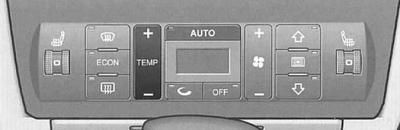
All modes of the air conditioner are switched on and off by pressing the keys. When the mode is on, the LED in the corresponding key lights up.
Typical setup
After turning on the ignition:
Set the temperature to 22°C (71°F) and press the AUTO button.
This setting ensures the fastest possible creation of a comfortable microclimate in the cabin.
Therefore, it makes sense to deviate from it only if this is dictated by your own well-being.
AUTO automatics (normal mode)
The temperature, quantity and distribution of air are regulated automatically, according to the criterion of the fastest achievement and subsequent maintenance of the desired temperature in the cabin. At the same time, automatic response to fluctuations in the outside air temperature, as well as to the effects of the sun, is ensured.
TEMP temperature control
The cabin temperature can be set between 18°C (64°F) and 29°C (84°F). When the regulator is set to one of the extreme positions "LO" and "HI", the temperature is not regulated. The system constantly operates in the maximum cooling or heating capacity mode. The temperature display can switch from the Celsius scale to the Fahrenheit scale and back in the following order:
Press and hold the key

Then press the plus temperature control key.
Heating (defrosting glass)

Maximum fast defrosting/defogging of windshield and side windows.
The temperature is regulated automatically. Maximum air supply is carried out mainly through channels 1 and 2.
Pressing this key turns off the circulation mode and the economy mode.
Circulation mode

In the circulation mode, the air supply from the outside is blocked, and its volume is distributed in the cabin in a circle. This prevents air contaminated with exhaust gases from entering the car. Driving in this mode should not be too long.
If the windows fog up, immediately turn on the mode

Warning: If you need to temporarily switch off the air conditioning compressor, for example due to excessive engine load, press the air circulation button again.
ECON economy mode
To save fuel, you can turn off the compressor. However, when the compressor is turned off, the ability to maintain a comfortable microclimate in the cabin is limited. If the cabin becomes too hot or the windows fog up, you can turn the compressor back on by pressing the ECON or AUTO button.
OFF turns off the air conditioner
When this button is pressed, the air conditioner is turned off. The access of outside air is blocked.
To turn on the air conditioner, press the AUTO button or one of the fan/temperature control buttons, air diffuser, or the OFF button.
Fan speed correction

By pressing the "+" or "-" keys, the fan speed set by the automatic system is changed. The actual speed is displayed as a segment display.
Seat heating*

Rear window heating

Air distribution keys
With keys


 you can change the programmed mode of the air distributor. Both separate and combined manipulation of these keys is possible.
If you need to return to automatic mode, disable the corresponding functions by pressing these keys separately or by pressing the AUTO key.
Air supply to the glass

All air consumption is realized through channels 1 and 2. Unlike the mode
 the amount of air does not increase.
Air supply from the instrument panel

All air consumption is realized with supply through deflectors 3 and 4 of the instrument panel.
Air supply to the footwell

All air flow is realized through the supply ducts 5 and the air duct outlets under the front seats.
Key recognition
The main manual settings of the air conditioner are programmed automatically for ease of use.
If another user of your car changes the air conditioner settings, after the ignition is turned on, they are automatically reset to their original position according to the parameters programmed into your key.
A prerequisite for this is that the previous user used a different car key than yours. Otherwise, the parameters set by this user will be programmed onto your key.
Therefore, when using the car with several drivers, each driver must use their own key to automatically set the air conditioner parameters.
General Provisions
In cold weather, the fan turns on only after the coolant has warmed up to the required temperature. The exception is the mode.
To avoid a drop in heating and cooling performance and fogging of the glass, it is important that the air intake in front of the windshield is not clogged with snow, ice or leaves.
On vehicles with automatic transmission, when starting off abruptly with the accelerator pedal fully depressed, or when preemptively shifting to a lower gear (Kick-Down), the air conditioning compressor is switched off for a while to realize full engine power.
The compressor switches off when the coolant temperature is too high to ensure normal engine cooling under extreme load conditions.
In cold weather, the compressor switches off automatically. In this case, it cannot be switched on even with the AUTO button.
When the compressor is on, the temperature and humidity in the cabin are lowered. This prevents the windows from fogging up.
The air conditioner operates most efficiently with the sunroof* closed and the windows up.
If, however, the air in the car's cabin has become hot as a result of the car being parked in the sun for a long time, then lowering the windows for a short time before turning on the air conditioner can speed up the cooling process.
When the outside temperature and humidity are high, condensed water may drip from the evaporator and form a puddle under the vehicle. This is normal and does not indicate a leak.
The dust filter captures suspended microparticles from outside air (for example, dust, pollen, etc.). Turn on the recirculation mode if the air is polluted by exhaust gases.
Replace the dust filter element according to the maintenance schedule to prevent loss of air conditioner power.
If the filter becomes dirty prematurely as a result of operating the vehicle in areas with severe air pollution, the filter element may need to be replaced more frequently than specified in the maintenance plan.
The air coming through the supply ducts and then distributed throughout the entire cabin is removed through the exhaust slots under the rear window. Therefore, do not cover them with clothing or similar items.
If you have the slightest suspicion that the air conditioner is damaged, turn it off immediately and have it checked at an Audi service station.
Only after this can the air conditioner be used again.
Repairing Audi air conditioners requires highly qualified technicians and special tools.
Therefore, if your air conditioner is faulty, please contact an Audi service station.