



Table of contents: Ventilation frames of forced exhaust… ↓ Checking, removing and installing… ↓
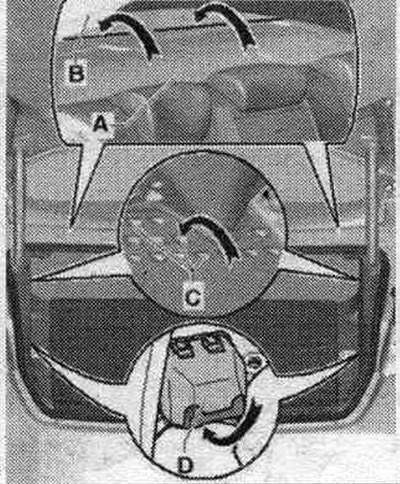
On the Audi A4 sedan, the exhaust ventilation of the passenger compartment is carried out through an opening located between the rear window "B" and the shelf "A" (body), in the luggage compartment. From the trunk, air flows through the exhaust splines "C" into the space between the body and the trunk lining to the exhaust frame "D".
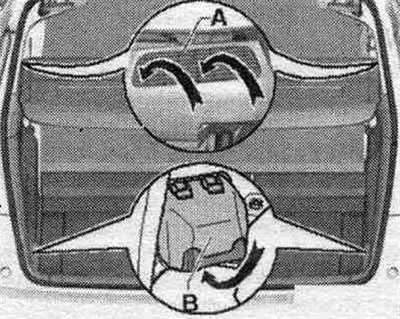
On the Audi A4 Avant, air flows through the left and right exhaust grilles "A" installed in the side trim into the area behind the side trim of the trunk. From there it then goes to the exhaust frame "B".
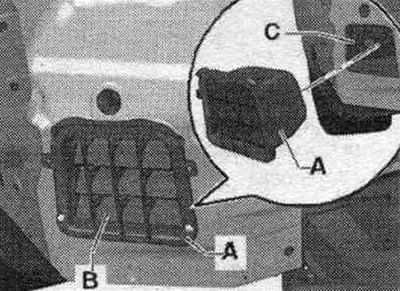
To ensure forced ventilation. one ventilation frame "A" is built into the ventilation opening "C" of the body on the left and right. The ventilation frames are forced-exhaust ventilators. "A" are removed and installed from the outside (with the bumper cover removed).
There are different types of ventilation. forced ventilation frames. "A" for vehicles with and without a noise-insulating cover "D". The installation of the noise-insulating cover "D" depends on the vehicle version. For vehicles with a high-voltage system (hybrid vehicles), you may have to remove the second battery "A1" to access the left soundproofing cover "D".
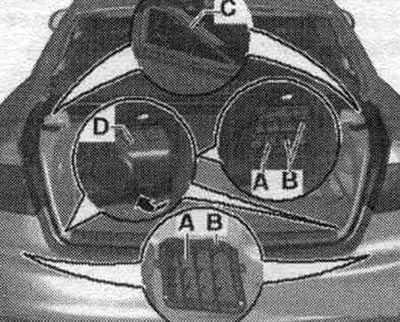
Checking the ventilation. holes in the trunk trim
Check the air duct patency through the ventilation frame of the trunk trim on the left and right "C" and behind the trunk trim to both vents. "A" frames in the luggage compartment (left and right). For perfect operation of the exhaust fan. it is not permitted to block the ventilation frames in the right and left side trim of the trunk "C" compartment. Blocked ventilation frames of the trunk trim "C" or clogged air ducts leading to the ventilation. frames "A" may cause fogging of the glass.
Checking the ventilation. forced exhaust ventilation frames. from the inside
Remove the right and left side trim covers of the trunk. Check the left and right ventilation frames "A" for patency. The sealing edges "B" in ventilation frames "A" should move freely and close automatically. glued seals. "B" edges may cause glass fogging. On cars with acoustic cover "D" make sure that the air duct under the acoustic cover is. the "arrow" cover to the ventilation frames "A" was not blocked by foreign objects. Blocked or clogged air ducts leading to the vent. frames "A" may cause fogging of the glass. To compact. edges "B" are closed correctly, ventilation frame "A" must be installed correctly.
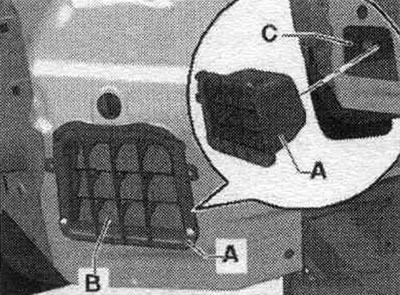
Ventilation frames of forced exhaust ventilation. outside: inspection, removal and installation
Remove the rear trim. bumpers. Check the left and right ventilation frames "A" for patency and the functioning of the seals. edges "B". Glued seals. "B" edges may cause glass fogging. To compact. edges "B" are closed correctly, ventilation frame "A" should be installed in only one position. The picture shows the ventilation frame "A" with the rear removed. bumper trim. When installing, the ventilation frame "A" should be pressed into the hole in the rear ceiling until all fasteners are securely fixed.
Checking, removing and installing the air intake duct
Turn off the ignition. Remove the water drain box cover and/or water baffle plate (various designs).
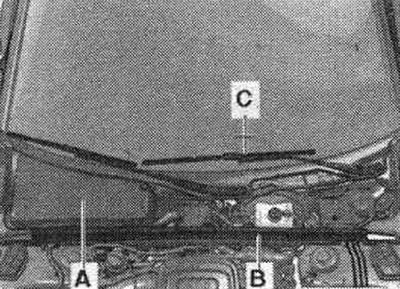
Depending on the vehicle version and the installed water drainage box cover, another additional cover with water drainage "B" may be installed on the fresh air intake channel "A".
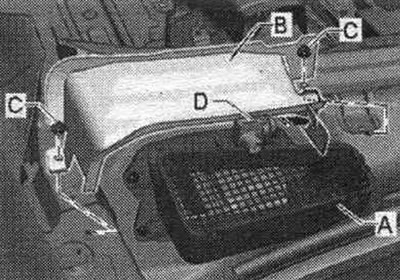
Remove both windshield wiper arms (only for vehicles where the fairing and the air intake duct housing on fairing "A" are one piece). Remove the rubber seal "B" on the left as much as necessary. Remove the air intake duct cover on the fairing "A" or the fairing (various designs). If necessary, carefully detach the fairing from the windshield frame mount "C".
Check the correct installation of the fairing "A" and for damage. Check the seals between the fresh air intake duct housing "A," the fairing, and the windshield crossmember "C" for damage and proper installation. These gaskets prevent water from seeping between the windshield crossmembers and through the fairing into the air conditioner intake duct.
Removal and installation
Carry out preliminary work.
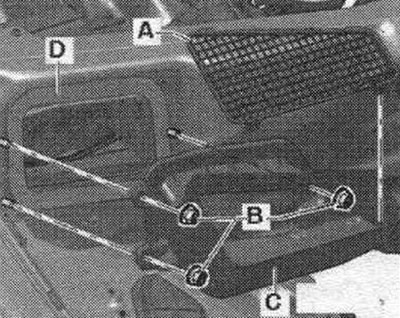
If present, disconnect connector "B" from "G238"/"G657" (various designs). The supply air suction shaft "C" is available in different designs (with or without a mount for "G238" "A", front or side mount), ensure correct design.
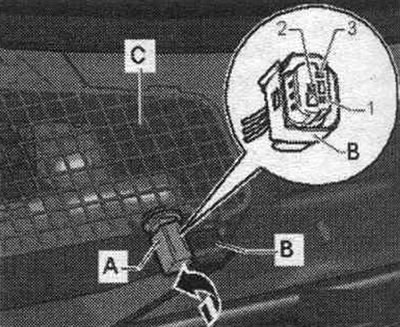
If present, unscrew the "C" bolts (tightening torque 3 Nm) and remove the gutter cover "B". Unscrew the bolts "B" (tightening torque: 3 Nm). Remove air intake duct "C". Install in reverse order. Before installing the air intake duct "C" and the adhesive seals, inspect them for damage. Replace any damaged seals or the air intake duct "C." During installation, ensure the air intake duct "C" and the corresponding gasket are correctly positioned. If the air intake duct "C" is incorrectly installed, water may enter the air conditioner's intake duct through the seal "D.". Before installing the fairing cover "A", check the fairing and the corresponding cover "A" seals (various designs) and the glass crossbar "C" for damage, if the seal is incorrectly installed or damaged, the cover or fairing can allow water to enter the air intake duct and then into the air conditioner air intake.
[This publication is borrowed from the resource: AUDImanual.ru]