



Table of contents: Elements outside the cabin, set of… ↓ Placement, control and operation of… ↓ The control of the coolant shut-off… ↓
Instructions. If there is a fault in the climate control system, the fault memory of the climate control system display panel, the Climatronic control unit "J255" should be read. If the indication to read the fault memory is displayed on another control unit, the fault memory of this control unit should also be read (e.g. on-board power supply control unit "J519", central control unit for the comfort system "J393"), certain elements of the climate control system (e.g. compressor regulating valve "N₂80", refrigerant temperature and pressure sensor "G395") are no longer controlled directly by the used climate control system display, the used Climatronic "J255" / their measured values are no longer processed directly by the used climate control system display, the used Climatronic "J255". If the fault is not displayed, read the measured value block of the climate control and display unit, Climatronic control unit "J255", and operate the faulty component using the "Actuator diagnosis" function. The "electrical system test" function is not described in this repair manual. When performing an electrical test using the "Guided fault finding" function, you will find information on the functions to be tested. The temperature-dependent resistance values at the various temperature sensors are shown in tables that can be called up using the function. After completing the repair, perform the following work: Interrogate the fault memory of the climate control and display unit, Climatronic control unit "J255" and delete any faults displayed. Check the coding of the climate control and display unit, Climatronic control unit "J255". Check the adaptation of the climate control and display unit, Climatronic control unit "J255". Perform basic settings for the climate control and display unit.
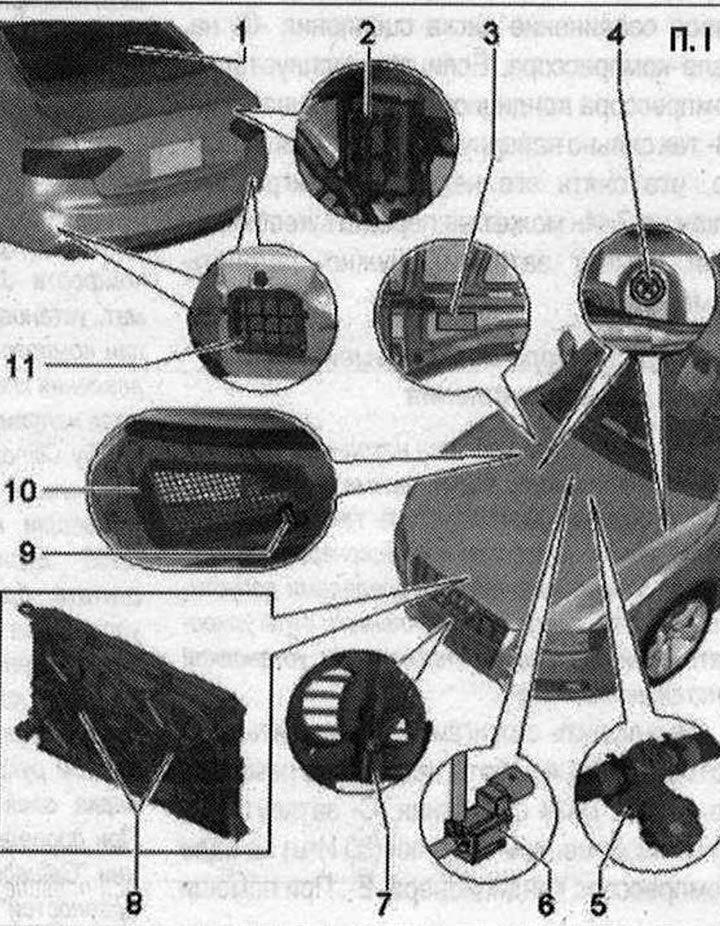
Elements outside the cabin, set of elements "1"
Instructions. The following figure shows the arrangement of units and parts for the Audi A5 Coupe, for the Audi A5 Sportback, Audi A4, Audi Q5, etc. There are minor differences in the arrangement of units/parts from this figure.
I
1. Rear window heating "Z1". The request for rear window heating is sent by the climate control and display module, settings, used Climatronic "J255" via the data bus system to the central control unit for the comfort system "J393". Control of the rear window heating "Z1" is carried out via the central control unit for the comfort system "J393"; 2. Central control unit for the comfort system "J393". Control of the heated rear window "Z1" is carried out via the central control unit for the comfort system "J393"; 3. Information plate with information on the type of refrigerant and the required filling volume; 4. Gutters, water drainage box; the drainage box has one drain installed on the left and right; 5. Coolant supply shut-off valve. Depending on the engine, the shut-off valve is installed in the direct or return coolant line from the engine to the air conditioning heat exchanger. The shut-off valve is currently installed only on vehicles with a 4 "or 6" cyl. gasoline engine. If an independent heater is installed on vehicles with such engines, (as additional equipment), then the shut-off valve is missing (the shut-off valve of the coolant of the heating system "N₂79", installed on a car with an independent heater, takes on this task - the independent heater. The shut-off valve is controlled by means of a vacuum through the shut-off valve of the coolant of the Climatronic unit "N422"; 6. Climatronic coolant shut-off valve "N422". The installation location and design of the Climatronic coolant shut-off valve "N422" varies. Depending on the engine and vehicle equipment, it can be installed in the engine compartment or in the water drainage box. The Climatronic coolant shut-off valve "N422" is currently installed only on vehicles with a 4 "or 6" cyl. engine). If an independent heater is installed on vehicles with such engines, (as additional equipment), then "N422" is missing (the heater coolant shut-off valve "N₂79", installed on a car with an independent heater, takes on this task; 7. Outside temperature sensor "G17". The measured value of the outside temperature sensor "G17" is evaluated by the on-board network "J519" and sent via the data bus system to the control and display panel, the Climatronic control unit "J255"; 8. The radiator fan "V7" and radiator fan 2 "U177" are installed in different versions depending on the vehicle equipment. The command to turn on one or all radiator fans "V7" is transmitted by the air conditioner indicator, Climatronic control unit "J255", via the data bus system to the corresponding engine control unit. Then the engine control unit turns on 1 or all radiator fans (radiator fan "V7" and radiator fan 2 "V177") directly or via the cooling system fan control unit "J293".; Check the supply of control signals to the climate control panel, Climatronic control unit "J255" settings. The corresponding engine control unit switches on, for example, the radiator fan "V7" and radiator fan 2 "V177" (directly or via the radiator fan control unit "J293") steplessly to the required power (depending on the engine type); 9. Air composition sensor "G238". The air composition sensor "G238" is installed only on vehicles with climate control, the "Komfort" system. The measured value of the air composition sensor "G238" is processed by the used on-board network "J519" and transmitted via the bus system to the control and display unit, the Climatronic control unit "J255". The control and display panel, the Climatronic control unit "J255", is switched on when there is a command for recirculation and there are no conditions for switching off; 10. Fresh air intake duct with grille. Check the fairing with the fresh air intake casing for proper installation and damage. Check the seals between the fresh air intake duct casing, fairing and glass crossbar for damage and proper installation. These gaskets prevent water from seeping between the glass crossbars and through the fairing into the air conditioner intake duct. Pay attention to the correct position of the intake grille. The intake filter prevents foreign objects from entering (eg foliage) into the air intake shaft climate, installations. Depending on the vehicle version for countries with high dust content in the air (for example, for China) there may be a filter instead of a grille, preventing dust and sand from entering through the supply fan; 11. Forced exhaust ventilation under the rear bumper is installed 1 forced exhaust ventilation on the left and right. The sealing edges of the ventilation frame must move freely and automatically close. For flawless operation of the interior ventilation, the trunk trim must not block the air ducts.
Placement, control and operation of the Climatronic unit coolant shut-off valve "N422" and the coolant shut-off valve
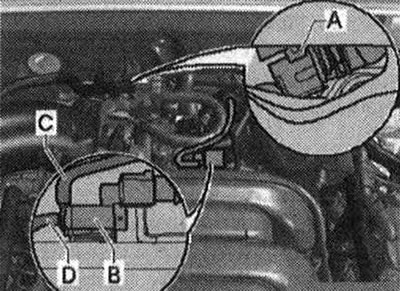
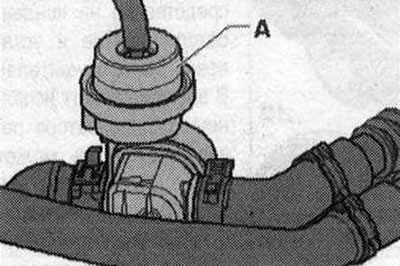
The installation location and design of the Climatronic coolant shut-off valve "N422" "B" and the coolant shut-off valve "A" depend on the engine, vehicle assembly and production time. This figure shows the design "N422-B" for the 6-cyl. FSI engine as it was installed at the beginning of production. Here, the "N422" "B" of design "1" is installed in the cylinder head area.
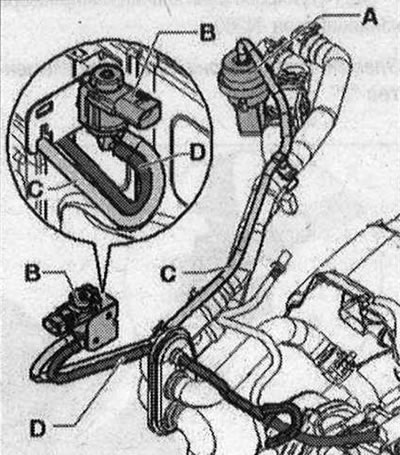
For certain vehicles (for example, for Audi Q5 with 6-cyl. diesel) "N422" "B" is installed in the water drainage box. This figure shows the version "2" "N422".
Instructions. The Climatronic coolant shut-off valve "N422" was installed, for example, at the beginning of production on cars with a 6-cyl. FSI engine). Installation on other engines was carried out gradually in the model year 2008. The exact application depends on the vehicle comp. and production date. If, for example, an independent heater is installed on the vehicle, then "N422-B" and shut-off valve "A" are not installed. The heater coolant shut-off valve "N₂79" installed in a vehicle with an independent heater performs the following tasks.
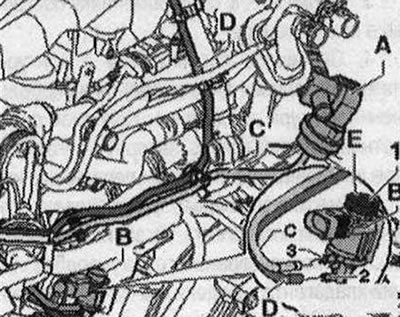
When installing "N422" "B" ensure that the low-pressure hoses are connected correctly. In version "1", the "3" "C" branch pipe of the low-pressure hose is connected to the shut-off valve "A". The vacuum from the engine is supplied through the "2" "D" branch pipe. In version "2", the "3" branch pipe of the low-pressure hose "C" is connected to the shut-off valve "A". The vacuum from the engine is supplied through the "2" "D" branch pipe.
Instructions. This figure shows, for example, the arrangement for a 4-cyl. diesel engine of the 2009 model year. Ventilation of the vacuum reservoir of the shut-off valve "A" after completion of control is carried out, for example, when performing "2" "N422" "B" through the branch pipe "1" located under the cap "E". Depending on the version, the vacuum hose "O" (to the shut-off valve "A") may be marked with a white mark at the connection point. Ensure that the vacuum hoses "N422--B" are correctly positioned. Mixed-up vacuum hoses may cause the interior heater to fail.
Instruction. "N422" "B" receives short control signals at certain intervals (for example, every 10 engine starts) from the control and display panel, Climatronic control unit "J255" to check the operation (without the need for a function). If the vacuum hoses are mixed up when connecting to "N422" "B", then for a short time the control signals are also sent to the coolant shut-off valve "A". After the control is completed with the vacuum hoses mixed up, the vacuum remains in the vacuum receiver of the shut-off valve "A" for an indefinite period. In this case, the shut-off valve "A" does not open. When the shut-off valve "A" is closed, the coolant cannot flow to the heat exchanger and the air conditioning system does not heat.
The coolant shut-off valve for Climatronic "N422" by regulating the climate control system, for example, receives a control signal only when the climate control system is set to the "OFF" operating mode. The engine speed must be less than 5000 rpm and the coolant temperature less than 90°C. By blocking the coolant circuit to the climate control system heat exchanger, the engine warms up faster when the coolant is cold. Since if the vacuum hoses are not connected correctly, the engine constantly sucks in a small amount of fresh air through the "1" "N422" branch pipe. This can additionally lead to problems with regulating the engine idle speed and to entering a fault in the engine control unit memory. The coolant shut-off valve "A", depending on the engine and vehicle version, is installed either in the water drain box or in the engine compartment (this figure shows, for example, the arrangement in the water drainage box on an Audi Q5 with a 6-cyl. TDI engine).
The control of the coolant shut-off valve of the heating system "N422" can be switched via the "Adaptation" function of the climate control system.
Instructions. For vehicles with 6-cyl. FSI engine. (in the 6-cyl. TFSI engine is currently not provided) and in other engines with additional equipment (eg on a car with a start-stop system), but without the additional kit of independent heater, the coolant circulation pump "V50" (water pump "V36") is additionally installed. Depending on the design of the control panel and climate control system, the Climatronic control unit "J255" can be designated as the coolant circulation pump "V50" in the guided troubleshooting, as well as the water pump "V36". Control "V50" ("V36") and "N422" depends on the kit and date of manufacture of the car. The coolant circulation pump "V50" (water pump "V36"), depending on the date of manufacture, is controlled via the circulation pump relay "L 60" (via the same output as the coolant shut-off valve of the Climatronic unit "N422") or directly from the climate control and display unit, the Climatronic control unit "J255", which is gradually installed from the model year 2009. Pay attention to the correct design of the climate control and display unit, the Climatronic control unit "J255" and the correct coding and adaptation in mode. J4a cars with the circulation pump relay "L60" (eg on a 2008 model year vehicle) management is carried out "V50" ("V36") with the ignition on, if the Climatronic coolant shut-off valve "N422" is not controlled correctly (e.g., with the "heat" temperature mode on the climate control and display panel, installation, Climatronic unit "J255"). On vehicles without the "L 60" circulation pump relay (gradual introduction from model year 2009) the coolant circulation pump "U50-U36" with the ignition on, depending on the coolant temperature and the settings on the climate control and display unit, the settings, the Climatronic control unit "J255" was controlled directly from this unit. On cars on which the coolant circulation pump "V50" "V36" and the coolant shut-off valve for Climatronic "N422" are controlled directly from the climate control panel and display unit, the Climatronic control unit "J255", these units store faults in the climate control panel and display unit, the Climatronic control unit "J255". Therefore, the design, coding and adaptation of "J255" should be taken into account.
The full version is posted on the resource: AUDIMANUAL.RU