



- cars with four-cylinder engines: 7.8-10.3 l;
- cars with five-cylinder engines: 8.5-13 l;
- cars with six-cylinder engines: 8.1-12.3 l.
A full tank of diesel-powered cars is enough for a range of over 1000 km.
The fuel tank capacity of the AUDI 80 is approximately 66 liters, and the quattro models - approximately 64 liters. The fuel tank is located under the bottom. It is made of plastic and has a very bizarre shape, especially in the quattro models (see illustration 1.0).
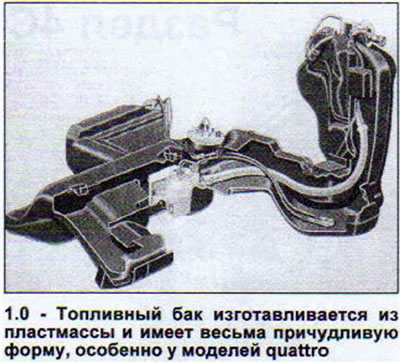
This shape of the tank, on the one hand, is determined by the desire to ensure maximum capacity of the trunk, and on the other hand, to use the smallest free space to maintain sufficient capacity of the fuel tank. The problem of fuel intake from such a tank is also solved accordingly. AUDI uses a suction jet pump, which, in addition to fuel from the tank, simultaneously captures fuel coming from the return fuel line back to the tank. In addition, a hose is connected to the filler neck of the fuel tank, going to the place of the main fuel intake by the pump. When filling even a small amount of fuel, thanks to the hose, it remains in the place of the main intake.
Caution! Before performing any work on the fuel system, it is necessary to disconnect the negative (-) terminal from the battery.
Fuel tank - ventilation
Fuel tank ventilation is extremely important for the functioning of the fuel system. Directly behind the filler neck is the fuel tank ventilation pipe. A shut-off valve is attached to this pipe, preventing fuel from flowing out of the ventilation hole by gravity. This valve closes the ventilation hole when the car is tilted at an angle of more than 45°. In the event of an accident, this valve prevents fuel from flowing out. A hose runs from the shut-off valve, connected to the adsorber of the fuel vapor recovery system, which is a tank with activated carbon located in the rear part of the wheel arch of the right front wheel. The fuel accumulated in the adsorber then enters the fuel system (see illustrations 1.0a, 1.0b, 1.0c).
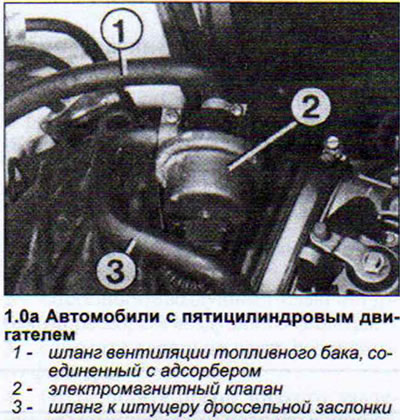
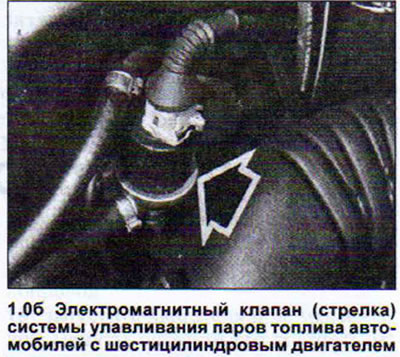
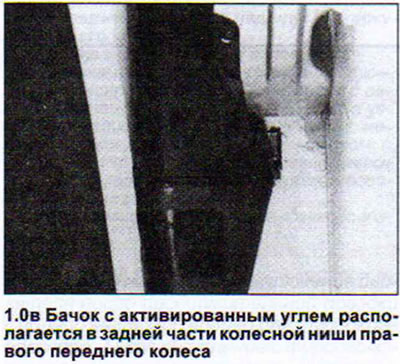
Diesel engines do not require a fuel vapor recovery system.
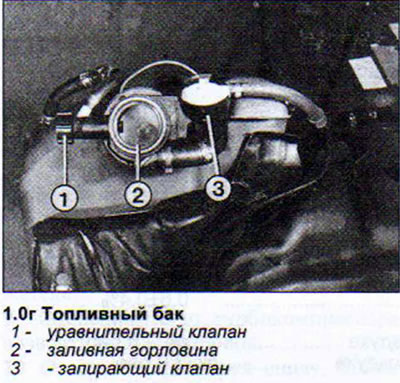
In addition, the fuel tank has an equalizing valve that, when refueling, opens the equalizing chamber of the tank, connected to the filler neck (see illustration 1.0g).
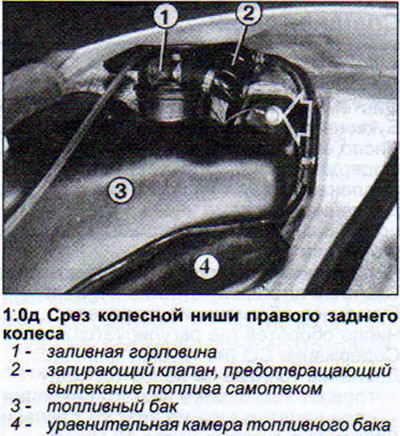
The equalizing chamber of the tank is located in the wheel well of the rear right wheel. During movement, as the amount of fuel in the tank decreases, the valve lets in air, thus equalizing the pressure (see illustration 1.0d).
"Emptying" the fuel tank of a diesel car can have certain consequences for the engine, especially when starting it. Air that gets into the fuel lines does not prevent the pump from delivering fuel. A similar problem occurs if air gets into the system when changing the fuel filter.
TD engines: To start such an engine with air in the system, you will have to work the starter for several minutes.
TDI engines. Bleeding the fuel system of these engines is quite problematic. On the connecting pipe of the return fuel line on top of the high-pressure fuel pump there is a pressure-reducing valve that allows fuel to be diverted only at a pressure of 4 bar. The pump is not able to create such pressure as long as there is air in the system. At the same time, the pump cannot pump out the trapped air and start supplying fuel. The way out of this situation is as follows.
1. Loosen the return fuel line connecting pipe by two turns.
2. Operate the starter until diesel fuel without air bubbles begins to flow out from under the loose fitting pipe.
3. Tighten the connecting pipe.
4. Turn on the starter and start the engine.
All types of diesel engines. When pumping the fuel system, the fuel heating performed by the heating unit on the fuel filter also interferes. The fuel heating system operates in such a way that the portion of the heated fuel that returns to the fuel tank is taken by the high-pressure fuel pump and mixed with the unheated fuel supplied to the system. Fuel heating is performed at air temperatures below +15°C. Since there is air in the return fuel line during pumping, it is pumped back into the system together with the fuel. The solution to this problem is as follows.
5. Disconnect for a while (if the air temperature is not high) fuel supply line from the fuel filter and connect it to the pump so that the fuel bypasses the filter.
6. Connect the fuel supply line to the fuel filter after starting the engine (see illustration).
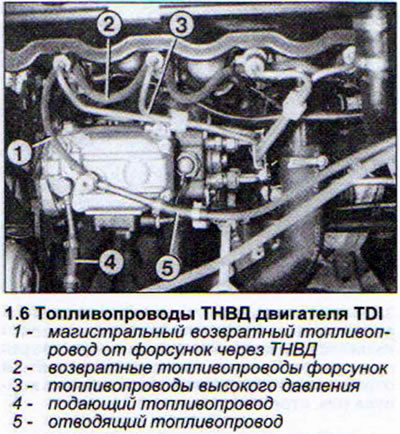
Attention! Do not mix up the connecting pipes for the return and supply fuel lines installed on the high-pressure fuel pump. The letters "OUT" ("back") are stamped on the end of the pipe for the return fuel line of TD engines. In addition, the pipe for the return fuel line has a smaller internal diameter. The head of the pipe for the return fuel line of TDI engines has an unusual shape.
When working on the fuel system, the main requirement is to maintain cleanliness. All fuel lines on which repair work is carried out must be cleaned beforehand. Do not forget that the hoses and pipelines are designed for pressures above 5 bar. Structurally, they are made of materials that can withstand high pressure. At the joints, they are fastened with nuts or clamps. After removing the clamps, the fuel hoses are removed by turning them on the connecting nipples. If you cannot remove the hose in this way, use a wrench and remove the hose. When connecting, secure the hoses with clamps with a screw connection.
For vehicles with five-cylinder engines and the KE-III-Jetronic fuel injection system, it must be taken into account that the fuel system remains under pressure for a long time after the engine has been switched off.
When disconnecting the fuel line, always keep a rag handy to prevent fuel from spilling or getting into your eyes.
The article was copied from the website AudiManual.ru