
Repair Chevrolet Repair Toyota Repair Honda Repair AvtoVAZ Repair Mercedes-Benz Repair BMW Repair Opel
Home  |  Contacts  |  Sitemap  |    
English Русский
Български
Беларускі
Український
Српски
Hrvatski
Română
Polski
Slovenský
Magyar
AudiManual.ru


  • AUDI 80
  • AUDI 100
  • AUDI A3
  • AUDI A4
  • AUDI A6
  • AUDI A8
  • AUDI Q
  • OTHER
  • ARTICLES
B8 (2007-2015) B7 (2004-2008) B6 (2000-2006) B6 (2000-2006, petrol) B5 (1994-2001) B5 (1994-2001, petrol)

General information about the Audi A4 (Audi A4 B5)

  • Home
  • Audi A4
  • B5 (1994-2001, petrol)
  • General information
  • Vehicle description
  • General information about the Audi A4
            0
Table of contents: Tradition obliges ↓ Engines ↓ Five-valve engine technology ↓ Philosophy of engine tuning ↓
In 1972, the Audi 80 was first introduced. Since then, 4 generations of models from Ingolstadt have entered the market. All of them have managed to gain a solid place in the market thanks to solid technology and unobtrusive appearance, which is also proven by the statistics of vehicle approvals. The A4 is proof of this in every respect and a worthy successor.

Tradition obliges


In 1972, the Ingolstadt automobile plant launched the Audi 80, which set a high standard for a mid-size car with its lightweight construction and compact dimensions, comfortable and spacious interior and luggage compartment, as well as modern engines and an exemplary chassis. The Audi A4, which continued the tradition of the Audi 80, came onto the market in November 1994. In its next model, Audi deliberately abandoned the large exterior dimensions. However, through the skilful use of space, the increase in track and wheelbase, it was possible to significantly improve the ratio of the interior length of the body to the wheelbase for those sitting in the passenger compartment.

Engines


In addition to the two new five-valve engines with a displacement of 1.8 liters, the Audi A4 also offers a redesigned four-cylinder, two-valve engine with a displacement of 1.6 liters and a newly designed cross-flow cylinder head for the A4. In addition, two engines are also used, already familiar from the Audi 80: a V6 with a displacement of 2.6 liters and 2.8 liters. Each of these individually is:


  • 1.6 litre four-cylinder engine with 74 kW
  • 1.8 litre, four-cylinder, five-valve engine with 92 kW
  • 1.8-litre, four-cylinder, five-valve turbocharged engine with 110 kW of power
  • V6 with a displacement of 2.6 liters and a power of 110 kW
  • V6 with a displacement of 2.8 liters and a power of 128 kW


In this gradation, it is interesting to be able to choose between two power units of the same power, because both the four-cylinder engine with a displacement of 1.8 hp turbocharger and the V6 with a displacement of 2.8 liters have the same power of 110 kW. With the same power, there are differences in the conceptual characteristics: depending on what the buyer prioritizes in the engine, a choice can be made between increased efficiency or greater comfort and smoothness.

Five-valve engine technology
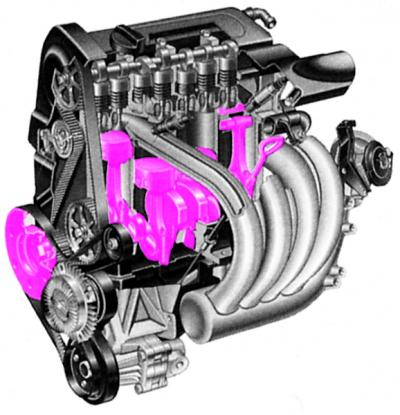


Five-valve engine technology


New head on an old block: The 1.6-litre engine for use in the Audi A4 is equipped with a new cross-flow cylinder head.
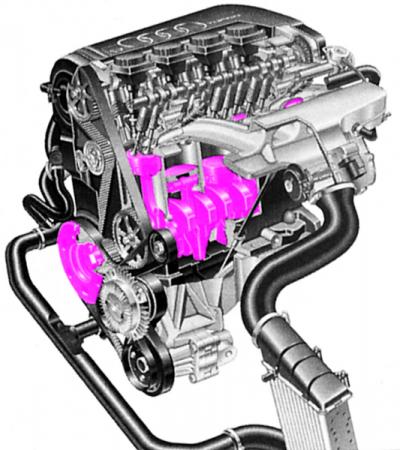
New head on an old block: The 1.6-litre engine for use in the Audi A4 is equipped with a new…


Five-valve engine technology, turbocharging and intercooler with 110 kW of power turn the 1.8-litre engine into a marvel of driving culture and traction.
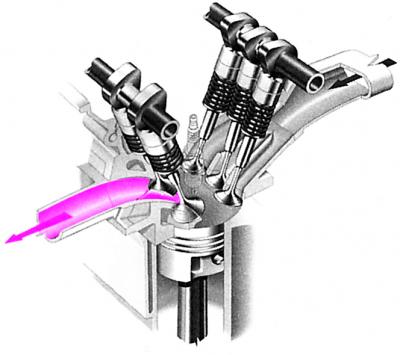


Five-valve engine technology, turbocharging and intercooler with 110 kW of power turn the 1.8-litre…


The five-valve engine has two overhead camshafts, one of which operates the three intake valves, while the other opens both exhaust valves.

Engine power, in addition to various parameters such as displacement and speed, depends to a large extent on how quickly the gas exchange can take place. The more fresh gas can enter the combustion chamber in the same unit of time, the more intense the power output. Most Audi engines have a long stroke, meaning that the piston stroke is greater than the cylinder diameter. Long stroke engines allow for short designs, are lighter than short stroke engines, run smoothly, especially at idle, and are distinguished above all by the fact that they already reach maximum torque at low speeds.

Filling the combustion chamber depends primarily on the opening and closing valves and the flow areas in the valves and cylinder head channels.

Three intake and two exhaust valves, i.e. five per cylinder in total, provide the maximum flow area. This results from the valve plate area and the opening stroke. Compared to common multi-valve concepts, five-valve technology in long-stroke engines offers the greatest possible advantages in terms of cylinder filling intensity.


At the same time, the technology of the five-valve engine allows for a combustion chamber with a centrally located spark plug, and due to this, a short spark path is possible to ensure fast, efficient combustion of the working mixture. At the same time, the risk of detonation is also reduced, and due to the high compression, intensive use of fuel becomes possible. The combustion of the working mixture in a five-valve engine is carried out "softer" than in two- and four-valve engines. Since, due to the larger cross-section of the valves, the forces that drive them are significantly weaker, then, in general, pleasant acoustics are created when the five-valve engine is running.

The five valves are actuated by two camshafts directly via hydraulic tappets. As has long been the case at Audi, the valve clearance is not adjustable.

The intake camshaft serves three valves on each cylinder, the exhaust camshaft serves two. Both camshafts are connected to each other by means of a chain, the drive from the crankshaft is provided by a toothed belt.

Philosophy of engine tuning


The high traffic density on our streets requires a different engine concept from that which existed in the 1980s: what is in demand is not the maximum power output, but the balance of fuel consumption, the range of power levels offered, the exhaust gas character and noise. The engine design chosen by Audi with its powerful torque in the lower engine speed range allows for low-speed driving and thus a noticeable reduction in fuel consumption.
The article was checked by auto expert Georgy Rodionov
This article is available at russian, bulgarian, belarusian, ukrainian, serbian, croatian, romanian, polish, slovak, hungarian

Share information:
Previous articles
Audi A4 B5: Vehicle description
Next articles

Chassis of the car
Passenger protection
Full zinc coating
Quattro all-wheel drive


Similar articles on other Audi car models:
Introduction to the Audi 80/90 B3 manual Audi 80 B3 (1986-1991, petrol)
Introduction to the Audi 100 C4 (petrol engines) manual Audi 100 C4 (1990-1994, petrol)
Audi A3/S3 cars — summary Audi A3 Type 8L (1996-2003)
Introduction to the Audi A6 manual Audi A6 C5 (1997-2004)
Link to this page in different formats


Visitor comments

No comments yet


How much will 49 + 36 =


A4(B8, 2007-2015) 
  • General information
  • Operating instructions
  • Power unit
  • Petrol engines 1.8 l
  • Petrol engines 1.8/2.0 l
  • Petrol engines 3.0 l
  • Petrol engines 3.2 l
  • Fuel system (petrol)
  • Diesel engines 2.0 l (CA*)
  • Diesel engines 2.0 l (CJCB)
  • Diesel engines 2.7/3.0 l
  • Diesel engines 3.0 l
  • Fuel system (diesel)
  • Transmission
  • Manual gearbox 0B1
  • Manual gearbox 0B2
  • Manual gearbox 0B3
  • Manual gearbox 0B4
  • Automatic transmission 0B5
  • Automatic transmission 0B6
  • Automatic transmission 0AW
  • All-wheel drive system
  • Chassis
  • Front suspension
  • Rear suspension
  • Brake system
  • Steering system
  • Body
  • Exterior
  • Interior
  • Seats
  • Doors, locks and windows
  • Security system
  • Heating and air conditioning
  • Electrical equipment
  • Audio system
  • Power devices
  • Equipment and devices
  • Lighting and lamps
  • Electrical circuits
 
A4(B7, 2004-2008) 
  • General information
  • Introduction to manual
  • Troubleshooting
  • Operating instructions
  • Maintenance
  • Power unit
  • Petrol engines 2.0 (ALT)
  • Petrol engines 2.0 (TFSI)
  • Petrol engines 1.8 (MPI)
  • Diesel engines
  • Cooling system
  • Air conditioner
  • Fuel and exhaust system
  • Ignition system
  • Starting and charging
  • Transmission
  • Clutch
  • Manual gearbox
  • Automatic gearbox
  • Drive shafts
  • Chassis
  • Brake system
  • Front suspension
  • Rear suspension
  • Steering
  • Body
  • Exterior
  • Interior
  • Electrical equipment
  • Equipment and devices
  • Lighting and signaling
  • Windscreen wipers and washers
  • Electrical diagrams
  • Electrical diagrams (since 2007)
 
A4(B6, 2000-2006) 
  • General information
  • Vehicle Description
  • User manual
  • Maintenance
  • Power unit
  • Gasoline engine
  • Diesel engine
  • Lubrication system
  • Cooling system
  • Supply system
  • Injection system
  • Exhaust system
  • Ignition and control
  • Transmission
  • Gear box
  • Clutch and drive shafts
  • Chassis
  • Brake system
  • Car suspension
  • Steering
  • Body
  • Heating and ventilation
  • Exterior (external elements)
  • Interior (internal elements)
  • Electrical equipment
  • Power devices
  • Lighting and appliances
  • Electrical circuits
 
A4(B6, 2000-2006, petrol) 
  • General information
  • Introduction to the guide
  • Car care
  • Power unit
  • Engine repair
  • Lubrication system
  • Cooling system
  • Injection and control system
  • Ignition system
  • Power and exhaust system
  • Transmission
  • Clutch and drive shafts
  • Car gearbox
  • Chassis
  • Suspension and wheels
  • Steering
  • Brake system
  • Body
  • Interior
  • Exterior
  • Electrical equipment
  • Equipment and devices
  • Lighting and signaling
  • Power devices
  • Electrical circuits
 
A4(B5, 1994-2001) 
  • General information
  • Introduction to the guide
  • Car care
  • Maintenance (gasoline)
  • Maintenance (diesel)
  • Power unit
  • Gasoline engines
  • Diesel engines
  • Engine overhaul
  • Cooling system
  • Fuel injection (gasoline)
  • Fuel system (diesel)
  • Exhaust system
  • Ignition system
  • Transmission
  • Clutch
  • Mechanical gearbox
  • Automatic gearbox
  • Drive shafts
  • Chassis
  • Brake system
  • Car suspension
  • Steering
  • Body
  • Exterior
  • Interior
  • Doors, locks and windows
  • Heating and ventilation
  • Electrical equipment
  • Power devices
  • Equipment and devices
  • Electrical circuits
 
A4(B5, 1994-2001, petrol) 
  • General information
  • Vehicle description
  • Maintenance
  • Power unit
  • Engine repair
  • Turbocharging
  • Exhaust system
  • Cooling system
  • Ignition system
  • Fuel system
  • Motronic injection system
  • MPI and MPFI injection system
  • Transmission
  • Clutch
  • Gearbox and shafts
  • Chassis
  • Steering
  • Car suspension
  • Brake system
  • Wheels and tires
  • Body
  • Heating and ventilation
  • Body parts
  • Electrical equipment
  • Fuses and relays
  • Power devices
  • Lighting and lamps
  • Tools and devices
  • Electrical circuits
 
AudiManual.ru © 2017-2026 · Mobile version · Feedback · Sitemap: EN BG BY UA RS HR RO PL SK HU · Site search · News and articles
80 B2 · 80 B3 petrol · 80 B3 · 80 B4 · 100 C3 diesel · 100 C3 petrol · 100 C3 · 100 C4 petrol · 100 C4 · A3 Type 8L · A4 B5 petrol · A4 B5 · A4 B6 petrol · A4 B6 · A4 B7 · A4 B8 · A6 C4 · A6 C5 · A6 C5 Allroad · A8 D2 · Q5 Type 8R · Q7 Typ 4L · Audi A2 ·
This site uses cookies 🍪. Click the button to accept this fact.