



Table of contents: Front axle ↓ Rear axle in front-wheel drive… ↓ Rear axle of Quattro models ↓ Braking system with ABS ↓ Electronic differential lock EDS ↓ Electronic wheel slip regulation ASR ↓
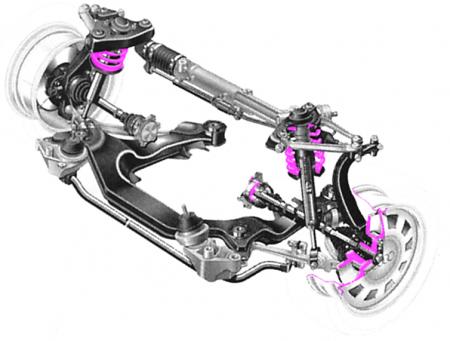
The four independent suspension arms are designed to match the front axle Audi A8. Due to the arrangement of the four transverse levers, it is achieved that the influence of the drive is practically not felt in the control.
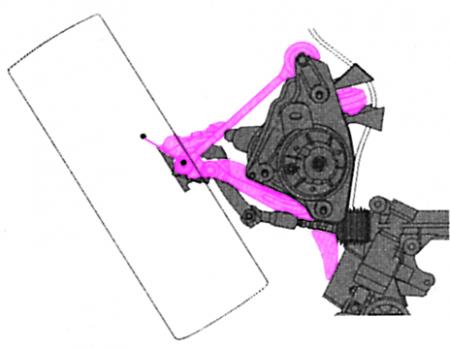
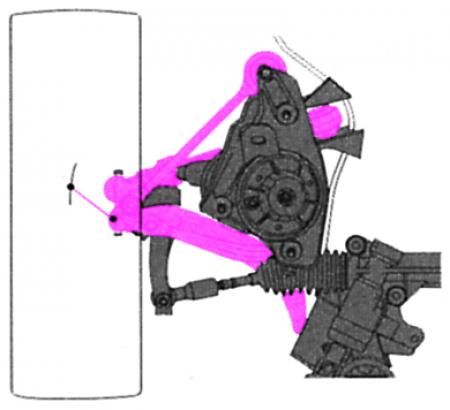
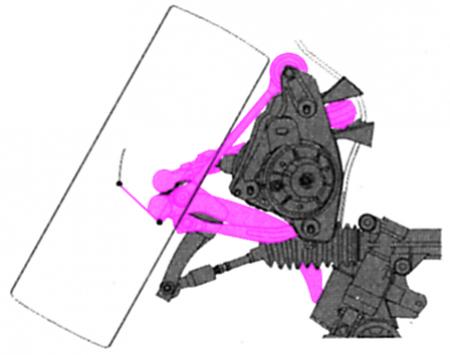
The three figures show where the imaginary left axle (arrow) is located at different wheel angles. The position of the axle with the steered wheels is especially important when the wheels are in neutral position. In this case, it is almost exactly in the center of the wheel.
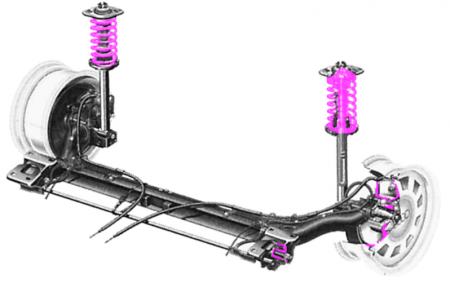
The front-wheel drive Audi A4 has a so-called linked-arm rear axle. It basically consists of two tubular longitudinal arms that are connected by a torsionally flexible V-shaped profile.
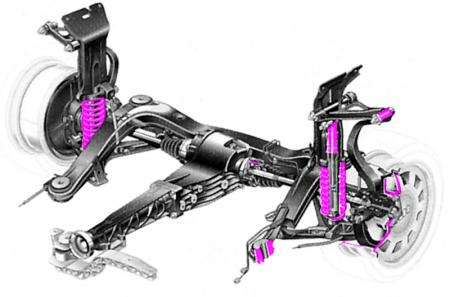
The Audi A4 quattro has a so-called double wishbone axle at the rear, with the rear-wheel drive in the center.
Front axle
With the four-link independent front axle suspension in Audi, each wheel is controlled by four aluminum wishbones. The two upper wishbones are mounted on the frame via rubber-metal bearings and connected to the wheel mount via low-friction ball heads. The two lower wishbones (one each for the load-bearing and leading wishbones) are mounted on the subframe via a rubber-metal bearing and each is connected to the wheel mount via a low-friction ball head. The gas-filled shock absorber and the coil spring are connected to form a shock absorber strut. The shock absorber strut does not take on the task of controlling the wheels. An additional spring made of cellular polyurethane in combination with a tension buffer spring in the shock absorbers ensures that strong body movements on the front axle are comfortably absorbed.
The independent suspension arms are positioned in such a way that they are largely smoothed out by the lifting of the front part of the car at the start of movement and its lowering during braking. To reduce longitudinal movements of the axle, the inner bearing of the leading arm is damped hydraulically. A tubular stabilizer fixed to the subframe, which is connected to the supporting arm by means of a connecting rod, reduces body roll on turns.
By using aluminum in various axle components and in the design configuration, as well as by using high-strength materials in the springs, it was possible to keep the expensive suspension design low in weight. The positive properties of the front suspension with four independent control arms are formed by the steering unit, which runs almost vertically through the center of the wheel. By steering unit, the engineer means the supposed line around which the wheel moves when the steering wheel is moved. The steering unit near the center of the wheel has great advantages, since with front-wheel drive, in addition to the forces applied to turn the wheel, the drive forces are also transmitted, which are again applied at the center of the wheel. The shorter the distance between the steering axle and the center of the wheel, the shorter the lever and the less interference there is with the steering.
With the four-link front axle, the A4 virtually eliminates the influence of drive forces on the steering, as the distance between the axle with the steered wheels and the wheel centre is very small – just 10 mm.
Rear axle in front-wheel drive vehicles
The well-known coupled-arm rear axle consists of two bending-rigid and torsionally rigid tubular longitudinal arms connected by a torsionally flexible, bending-rigid V-shaped cross-section. An additional stabilizer is welded to the ends of the longitudinal arms. This achieves high lateral rigidity of the axle and outstanding track stability. This rear axle must be re-adjusted in many details. The priority goals are to increase ride comfort and stability, reduce noise and reduce weight.
The design of the rear axle with coupled levers ensures that when both wheels are simultaneously compressed, it behaves like a rear axle with longitudinal levers, and when the spring shock absorber telescopic strut is alternately compressed, it behaves like a diagonal lever of an independent rear axle suspension.
Rear axle of Quattro models
The Audi A4 quattro models feature double wishbone independent wheel suspension, including elastic mounts for the rear wheels. The upper wishbones, located above the wheels, provide the possibility of installing a large luggage compartment.
The wheel suspension system is guided by two triangular wishbones with an additional rod arm on each side. The shock absorbers and coil springs are combined into shock absorber struts to save space.
Braking system with ABS
The fifth-generation ABS with electronic brake force distribution (EBV) as standard ensures high braking stability in a wide range of driving conditions and makes a mechanical brake force regulator unnecessary. Since the electronic ABS control is significantly more sensitive than a mechanical brake force regulator, a significantly larger adjustment range is used. In order to ensure driving stability even when braking on bends, the proportion of the braking force on the rear axle must be reduced. The EBV detects via the ABS speed sensors whether the Audi A4 is driving straight ahead or cornering. When cornering, the braking pressure on the rear wheels is reduced. This allows the rear wheels to generate maximum lateral force.
Electronic differential lock EDS
EDS is installed as standard on all A4 quattro models and is a special option for front-wheel drive models with four-cylinder engines with a displacement of 1.8 litres or more.
The electronic differential lock EDS in all-wheel drive models is a targeted friction clutch on up to three wheels, in front-wheel drive vehicles – on one wheel. This ensures maximum traction when starting off in extreme conditions, such as on slippery roads.
Electronic wheel slip regulation ASR
In the front-wheel drive A4 models with 2.6-litre and 2.8-litre V6 engines, the ASR electronic traction control is available as a special traction-enhancing option, which also includes all the functions of the EDS. While the EDS includes targeted friction clutching to improve traction, the ASR electronic traction control provides additional intervention in the engine management if necessary. The purpose of the electronic traction control is to prevent the front wheels from spinning, regardless of how much the driver applies the accelerator.
The original source of the article can be found on the website AudiManual.ru