
Repair Chevrolet Repair Toyota Repair Honda Repair AvtoVAZ Repair Mercedes-Benz Repair BMW Repair Opel
Home  |  Contacts  |  Sitemap  |    
English Русский
Български
Беларускі
Український
Српски
Hrvatski
Română
Polski
Slovenský
Magyar
AudiManual.ru


  • AUDI 80
  • AUDI 100
  • AUDI A3
  • AUDI A4
  • AUDI A6
  • AUDI A8
  • AUDI Q
  • OTHER
  • ARTICLES
B8 (2007-2015) B7 (2004-2008) B6 (2000-2006) B6 (2000-2006, petrol) B5 (1994-2001) B5 (1994-2001, petrol)

All-wheel drive concepts (Audi A4 B5)

  • Home
  • Audi A4
  • B5 (1994-2001, petrol)
  • General information
  • Vehicle description
  • All-wheel drive concepts
            0
Table of contents: All-wheel drive ↓ Permanent all-wheel drive ↓
All-wheel drive concepts


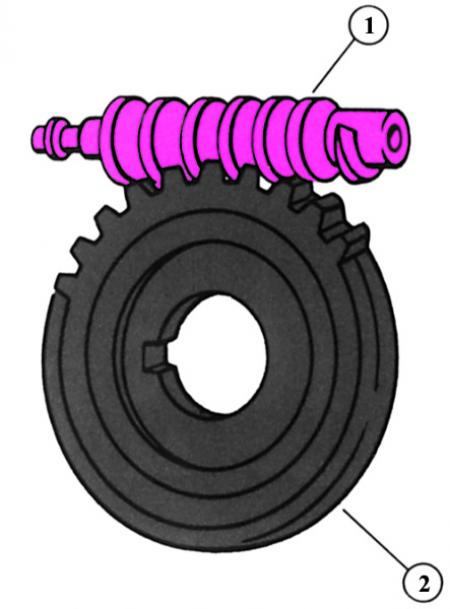
The Torsen differential is based on the principle of a worm drive. The worm drive can be designed to provide a higher or lower degree of locking. The numbers indicate:
  • 1 - worm;
  • 2 - worm wheel.

All-wheel drive


Until then, all-wheel drive was almost inseparably linked to the concept of a high-performance vehicle. The all-wheel drive concept used in this family of vehicles was simple:
  • In addition to the standard drive (front engine, rear drive) a second transmission was simply routed to the front axle by means of a transmission branch and an additional cardan shaft. Normal driving was carried out with the standard drive, and only if road conditions required it, the front drive transmission was connected. This design with a plug-in all-wheel drive is still used today in off-road vehicles.
  • Disadvantage: All-wheel drive must be disengaged for driving on hard ground, as the front wheels travel a greater distance than the rear wheels when turning. Different wheel speeds cause transmissions to become overstrained.
  • Effect: the car is difficult to control, on turns, to relieve tension from the drive, the wheel rubs with very slight slippage at certain intervals - the car jumps.


Permanent all-wheel drive


When the idea of a permanent all-wheel drive came to mind, it was necessary to come up with a method of alignment that would not allow overstraining of both axle drives relative to each other. This problem is solved by the so-called central differential.

Differentials have long been known in the automobile industry. They divide the forces between the right and left drive wheels. In this case, too, alignment is necessary because, as is well known, on turns, the outer wheel always travels a greater distance than the inner wheel. This alignment is provided by the axle differential. It provides the axle drive while simultaneously allowing both drive wheels to rotate freely relative to each other.

Anyone who has gotten stuck on the road in winter knows the treachery of the object: a wheel standing on ice turns, the opposite wheel on rough ground does not transmit force and stands still.

One thing becomes clear: such a differential is not suitable as a central differential, because exactly the opposite is needed. The force must be directed to where the wheels can carry you to the ground, namely: where there is a road surface with grip. And since this is never known, the distribution of force must be automatic and without delay. After various stages of development of a locking central differential with manual engagement, today the so-called Torsen distribution differential is integrated into the Audi Quattro models.

[The original material is located on the website «AUDImanual»]
The article was checked by auto expert Georgy Rodionov
This article is available at russian, bulgarian, belarusian, ukrainian, serbian, croatian, romanian, polish, slovak, hungarian

Share information:
Previous articles
Audi A4 B5: Vehicle description
Next articles

Quattro all-wheel drive
Full zinc coating
Passenger protection
Chassis of the car
Torsen distribution differential
Driving dynamics on dry roads
Operating instructions for quattro cars
Differential lock mechanism


Similar articles on other Audi car models:
Driving with all-wheel drive Audi 80 B3 (1986-1991, petrol)
Front wheel drive Audi 100 C3 (1982-1990, petrol)
Changing the oil in the Haldex clutch of all-wheel drive models Audi A3 Type 8L (1996-2003)
Shock absorber strut for all-wheel drive vehicles Audi A6 C5 (1997-2004)
General information about all-wheel drive Audi A8 D2 (1994-2002)
Steering knuckle, wheel bearing module, shock absorber,… Audi Q5 Type 8R (2008-2017)
Removal and installation the crankshaft belt drive pulley Audi A2 (1999-2005)
Link to this page in different formats


Visitor comments

No comments yet


How much will 38 + 12 =


A4(B8, 2007-2015) 
  • General information
  • Operating instructions
  • Power unit
  • Petrol engines 1.8 l
  • Petrol engines 1.8/2.0 l
  • Petrol engines 3.0 l
  • Petrol engines 3.2 l
  • Fuel system (petrol)
  • Diesel engines 2.0 l (CA*)
  • Diesel engines 2.0 l (CJCB)
  • Diesel engines 2.7/3.0 l
  • Diesel engines 3.0 l
  • Fuel system (diesel)
  • Transmission
  • Manual gearbox 0B1
  • Manual gearbox 0B2
  • Manual gearbox 0B3
  • Manual gearbox 0B4
  • Automatic transmission 0B5
  • Automatic transmission 0B6
  • Automatic transmission 0AW
  • All-wheel drive system
  • Chassis
  • Front suspension
  • Rear suspension
  • Brake system
  • Steering system
  • Body
  • Exterior
  • Interior
  • Seats
  • Doors, locks and windows
  • Security system
  • Heating and air conditioning
  • Electrical equipment
  • Audio system
  • Power devices
  • Equipment and devices
  • Lighting and lamps
  • Electrical circuits
 
A4(B7, 2004-2008) 
  • General information
  • Introduction to manual
  • Troubleshooting
  • Operating instructions
  • Maintenance
  • Power unit
  • Petrol engines 2.0 (ALT)
  • Petrol engines 2.0 (TFSI)
  • Petrol engines 1.8 (MPI)
  • Diesel engines
  • Cooling system
  • Air conditioner
  • Fuel and exhaust system
  • Ignition system
  • Starting and charging
  • Transmission
  • Clutch
  • Manual gearbox
  • Automatic gearbox
  • Drive shafts
  • Chassis
  • Brake system
  • Front suspension
  • Rear suspension
  • Steering
  • Body
  • Exterior
  • Interior
  • Electrical equipment
  • Equipment and devices
  • Lighting and signaling
  • Windscreen wipers and washers
  • Electrical diagrams
  • Electrical diagrams (since 2007)
 
A4(B6, 2000-2006) 
  • General information
  • Vehicle Description
  • User manual
  • Maintenance
  • Power unit
  • Gasoline engine
  • Diesel engine
  • Lubrication system
  • Cooling system
  • Supply system
  • Injection system
  • Exhaust system
  • Ignition and control
  • Transmission
  • Gear box
  • Clutch and drive shafts
  • Chassis
  • Brake system
  • Car suspension
  • Steering
  • Body
  • Heating and ventilation
  • Exterior (external elements)
  • Interior (internal elements)
  • Electrical equipment
  • Power devices
  • Lighting and appliances
  • Electrical circuits
 
A4(B6, 2000-2006, petrol) 
  • General information
  • Introduction to the guide
  • Car care
  • Power unit
  • Engine repair
  • Lubrication system
  • Cooling system
  • Injection and control system
  • Ignition system
  • Power and exhaust system
  • Transmission
  • Clutch and drive shafts
  • Car gearbox
  • Chassis
  • Suspension and wheels
  • Steering
  • Brake system
  • Body
  • Interior
  • Exterior
  • Electrical equipment
  • Equipment and devices
  • Lighting and signaling
  • Power devices
  • Electrical circuits
 
A4(B5, 1994-2001) 
  • General information
  • Introduction to the guide
  • Car care
  • Maintenance (gasoline)
  • Maintenance (diesel)
  • Power unit
  • Gasoline engines
  • Diesel engines
  • Engine overhaul
  • Cooling system
  • Fuel injection (gasoline)
  • Fuel system (diesel)
  • Exhaust system
  • Ignition system
  • Transmission
  • Clutch
  • Mechanical gearbox
  • Automatic gearbox
  • Drive shafts
  • Chassis
  • Brake system
  • Car suspension
  • Steering
  • Body
  • Exterior
  • Interior
  • Doors, locks and windows
  • Heating and ventilation
  • Electrical equipment
  • Power devices
  • Equipment and devices
  • Electrical circuits
 
A4(B5, 1994-2001, petrol) 
  • General information
  • Vehicle description
  • Maintenance
  • Power unit
  • Engine repair
  • Turbocharging
  • Exhaust system
  • Cooling system
  • Ignition system
  • Fuel system
  • Motronic injection system
  • MPI and MPFI injection system
  • Transmission
  • Clutch
  • Gearbox and shafts
  • Chassis
  • Steering
  • Car suspension
  • Brake system
  • Wheels and tires
  • Body
  • Heating and ventilation
  • Body parts
  • Electrical equipment
  • Fuses and relays
  • Power devices
  • Lighting and lamps
  • Tools and devices
  • Electrical circuits
 
AudiManual.ru © 2017-2026 · Mobile version · Feedback · Sitemap: EN BG BY UA RS HR RO PL SK HU · Site search · News and articles
80 B2 · 80 B3 petrol · 80 B3 · 80 B4 · 100 C3 diesel · 100 C3 petrol · 100 C3 · 100 C4 petrol · 100 C4 · A3 Type 8L · A4 B5 petrol · A4 B5 · A4 B6 petrol · A4 B6 · A4 B7 · A4 B8 · A6 C4 · A6 C5 · A6 C5 Allroad · A8 D2 · Q5 Type 8R · Q7 Typ 4L · Audi A2 ·
This site uses cookies 🍪. Click the button to accept this fact.