



Table of contents: Operating principle ↓ Location ↓
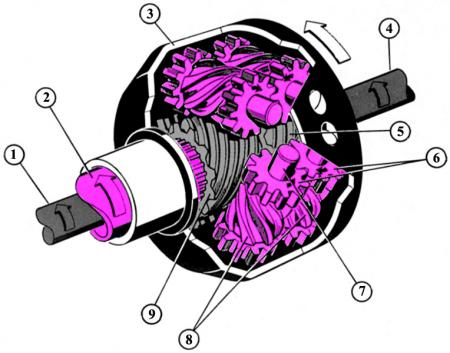
- 1 - drive to the front axle;
- 2 - hollow shaft (drive to gearbox);
- 3 - differential housing;
- 4 - flange/propeller shaft (for rear axle drive);
- 5 - rear axle drive worm;
- 6 - toothed wheel;
- 7 - worm wheel axis;
- 8 - worm wheels;
- 9 - front axle drive worm.
Distribution (central) the differential serves to align the front and rear transmission. (The front and rear axle differentials operate independently of it.)
It is located - not perceived from the outside as a separate unit - at the back of the manual transmission. Engineers say: integrated.
The name Torsen comes from the gearbox company Gleason, where this differential was invented. Its name is derived from the English letters Torque Sensing, which means "sensing torque". Thus, this concept already contains a description of the function, since:
- the differential transmits increased force to the drive axle that has better traction;
- it happens so effectively (due to design), that this axle can transmit 3.5 times more force than the other axle;
- but with equally good soil properties, the drive is equally distributed between the front and rear axles, i.e. there is no design-based preference for one axle.
Operating principle
The operation of the torsion differential is based on the principle of a worm drive and uses its fundamental principles:
- the worm drive can be designed to have high or low locking capacity (the magnitude of the lock in this case is a multiple of the force with which the transmission must turn);
- the value of the blocking value depends on the angle of the worm, i.e. the worm has many flat or few steep turns;
- an example of a flat worm with a high degree of locking is a car jack in which the knee acted upon by the worm lifts the car, but the car can never move the knee by its own weight.
Location
By cleverly arranging a total of eight worm wheels and 12 gears in combination with the differential housing, hollow shaft, front drive shaft and rear drive shaft, the best possible performance of the function discussed in the penultimate paragraph is achieved.