



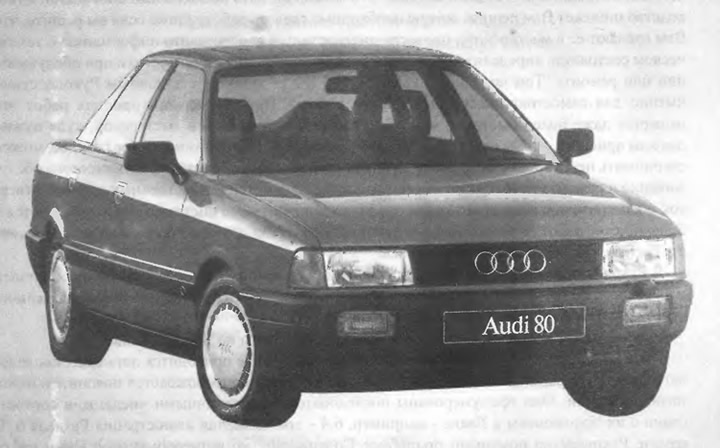
the "new" Audi 90 was introduced in July 1987. Its features included standard power steering, high-quality upholstery, electrically operated windows and outside mirrors, central locking, tinted glass, a stereo with 4 speakers, front fog lights and a self-monitoring system. The 2.2/2.3E models have alloy wheels, sports seats and a rear spoiler.
the "new" Audi Coupe was introduced in December 1988. Its features: galvanized galvanized body, cable protection system function "Procon-Ten", folding rear seats, and on later models, a 20-valve engine equipped with a catalytic converter.
The purpose of this Guide is to be a simple and clear instruction that will allow you to competently discuss and plan the repair of your car with a professional mechanic or to carry it out yourself. This can be done in several ways. The Guide will help you decide what work needs to be done (even if you decide to have it done in a workshop), perform diagnostics and provide information on the technical condition, determine the sequence of actions and diagnostics during maintenance or repair. However, we hope that you will use this Guide specifically for doing the work yourself. When performing simple jobs, it will be even faster than servicing the car in a workshop, where you need to come twice to leave and pick up the car. And, perhaps most importantly, you can save some money on labor costs. For maintenance and repair, you need to have a good set of metric wrenches, screwdrivers and measuring probes, since these simple hand tools are used in most jobs. There are warnings in the text when special tools or special training are needed for repair.
The Manual provides drawings and descriptions showing the function of the various parts and their locations. The work is described and photographed in a step-by-step sequence, so that even a beginner can do it.
The Manual consists of 12 Sections. Sections are divided into Parts and Chapters.
There are many illustrations, especially in those parts that give a detailed sequence of operations to be carried out. The text is accompanied by explanatory illustrations. They are numbered consecutively with decimal numbers, according to their position in the Chapter - for example, 6.4 is the fourth illustration of Section 6. At the beginning of the Manual there is a detailed Table of Contents, from which you can easily find the question that interests you.
the "left" or "right" of a car is considered relative to the person sitting in the driver's seat facing forward.
Unless otherwise stated, nuts and bolts are loosened by turning counterclockwise and tightened by turning clockwise.
Vehicle manufacturers are constantly making changes to specifications, specifications and recommendations, and when notified, we incorporate them into our Guide as early as possible.
(The article was copied from the website: «AudiManual»)