



Therefore, these engines are also called 6V. The engines are cooled by a cooling liquid. The engines are located in the engine compartment along the axis of the car.
The cylinder block is made of gray cast iron, and the cylinder head is made of aluminum alloy and is bolted to the cylinder block. Only the cylinder block of the 125 hp engine is made of aluminum alloy. An oil pan is attached to the bottom of the engine cylinder block, into which the oil necessary for lubrication and cooling of the engine flows.
The petrol engines and the 2.5-I-TDI diesel engine use a cross-flow design, whereby air enters the engine cylinders on one side of the engine and exhaust gases exit on the other side of the engine. This engine design significantly improves cylinder filling and gas exchange, so that the energy of the air-fuel mixture is used most efficiently.
Engine 1.8-I. Each engine cylinder has three intake and two exhaust valves. The valves are driven by two camshafts. One camshaft controls the intake valves, and the other camshaft controls the exhaust valves. The camshaft that controls the exhaust valves is driven by a toothed belt from the crankshaft pulley. The camshaft that controls the intake valves is driven by a chain from the camshaft that controls the exhaust valves.
Diesel engine 1.9-I-TDI. The camshaft installed in the cylinder head is driven by a toothed belt from the crankshaft pulley. To supply fuel to the engine cylinders, a high-pressure fuel pump is used, attached by a flange to the side of the cylinder block and driven by a toothed belt.
Diesel engine 2.5-I-TDI. This is an engine developed by AUDI and first installed in the A6. Each cylinder of the engine has two intake and two exhaust valves. Each section of the cylinder block has two camshafts. The camshaft controlling the intake valves is driven by a toothed belt from the crankshaft pulley. The camshaft controlling the exhaust valves is driven by gear engagement from the camshaft controlling the intake valves. The fuel pump is driven by a separate toothed belt.
Engines 2.4- and 2.8-I. On the V6 petrol engine, as well as on the 1.8-I engine, each cylinder has three intake and two exhaust valves. Each section of the cylinder block has two camshafts. The camshaft that controls the exhaust valves is driven by a toothed belt from the crankshaft pulley. The camshaft that controls the intake valves is driven by a chain from the camshaft that controls the exhaust valves.
All engines. The intake and exhaust valves are controlled by the camshaft via hydraulic tappets. Valve clearance adjustment is performed automatically using hydraulic tappets and does not require manual adjustment.
An oil pump, located in the oil pan, is used to supply oil to the rubbing surfaces of the engine. On the V6 petrol engine, the oil pump is mounted on the front side of the cylinder block. On the V6 TDI engine, the oil pump drive chain also drives the balance shaft, which reduces unwanted engine vibrations.
The water pump on 150hp engines is mounted on the side of the engine block. The water pump is driven by a separate belt. A wide poly V-belt also drives the alternator, power steering pump and, if equipped, the air conditioning compressor. On 125hp and V6 engines, the water pump is located at the front of the engine and is driven by a toothed belt. Keep in mind that the engine cooling system must be filled year-round with a mixture of antifreeze and low-lime water.
The preparation and ignition of the fuel-air mixture in the engine cylinders is carried out by the engine management system, which does not require adjustments. The ignition advance angle and idle speed are regulated by the engine management system.
Attention. The electric fan may turn on even after the ignition is turned off. Therefore, when working on a hot engine, it is necessary to disconnect the electrical connector from the fan motor for the duration of the work.
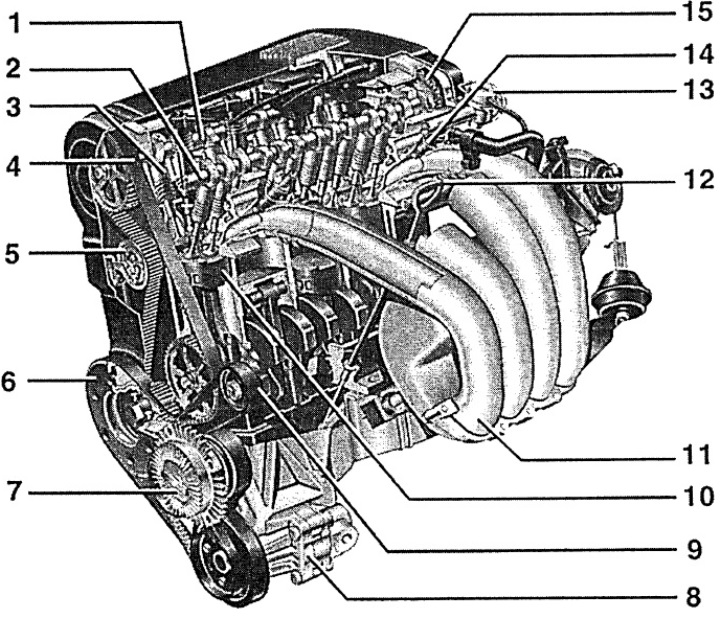
Fig. 2.1. Engine 1.8-I
1 - camshaft controlling the exhaust valves,
2 - camshaft controlling the intake valves,
3 - hydraulic pusher,
4 - toothed belt,
5 - roller of the toothed belt tensioning mechanism.
Tensioner roller with pneumatic cushioning.
6 - vibration damper,
7 - viscous coupling hub,
8 - power steering pump,
9 - generator pulley,
10 - piston,
11 - suction pipeline,
With pipeline length switching valve.
12 - dipstick for measuring oil level,
13 - fuel pressure regulator,
14- fuel injector,
15 - chain.
With hydraulic tensioner and relative rotation mechanism of camshafts.
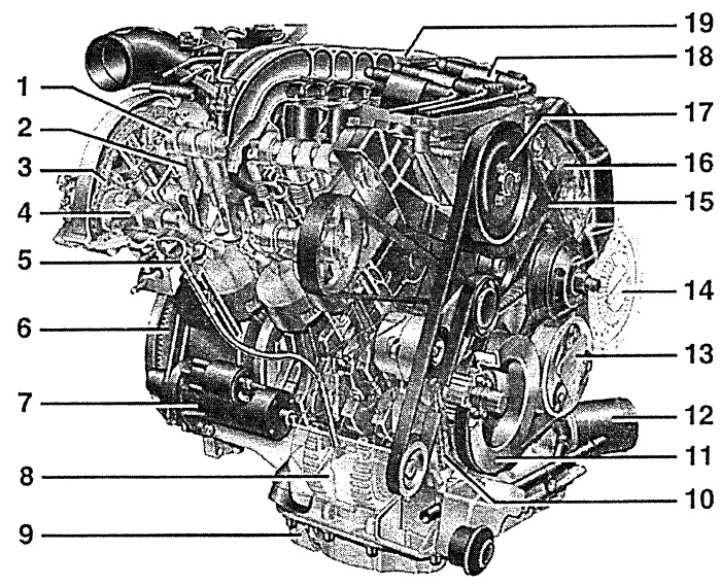
Fig. 2.2. Petrol engine V6 2.4-I/ 2.8-I
1 - camshaft controlling the intake valves,
2 - hydraulic pusher,
3 - chain,
With hydraulic tensioner and relative rotation mechanism of camshafts.
4 - camshaft controlling the exhaust valves,
5 - dipstick for measuring oil level,
6 - flywheel,
7 - starter,
8 - generator,
9 - oil pan,
10- oil pump drive chain,
11 - damper (vibration damper),
12 - oil filter,
13 - air conditioning compressor pulley,
14 - radiator fan with viscous coupling,
15 - poly V-belt,
16 - toothed belt,
17 - power steering pump pulley,
18 - ignition coil,
19 - suction pipe,
With pipeline length switching valve.
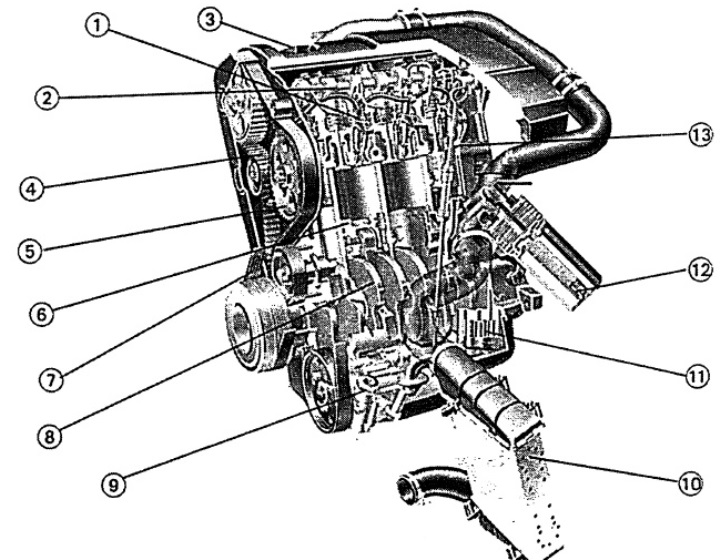
Fig. 2.3. Diesel engine 1.9 TDI
1 - nozzle,
2 - camshaft,
3 - oil filler cap,
4 - toothed belt,
5 - fuel pump pulley,
6 - piston,
7 - poly V-belt,
8 - crankshaft,
9 - power steering pump,
10 - radiator,
11 - oil pump,
12 - oil filter,
13 - oil level dipstick/
[The original article is available on the online resource: audimanual.ru]