The disc brakes are cooled by the oncoming air flow. Additional cooling is provided to the front brake discs of cars with an engine of 85 kW or more. The same applies to models with a 66 kW engine with automatic transmission. This additional cooling is provided by special large holes through which the air flow passes.
On AUDI 80 cars, the front wheels, and on some models, the rear wheels, are equipped with disc brakes with a so-called floating caliper, consisting of a support and a wheel cylinder. This caliper has the shape of a clenched fist. The piston in the wheel cylinder housing presses the inner brake shoe to the brake disk. At the same time, the brake cylinder housing itself shifts in the guide sleeve and presses the outer brake shoe to the brake disk.
Moisture on the brake discs when driving on a wet road in the rain or snow slows down the brakes for a few fractions of a second. This time is needed to remove moisture from the brake disc by evaporation. This effect is aggravated in winter, because the salt that is sprinkled on the roads during this period of time settles on the brake discs and pads.
Front Disc Brake Pads
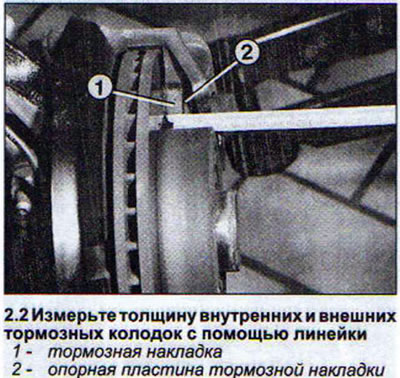
The brake pads of the front disc brakes are usually sufficient for a mileage of 50,000 km. At the same time, we recommend not to neglect regular visual inspection of their condition. The permissible residual thickness of the brake pads is 2 mm. The thickness of the metal plate on which the pad is attached is not taken into account. This plate is about 5 mm thick. Visual inspection of the thickness of the pads is performed with the wheel cap removed.
1. Illuminate the brake pads with a flashlight through the hole in the wheel rim and assess the condition and thickness of the brake pads. More accurate is to check the brake pads on the removed wheels.
2. Measure the thickness of the inner and outer brake pads using a ruler (see illustration).