



1. Fill the expansion tank with new brake fluid. While bleeding, monitor the brake fluid level in the tank and top it up regularly if necessary. Otherwise, its level may drop and air will be pumped into the system again instead of being removed.
2. Remove the protective cap from the corresponding bleed nipple. The bleeding sequence is as follows: rear right, rear left, front right, front left.
3. Clean the nipple and put a transparent hose on it (identical to windshield washer hose). Place the free end of the hose in a container partially filled with brake fluid (see illustration).
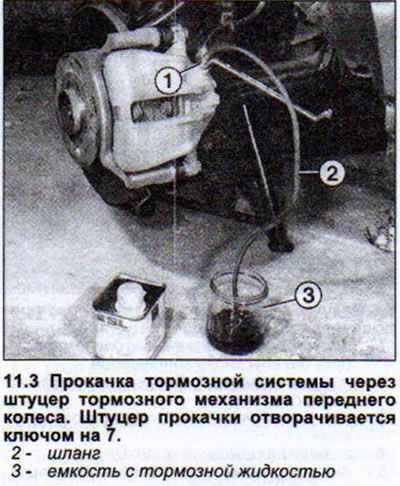
4. Ask an assistant to press the brake pedal (pump) to increase the pressure in the system.
5. Loosen the bleed screw of the corresponding wheel by about ½ a turn and release the pressure. The assistant should press the brake pedal all the way down and hold it in this position.
6. Close the fitting and increase the pressure in the system again.
7. Open the nipple again.
8. Repeat the above procedure until the air bubbles in the hose disappear. If a large amount of brake fluid was drained from the hydraulics before repair work, the system is bled in at least two passes.
If the system stops releasing air bubbles, have an assistant hold the brake pedal down and tighten the bleed nipple. Tighten the nipple carefully. Applying too much force can cause the threads to strip.
9. Repeat the above procedure on the remaining wheel brakes.