



Table of contents: ABS malfunction ↓ Electronic differential lock ↓
The ABS system prevents wheel locking by metering the braking force applied to the brake pedal and maintains vehicle control during sudden braking. However, contrary to popular belief, ABS is not always able to reduce the braking distance.
The ABS hydraulic unit is located in the engine compartment between the main brake cylinder and wheel brake lines (see illustration 12.0).
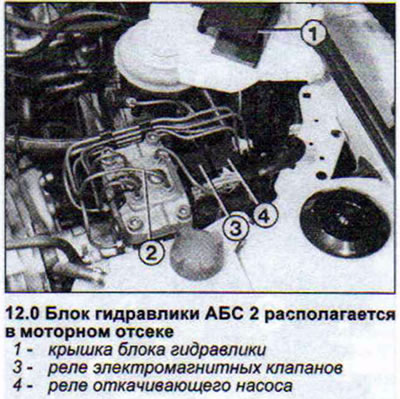
In accordance with the commands given by the electronic ABS control unit, the pressure in the wheel brakes is maintained constant, reduced or increased again. However, this pressure cannot be higher than that which appears in the main brake cylinder as a result of the action on the brake pedal. Electromagnetic valves are responsible for regulating the pressure - one for each wheel brake mechanism. When electric current with maximum voltage is supplied to them, they reduce the pressure, and when minimum, they increase it. Due to the fact that the pressure in the system that appears when the brake pedal is pressed cannot be removed, a special pump is installed to reduce it, which diverts part of the brake fluid back to the main brake cylinder. The operation of the ABS can be determined by the pulsation of the brake pedal. Above the ABS hydraulic unit, there are two relays. One, larger in size, provides power to the pump, and the smaller one is "responsible" for the electromagnetic valves.
Each wheel has an ABS sensor that measures the number of wheel revolutions and sends this information to the control unit (see illustration 12.0a).
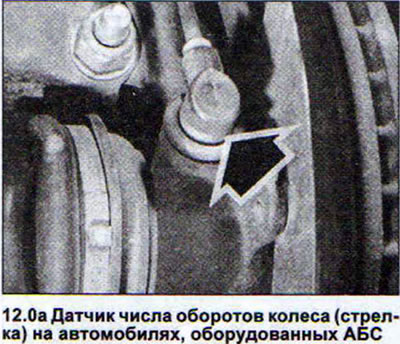
Based on it, the control unit controls the ABS hydraulics. ABS sensors are a core with a coil. The sensors receive information about the number of wheel revolutions by induction from the gear on the wheel hub.
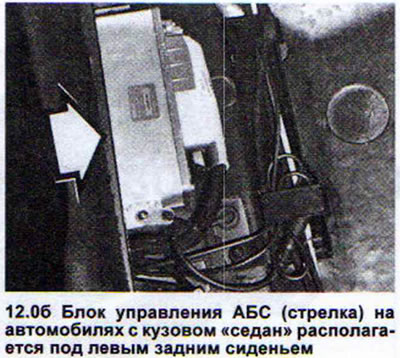
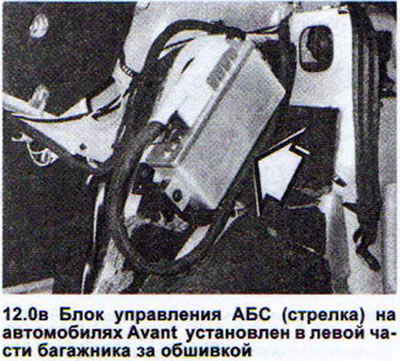
The ABS control unit on sedan cars is located under the left rear seat (see illustration 12.0b), for Avant cars - on the left side of the trunk behind the trim (see illustration 12.0b).
The electronic ABS unit, along with hydraulic control, has a self-diagnostic function. If a malfunction is detected, the electronic unit switches off the ABS and a signal lamp lights up on the instrument panel.
Cars produced before 7/92 have an ABS switch on the instrument panel. With its help, when driving on ice or gravel roads, the ABS can be switched off to ensure a shorter braking distance.
ABS malfunction
When the ABS is switched off, the corresponding signal lamp lights up on the instrument panel. If the car engine is turned off, then when it is started, the ABS, despite being switched off, is automatically switched on.
The indicator light on the instrument panel lights up when the ignition is turned on. The light should go out immediately after the engine starts or when the vehicle starts moving at a speed of more than 6 km/h. If the voltage of the vehicle's electrical system drops below 10 V, the indicator light also lights up. The indicator light may also light up if one of the wheels turns faster than the others for 20 seconds. In this case, the ignition must be turned off and then turned on again.
If the indicator light is constantly on, the ABS is not working. The cause of the ABS failure should be determined by a specialized workshop. Not all auto repair shops can perform ABS-related work.
A car enthusiast can independently check the plug connections of the ABS control unit with the wheel speed sensors or with the ABS hydraulic unit.
Warning! If the ABS indicator light on the instrument panel is constantly on, regardless of whether the ABS is intentionally disabled or has failed, then you can continue driving without fear. In this case, the brakes function as in cars without ABS.
Electronic differential lock
As an additional equipment, the AUDI 80 can be equipped with an electronic differential lock in combination with ABS. Using ABS, the EBD improves traction under unfavorable driving conditions, for example, when one of the front wheels spins when starting off. This situation is recorded by the wheel speed sensor and transmitted to the ABS and EBD control unit, which activates the disc brake mechanism of this wheel. The disc brake mechanism of the wheel is driven by a pair of additional electromagnetic valves on the ABS hydraulic unit. ABS opens the accumulator, applying pressure to the wheel cylinder and braking the wheel until both wheels have equal traction. As soon as this moment is reached, the control unit closes the electromagnetic valves and stops braking the wheel.
The electronic differential lock also has a self-diagnosis function, preventing erroneous control of the front brakes. At a vehicle speed of over 40 km/h, the EBD switches off. The same thing happens if the control unit detects a malfunction of the EBD. The ABS continues to operate. If one of the wheel speed sensors fails or there are failures in the electronic unit, the EBD and ABS are switched off. The operation of the AUDI 80 braking system is preserved.