



Table of contents: Rear Disc Brake Pads - Replacement ↓ Support - removal and installation ↓ Rear Brake Disc - Replacement ↓
Cars with ABS are equipped with a disc brake mechanism on the rear wheels instead of a drum brake mechanism. As on the front wheels, this mechanism is a floating caliper. In addition to the hydraulic drive, the rear wheel brake mechanism is also driven by a cable drive of the parking brake. The cable on the parking brake lever through the pusher drives the piston of the wheel cylinder, which presses the brake pads to the disk.
The rear disc brake mechanism is adjusted automatically. The piston of the wheel cylinder moves out of the cylinder as the brake pads wear out, ensuring optimal pressure of the pads on the disc during braking. The incoming brake fluid prevents play between the pads and the brake drum during braking.
The situation is different with the mechanical parking brake. At a certain point, the parking brake actuator pusher will not reach the wheel cylinder piston, which shifts as the brake linings wear out. This situation is prevented by a clearance adjustment device, which "lengthens" the pusher as needed. The main element of the adjustment device is a threaded mechanism, along which the second part of the pusher shifts as the brake linings wear out, thereby maintaining the previous gap between the brake shoes and the piston and not allowing the piston to move back. For this reason, when replacing worn brake linings with new ones, the wheel cylinder piston cannot simply be pressed into its original position. It should only be unscrewed back.
Checking the condition of the rear disc brake pads is done in the same way as the front ones. The residual thickness of the brake pads without taking into account the support plates should not be less than 2 mm (see illustration 5.0).
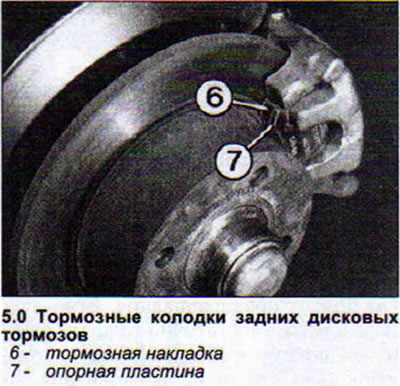
At the same time as checking the brake pads, the condition of the brake discs is also checked. The sequence of actions, as well as the permissible wear of the disc, are identical to the order of checking and wear of the brake discs of the front wheels
Rear Disc Brake Pads - Replacement
To replace the brake pads of the rear disc brakes, in addition to the new pads, you will need four self-locking bolts, which are usually included in the delivery set. In general, this work does not present any particular difficulties, provided that the car owner has a special key 3131. The following procedure is given taking into account that such a key is purchased or made independently using a template.
1. Remove both floating bracket mounting bolts. Hold the guide pin by the hexagon to prevent it from turning.
2. Remove the floating bracket (caliper).
3. Remove the brake pads from the guides.
4. Install the special key 3131 on the wheel cylinder piston and screw the piston back into the cylinder (see illustration).
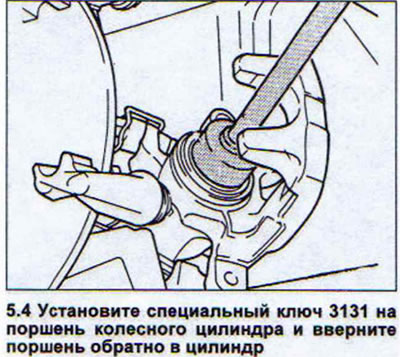
6. Ask an assistant to monitor the brake fluid level in the expansion tank. If, when the wheel cylinder piston returns, the brake fluid level increases so much that it can spill over the edge, then remove the fluid.
Caution! The piston of the wheel cylinder of the rear disc brake mechanism is screwed in, not pressed in. Failure to do so will destroy the mechanism for adjusting the clearance between the piston and the parking brake actuator pusher.
7. Install the brake pads with new brake linings.
8. Secure the floating bracket with new self-locking bolts to a torque of 35 Nm. When tightening the bracket mounting bolt, hold the guide pin with a thin spanner to prevent it from turning. If you use a sufficiently thick spanner to hold the guide pin from turning, the spanner will be jammed when tightening and the tightening torque will be set incorrectly.
9. Adjust the brake mechanism. To do this, place the rear of the car on jack stands.
10. Release the parking brake.
11. Make sure that the parking brake cables are not taut. To do this, move and release the parking brake lever alternately on the left and right wheel calipers until it stops. If the parking brake lever of the opposite caliper also moves all the way to the stop and returns to its original position, then the parking brake cables are too taut.
12. Loosen them by turning the central tension adjustment nut.
13. Lower the vehicle.
14. Press the brake pedal without starting the engine about 40 times.
15. Place the car on jack stands.
16. Make sure the rear wheels rotate freely.
Support - removal and installation
17. Disconnect the brake hose from the caliper if the caliper will be removed for replacement.
The procedure for removing the caliper is the same as for replacing the brake pads.
18. Disconnect the parking brake cables.
19. Remove both bolts securing the brake shield to the hub. When installing, tighten these bolts to 65 Nm.
The caliper is installed in the same way as when installing after replacing the brake pads.
20. Adjust the brake mechanism.
Replacing the piston seals of the wheel cylinder of the rear wheel brake mechanism is performed identically to replacing the seals on the front wheels.
Rear Brake Disc - Replacement
21. Remove the caliper.
22. Remove the brake disc.
23. Clean the brake disc seat on the hub and install a new brake disc.
24. Adjust the brake mechanism.
[The original version is on the portal: Audimanual.ru]