



The ABS system was initially only installed on quattro models and vehicles with a six-cylinder engine. Since January 1993, all AUDI 80 models have been equipped with the ABS system.
When the brake pedal is pressed, the pusher connected to the pedal presses on two pistons located one behind the other in the main brake cylinder. This squeezes out the brake fluid and the resulting pressure is transmitted through the hoses and pipes of the brake system to the working cylinders of the wheel brake mechanisms. The pistons of the working cylinders press the brake shoes to the brake discs. On the rear wheels of AUDI 80 cars produced before 10/92 with a 66 kW engine without ABS, brake drums are installed instead of brake discs. All other versions, including models with a 66 kW engine with ABS, have disc brakes both at the front and rear.
The brake fluid pressure is distributed through two independent brake circuits located diagonally. This means that the brake circuit is formed by the front wheel and the diagonally opposite rear wheel. This ensures that the vehicle stops with sufficient efficiency in the event of failure of one of the circuits of the working system. In this case, more force is required on the brake pedal, and the braking distance will be longer.
The parking brake acts on the rear wheel brakes via cables, regardless of the type of brake mechanism.
Brake fluid
AUDI 80 vehicles use brake fluid of specification FMVSS116DOT4. All fluids of the specified specification can be mixed with each other without any concerns.
Brake fluid is poisonous and aggressive towards the car's paintwork. It does not freeze even at temperatures of -40°C and has a boiling point of about 260°C. The disadvantage of brake fluid is its increased hygroscopicity, which leads to a decrease in the boiling point. With 2.5% water in the brake fluid, its boiling point is already only 150°C. This is dangerous, especially under high load on the brake mechanisms. Moisture absorbed by the brake fluid not only reduces its boiling point, but also leads to corrosion of the brake cylinders and pipes. For this reason, the maintenance plan provides for replacing the brake fluid every two years.
To replace the brake fluid you need two liters of fresh fluid.
1. Drain all the brake fluid from the expansion tank, using a siphon or an old oil can. Once all the fluid has been drained from the expansion tank, pour new fluid into the tank.
2. Bleed the system until fresh brake fluid comes out of the bleeder nipple. To ensure that all used brake fluid is removed, drain 500 cm³ of brake fluid from each bleeder nipple when bleeding.
The order of pumping is: rear right, rear left, front right and lastly front left.
Attention! Used brake fluid must be disposed of.
Low brake fluid level is signaled to the driver by a control lamp on the instrument panel. At the same time, we recommend regularly performing a visual inspection of the system.
3. Open the hood and, if necessary, wipe the expansion tank with brake fluid with a rag.
The expansion tank is made of transparent material, which allows you to easily determine the brake fluid level, which should be between the MIN and MAX marks (see illustration 1.0).
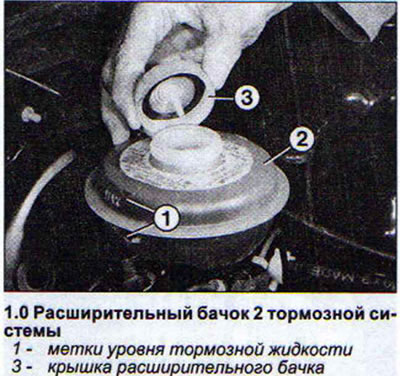
When the brake pads wear out, the brake fluid level drops, and after installing new ones, its level is slightly higher, which is acceptable. However, if the brake fluid level has dropped to the MIN mark or below, then you need to urgently look for the leak. There should be no other reason, because the liquid does not evaporate or is not consumed.
In order to quickly determine the location of a possible leak, it is desirable that the bottom and the units and parts located there are dry. Wet areas suggest a liquid leak.
4. Check all the connection points of the brake system, as well as the calipers and shields of the brake drum mechanisms, behind which the wheel brake cylinders are located.
5. Make sure that the brake hoses are not wet, swollen or frayed. If so, replace the corresponding hose.
6. Do not clean the brake lines with a screwdriver, sandpaper or wire brush because these pipes have a protective coating. Such cleaning will cause rust to form.
7. Apply rust protection primer to areas where the protective coating is damaged.
8. Replace pipelines that have corrosion pits and deflections.
9. Install new protective caps on the bleed nipples if the old ones are missing.
10. Check the brake system. To do this, press the brake pedal sharply. The counter-pressure on the pedal should not decrease even after several minutes. Otherwise, there is a defect in the protective cuff of the master brake cylinder. If the cuff of the master brake cylinder is defective, the level of brake fluid in the expansion tank does not decrease. However, fluid under pressure leaks onto the back of the piston of the master brake cylinder.
Brake fluid leaks on the piston seals of the calipers and wheel brake cylinders can be identified by dark spots on the surface of the brake mechanism shield and caliper.
Increased brake pedal travel may indicate that the brake linings are worn out and need to be replaced. Excessive brake pedal travel may also be caused by jammed brake shoes or rusted brake drums on vehicles with this type of rear brakes. Excessive pedal travel is also observed when air gets into the brake system.
11. Press the brake pedal with your hand. The free travel of the pedal should not be more than ⅓ of its possible total travel.
If you are unsure of your abilities, we recommend that you contact a workshop to check the brake system.