
Repair Chevrolet Repair Toyota Repair Honda Repair AvtoVAZ Repair Mercedes-Benz Repair BMW Repair Opel
Home  |  Contacts  |  Sitemap  |    
English Русский
Български
Беларускі
Український
Српски
Hrvatski
Română
Polski
Slovenský
Magyar
AudiManual.ru


  • AUDI 80
  • AUDI 100
  • AUDI A3
  • AUDI A4
  • AUDI A6
  • AUDI A8
  • AUDI Q
  • OTHER
  • ARTICLES
B4 (1991-1996) B3 (1986-1991) B3 (1986-1991, petrol) B2 (1979-1986)

Disassembly and assembly of the cylinder head (Audi 80 B2)

  • Home
  • Audi 80
  • B2 (1979-1986)
  • Power unit
  • Engine FZ
  • Disassembly and assembly of the cylinder head
            0
Table of contents: Disassembly ↓ Assembly ↓

Disassembly


Loosen the valve drive clearance adjusting bolts as much as possible so that the valve drive levers can be removed.

Remove the lever retaining springs and the levers themselves (see photo).
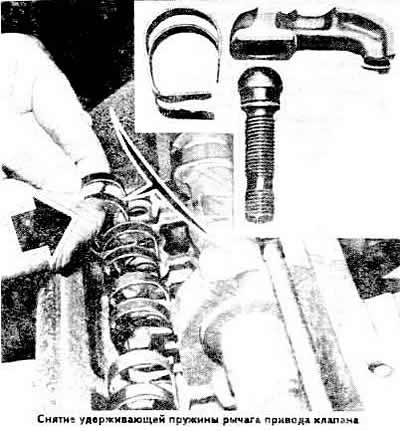
Remove the lever retaining springs and the levers themselves (see photo).


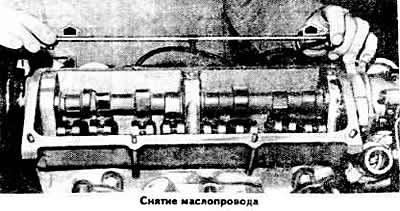
Remove the oil line.

Remove the camshaft from the cylinder head supports.

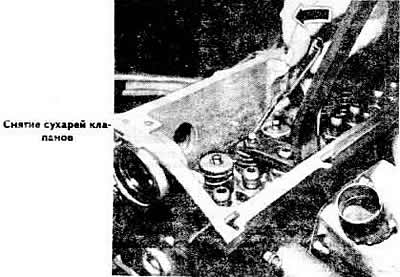
Compress the valve springs with a special device, release the valves from the crackers and remove the valves.

Remove the springs with plates.

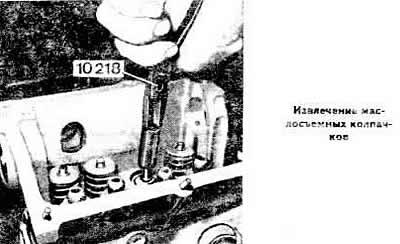
Remove the valve stem oil seals and spring support washers using pliers 10 218.

If the removed parts do not need to be replaced, arrange them in order so that they can be installed in their original place during assembly.

Wash all removed parts with gasoline or trichloroethylene.

Check the degree of wear of the valve guide bushings (for dimensions, see subsection "Design and technical characteristics").

Measure the clearance between the valve stem and the guide bushing using a stand with an indicator. To do this, insert a new valve into the guide bushing so that its stem is level with the edge of the bushing. Place the indicator leg on the valve head and measure the clearance.


If the clearance exceeds the maximum allowable clearance, equal to 1.0 mm for intake valves and 1.3 mm for exhaust valves, replace the cylinder head, since replacement of the guide bushings is not allowed and they are not supplied as spare parts.

Using a ruler, check the non-flatness of the mating surface of the cylinder head (it is best to perform this operation on a surface plate) and sand it if necessary.

Check the condition of the valve springs and valves.

Check the condition of the valve seats and grind them if necessary. Grinding should be carried out only with the help of special equipment and in compliance with the dimensions specified in the subsection "Design and technical characteristics".

If necessary, grind the working chamfers of the inlet valves. The working chamfers of the outlet valves cannot be ground. Wiping the outlet valves is allowed, in other cases they must be replaced.

Before assembly, thoroughly clean the cylinder head.

Assembly


Install the valve spring support washers in place, insert the valves into the guide bushings, having first lightly lubricated the valve stems with engine oil.

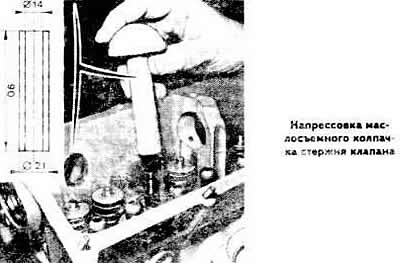
Use the VW 10 204 mandrel to press new valve stem seals onto the guide bushings. To do this, press the valve stem seal into the mandrel hole, press hard on the head of the tool and press the valve stem seal onto the valve stem until it stops. After removing the mandrel, check that the seal is installed correctly.

Install the valve springs and spring retainers. Install the crackers using a valve spring compressor.


Lubricate the bearing journals and camshaft cams with engine oil and install it together with the oil seal.

Install the levers onto the adjusting bolts.

Install the retaining levers by inserting them into the grooves of the adjusting bolts so that the springs rest on the levers.

Note: If the threads on the adjusting bolt bushing are damaged, a Helo-Coli or SEDC type threaded insert bushing can be used.

Using mandrel 10 203, press in the camshaft oil seal.

Install the camshaft toothed pulley and tighten its mounting bolt to a torque of 8 kgf·m.
Install the camshaft toothed pulley and tighten its mounting bolt to a torque of 8 kgf·m.

Install the camshaft toothed pulley and tighten its mounting bolt to a torque of 8 kgf·m.

Install the camshaft toothed pulley and tighten its mounting bolt to a torque of 8 kgf·m.
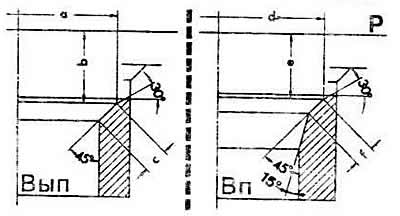

Dimensions for grinding valve seats:

Dimensions for grinding valve seats:
Vp-intake valve seat;
Vyp — exhaust valve seat;
P — mating surface of the cylinder head;
a and d — outer diameter of the working chamfer of the valve seat;
b and e — recess of the working chamfer and valve seat;
c and f are the width of the working chamfer of the valve seat.

c and f are the width of the working chamfer of the valve seat.


(Information obtained from this resource: AUDImanual)
The article was checked by auto expert Georgy Rodionov
This article is available at russian, bulgarian, belarusian, ukrainian, serbian, croatian, romanian, polish, slovak, hungarian

Share information:
Previous articles
Audi 80 B2: Engine FZ
Next articles

Removal and installation the cylinder head
Adjusting the tension of the timing belt
Removal and installation the camshaft drive belt
Replacing the camshaft seal
Removal and installation the engine
Disassembling the engine
Checking the engine
Engine assembly


Similar articles on other Audi car models:
Cylinder head — disassembly, cleaning, inspection and assembly Audi 100 C3 (1982-1990, diesel)
Removal and installation the cylinder head (petrol) Audi A3 Type 8L (1996-2003)
Cylinder head — disassembly, cleaning, inspection and assembly Audi A4 B5 (1994-2001)
Cylinder head — 1.8-I engine (125/150 hp) Audi A6 C5 (1997-2004)
Left cylinder head cover Audi A8 D2 (1994-2002)
Cylinder head Audi Q5 Type 8R (2008-2017)
Cylinder head — design description Audi A2 (1999-2005)
Link to this page in different formats


Visitor comments

No comments yet


How much will 41 + 30 =


80(B4, 1991-1996) 
  • General information
  • User manual
  • Maintenance
  • Troubleshooting
  • Power unit
  • Engine
  • Cooling system
  • Heating and ventilation
  • Petrol injection
  • Diesel fuel system
  • Fuel system
  • Exhaust systems
  • Ignition system
  • Transmission
  • Clutch
  • Car gearbox
  • Chassis
  • Brake system
  • Suspension and steering wheel
  • Body
  • Body and trim
  • Electrical equipment
  • Electrical system
  • Electrical circuits
 
80(B3, 1986-1991) 
  • General information
  • Repair characteristics
  • Maintenance
  • Power unit
  • Gasoline engine
  • Diesel engine
  • Engine lubrication system
  • Fuel system (gasoline)
  • Injection system (gasoline)
  • Fuel system (diesel)
  • Ignition system
  • Cooling system
  • Heater
  • Exhaust system
  • Transmission
  • Clutch and gearbox
  • Chassis
  • Steering
  • Brake system
  • Car suspension
  • Body
  • Body elements
  • Electrical equipment
  • Power devices
  • Lighting and appliances
  • Electrical circuits
 
80(B3, 1986-1991, petrol) 
  • General information
  • User manual
  • Maintenance
  • Power unit
  • Engine 4-cylinder
  • Engine 5-cylinder
  • Cooling system
  • Fuel and exhaust systems
  • Ignition system
  • Transmission
  • Clutch
  • Mechanical transmission
  • Automatic transmission
  • Drive shafts
  • Chassis
  • Brake system
  • Suspension
  • Steering
  • Body
  • Exterior
  • Interior
  • Electrical equipment
  • Equipment and devices
  • Electrical circuits
 
80(B2, 1979-1986) 
  • General information
  • User manual
  • Power unit
  • Engine FZ
  • Engine EP, YP, YZ, DT, DS, DZ
  • Transmission
  • Clutch
  • 4 speed gearbox
  • 5 speed gearbox
  • Front wheel drive
  • Chassis
  • Front suspension
  • Rear suspension
  • Steering
  • Brake system
  • Electrical equipment
  • Equipment and devices
  • Electrical circuits
 
AudiManual.ru © 2017-2026 · Mobile version · Feedback · Sitemap: EN BG BY UA RS HR RO PL SK HU · Site search · News and articles
80 B2 · 80 B3 petrol · 80 B3 · 80 B4 · 100 C3 diesel · 100 C3 petrol · 100 C3 · 100 C4 petrol · 100 C4 · A3 Type 8L · A4 B5 petrol · A4 B5 · A4 B6 petrol · A4 B6 · A4 B7 · A4 B8 · A6 C4 · A6 C5 · A6 C5 Allroad · A8 D2 · Q5 Type 8R · Q7 Typ 4L · Audi A2 ·
This site uses cookies 🍪. Click the button to accept this fact.