



Table of contents: Manual transmission (MT) ↓ Automatic (AT) and continuously… ↓ AT/CVT operating modes ↓ Starting the movement, switching… ↓ Emergency mode ↓
Manual transmission (MT)
The manual transmission is controlled by a gear shift lever located in the center console (22 in illustration 14.1). The diagram of the gear shift lever positions is shown on the lever handle.
Engage reverse gear only after the vehicle has come to a complete stop.
Automatic (AT) and continuously variable (CVT) transmissions
The AT installed on the models under consideration has a manual gear shift function.
CVT "Multitronic" with a V-chain variator allows changing the gear ratio not in steps, but smoothly, which increases comfort and efficiency. CVT, like AT, has a manual gear shift function.
The AT and CVT are controlled using the AT/CVT mode selector lever located in the center console (see illustrations 23.1). Additionally, there are "+" switches on the back of the steering wheel, duplicating the corresponding positions of the selector lever.
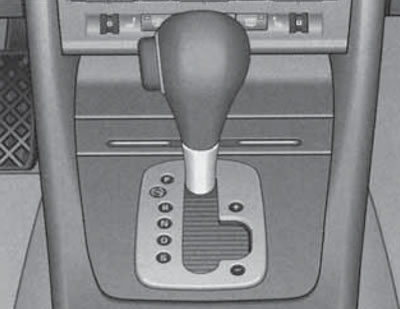
23.1. AT/CVT mode selector lever
In the bottom line of the central display of the instrument cluster (7 in illustration 15.1) in automatic AT/CVT mode, the selected mode is displayed ("P", "R", "N", "D" or "S"), and in manual mode - the engaged gear.
AT and CVT have a "Kick-down" function - the maximum possible gear reduction with the gas pedal fully depressed (with overcoming some resistance at the full throttle point). This function is designed to provide maximum acceleration, for example when overtaking. After shifting to the maximum permissible downshift and accelerating, the AT/CVT will shift to upshifts only when the maximum permissible rpm is reached, until the accelerator pedal is released.
Caution: When downshifting on slippery roads, there is a risk of skidding.
AT/CVT operating modes
"R" (parking mode) should be switched on only after the car has come to a complete stop, since when it is selected the drive wheels are locked; to turn on/off the "P" mode, depress the brake pedal and press the button on the side of the selector lever.
"R" (reverse mode) should be engaged only after the vehicle has come to a complete stop. On CVT models, this mode uses the lowest gear ratio. To engage the "R" mode, depress the brake pedal and press the button on the side of the selector lever.
"N" (neutral mode) may be required to move the vehicle freely (for example, when passing through an automatic car wash or when towing a car). In this mode, the wheels are free to rotate unless the brakes are applied.
"D" (automatic gear shift mode) should be used in most driving situations. In this mode, the forward gears are switched automatically at the optimal moments. To move the selector lever from position "N" to position "D" at a speed of less than 5 km/h or when the car is stationary, you must depress the brake pedal. If the "N" mode was selected while driving, then before engaging the "D" mode, release the gas pedal and wait until the revs drop to idle.
"S" (sports mode). The sport mode is designed for drivers with an energetic driving style. Upshifts are engaged later and downshifts are engaged earlier, which allows the engine power to be fully utilized. On models with automatic transmission, maximum speed is achieved only in this mode. To move the selector lever from the "N" position to the "S" position at a speed of less than 5 km/h or when the car is stationary, you must depress the brake pedal. If the "N" mode was selected while driving, then before engaging the "S" mode, release the gas pedal and wait until the revs drop to idle.
"+" and (manual gear shift mode). Manual mode can be used if the driver wants to shift gears whenever he or she deems it necessary. On CVT models, gears are pre-programmed individual gear ratios. Shifting up or down is only possible at the appropriate engine speed and driving speed (for example, downshifting is not performed at unacceptably high engine speeds - the speed is reduced first).
Starting the movement, switching modes and gears
Caution: Keep the brake pedal depressed until you decide to start moving, because once the drive mode is engaged ("D", "S", "R" or river mode) the car starts moving as soon as the brake pedal is released.
AT/CVT mode switching has the following limitations:
- the "P" mode can only be switched off when the engine is running, the brake pedal is depressed and the button on the selector lever handle is pressed;
- disengaging the "N" mode at a speed of less than 5 km/h or when the vehicle is stationary is also only possible with the brake pedal depressed and the button on the selector lever handle pressed;
- when quickly moving the selector lever through the "N" position (less than 1 second) the selector lever is not locked. This can be used, for example, to rock the car when driving out of mud or snow.
The need to press the brake pedal is indicated by an indicator located between the "P" and "R" position indicators.
To start moving, engage the "D" mode and wait until the clutch is engaged (this can be felt by the engine's thrust and slight jolt). After this, release the brake pedal and then press the gas pedal.
During short stops (for example, at a traffic light or in a traffic jam) to hold the car, it is enough to keep the brake pedal pressed.
When stopping the car for a long time, press the brake pedal, set the parking brake, engage the "P" mode and only then release the brake pedal. Following this sequence of actions reduces the load on the lever locking mechanism in the "P" position and makes it easier to subsequently move the lever out of this mode.
Emergency mode
In case of a malfunction, the AT/CVT switches to the emergency program.
In the emergency mode of the automatic transmission, all indicator segments in the central display light up or go out. The selector lever can be set to all positions. In the "D" and "S" positions, the automatic transmission only works in 4th gear. Manual mode does not work. The electronic lock of the lever in the "R" position also does not work.
On models with CVT, all segments of the indicator light up in the central display. If the indicator lights up in inverse color, you can continue driving, but at the first opportunity, you should carry out diagnostics and repair of the CVT. Flashing of the indicator indicates the presence of a serious malfunction - you should drive to the service station with special care for subsequent repair.