



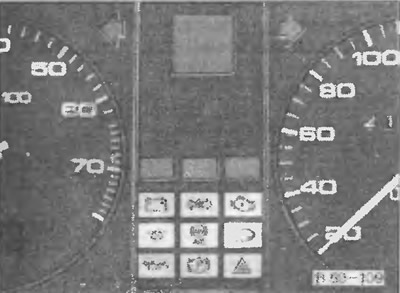
Direction indicator lamps

When the direction indicators are turned on, the indicator lamp flashes.
If any of the direction indicator lamps is faulty or burnt out, the indicator lamp starts to flash twice as fast. This operating principle of the indicator lamp does not apply to the direction indicators of trailer devices.
Generator
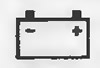
The control lamp lights up simultaneously with the ignition on. After the engine starts, it should go out.
If the indicator light comes on while driving, stop the car immediately, turn off the engine, and check the condition of the alternator V-belt.
If it is torn, you can safely continue driving to the nearest service station. The engine cooling system pump operates autonomously.
At the same time, try to turn off all unnecessary power consumers, since the battery charging has stopped and it may discharge.
If the indicator light comes on and the V-belt is not damaged, seek help from specialists, because the battery charging process is disrupted for some reason.
Trailer direction indicator lamps

The indicator lamp starts flashing simultaneously with the trailer direction indicators. It stops flashing if any of the trailer direction indicators is faulty.
Engine electronics
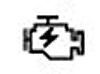
The control lamp lights up immediately after the ignition is turned on. As soon as the engine starts, it goes out.
If this does not happen, or it lights up while driving, then there is a malfunction in the engine's electronic system.
The indicator light also lights up when you fill up with the wrong type of fuel or with a low octane number. It goes out when you reduce the load on the engine.
If the lamp does not go out or lights up again, you should drive to a service station at low speed and seek help from specialists.
Preheating device (diesel only)
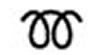
When starting a cold engine, the indicator lamp lights up simultaneously with the ignition being turned on.
If the lamp does not light, the preheater is faulty. You need help from specialists.
As soon as it goes out, start the engine immediately. When starting a hot engine, the control lamp does not light up - the engine can be started immediately.
ABS system

The indicator lamp lights up when the ignition is turned on. It goes out after the engine is started, when the generator indicator lamp goes out and the self-diagnosis cycle is completed.
If, however, the rear axle differential lock is engaged at this time in all-wheel drive vehicles, it will only go out after the lock is disengaged.
If the indicator lamp does not go out or lights up while driving, when the differential lock is on, and the lock itself has not yet occurred, try pressing the system on button again.
If the lamp does not go out this time, then the ABS is faulty. In this case, the car can only be braked using the regular brake system. You need to contact a service station for help as soon as possible.
High beam

The indicator lamp lights up when the high beam or the light signal and siren are switched on.
Oil pressure
For modifications without an automatic control system (Auto-Check-System) the lamp lights up immediately after the ignition is turned on. As soon as the engine starts, it goes out.
If this does not happen or it lights up while driving at an engine crankshaft speed of 2000 rpm and at the same time an inytyi appears that is not typical for the normal operating mode - stop the car, turn off the engine, check the oil level, and top up if necessary.
If the lamp does not go out after this, do not resume driving. The engine should not even idle. The help of specialists is required.
Note: This lamp monitors the oil pressure, not the oil level. Modifications with the automatic control system do not have this lamp.
Coolant temperature/level

The indicator lamp flashes for a few seconds after the ignition is turned on. Functional system control mode.
If the light does not go out after starting the engine or starts flashing while driving, it means one of two things:
- Coolant temperature too high
- Coolant level is critically low
In any case, stop immediately, turn off the engine and check the coolant level. Top up if necessary.
Warning: Risk of scalding! When the engine is hot, the liquid in the cooling system is under pressure. Therefore, before unscrewing the cap of the expansion tank - wait a little, let the engine cool down.
Do not touch the electric fan! It may turn on spontaneously at any time, even when the ignition is off.
If the coolant level is normal, the fan fuse may have blown. Check it and replace it if necessary.
If the light does not go out in this case, you cannot continue driving. You need the help of specialists.
If the probable cause of the malfunction is the fan, and the coolant level is normal and the warning light has gone out, you can drive to the nearest service station on your own. However, since air flow is required to cool the radiator, you should drive quickly and avoid idling the engine.
Parking brake

The control lamp lights up when the ignition is on after the parking brake is applied. After the brake is released, it goes out.
Emergency alarm system

Brake system

The control lamp starts flashing after the ignition is turned on. System self-diagnosis mode.
If the lamp stops blinking and lights up constantly, this is a signal of a critically low brake fluid level. The lamp only works when the ignition is on. If it does not go out or, on the contrary, lights up while driving, this means that the brake fluid level in the expansion tank is below normal. If, in addition, there is an unusual free travel of the brake pedal, there may be a malfunction of the brake cylinders.
Battery voltage is not normal
Contact a service station and check the tension of the V-belt or the condition of the battery.
Windscreen washer fluid level

Add water to the tank.
Fuel reserve
The fuel tank is running low on fuel. See the section "Fueling".