



Table of contents: 1 and 8 - Rotary switch for heated… ↓ 2 - Rear window heating ↓ 3 - Fog lights ↓ 4 - Rear fog lights ↓ 5 - Anti-lock braking system (ABS) ↓ 6 - Trip computer function switch ↓ 7 - Automatic headlight beam… ↓ 8 - Front seat heating control ↓
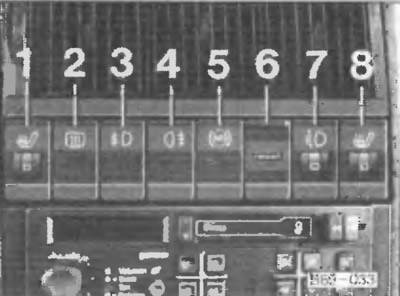
1 and 8 - Rotary switch for heated front seats
When the ignition is on, the front seat cushions and backrests can be heated.
The heating element is switched on and adjusted in steps by turning switch 1 (driver's seat) and - 8 (front passenger seat).
To turn on the heating, turn the switch from position 0 - up and set it to the required temperature mode - scale gradation 1-6. In this case, the selected digital indicator should be illuminated from the inside.
2 - Rear window heating
The rear window heating operates only when the ignition is on. During the heating period, the control lamp built into the switch lights up.
After drying the rear window, the heating should be switched off immediately. Reducing the power consumption has a positive effect on saving fuel consumption.
In vehicles with electrically adjustable exterior rear-view mirrors from inside the vehicle, the mirror surfaces are heated simultaneously with the rear window heating.
Note: Please note. For modifications with antenna devices on the rear window, the two upper heating threads are equipped under the antenna and do not heat up.
3 - Fog lights
The fog lights are switched on simultaneously with the external lighting: parking lights, low beam or high beam. At the same time, the indicator lamp lights up.
Due to the strong blinding effect, it is recommended to use fog lights in strict compliance with traffic regulations.
4 - Rear fog lights
They only turn on when the front fog lights, low beam or high beam are on.
The control lamp lights up in the switch. They must be used in strict compliance with the requirements of the traffic regulations.
5 - Anti-lock braking system (ABS)
Contributes to a significant increase in vehicle stability while driving.
The main advantage of the anti-lock braking system ABS compared to the conventional braking system is that even when braking fully on a slippery section of the road, the wheels do not lock, the stability of control and maximum stability of the car are maintained. When one of the wheels, for example, picks up speed insufficient for the acceleration of the car and is ready to lock, the pressure of the braking system on it is automatically reduced. This regulation process is accompanied by a slight noise and twitching of the brake pedal, this is a kind of warning to the driver that the wheels are on the verge of locking.
In this case, you should immediately reduce speed and change the driving mode of the car taking into account the developing road conditions. This is especially important during icy conditions. In such conditions, even the anti-lock braking system cannot guarantee the stability of the car. Therefore, you should not neglect the usual rules of safe driving.
The ABS system is automatically activated each time the engine is started. If the vehicle is equipped with a rear axle differential lock, the system is automatically activated only after this lock is released.
The ABS operating mode is controlled by a special lamp on the instrument panel. Under normal vehicle operating conditions, the system should operate continuously. Only in exceptional cases would it be preferable to turn it off for a short time.
The system is switched on and off by pressing the ABS button.
Note: When driving on gravel or slippery roads covered with loose snow, when driving is generally only permissible with extreme caution, disabling the ABS system will reduce the required braking distance, i.e. when the wheels lock, an additional lump of gravel or snow accumulates in front of them, increasing the braking efficiency.
At the same time, it should not be forgotten that this reduces the stability of control and the stability of the car. The ABS system is also switched off when:
- checking and repairing the brake system;
- when the rear axle differential lock is engaged.
As soon as the differential lock is disengaged, either manually or automatically after reaching a speed of approximately 25 km/h, the ABS anti-lock braking system will automatically turn on.
6 - Trip computer function switch
The on-board computer only works when the ignition is on.
7 - Automatic headlight beam adjustment
The regulator allows you to adjust the angle of the headlights to match the vehicle load. This reduces the blinding effect of the headlights on oncoming cars. At the same time, the driver is provided with the best possible visibility of the road.
The direction of the light beam is shifted by rotating the rotary control from position "0" downwards.
The following headlight positions correspond approximately to the following vehicle load:
- 0 - a car with two adult passengers and an empty luggage compartment.
- I - a car with passengers according to the number of seats and with an empty luggage compartment.
- II - a vehicle with passengers according to the number of seats and a fully loaded luggage compartment, observing the permissible load standards on the rear axle.
- III - a car with a driver and a fully loaded luggage compartment, observing the permissible load standards on the rear axle.
If the vehicle is towing a trailer or its load differs from the above, intermediate positions of the recommended headlight positions can be selected. When determining the vehicle load, the estimated weight of one passenger or driver is 75 kg.
Note: Stationary adjustment of headlights using special equipment is always carried out only in the initial (main) position of the headlights, marked on the rotary regulator with the number "0".