



Table of contents: Speedometer ↓ Tachometer ↓ 1 - Instrument lighting ↓ 2 - Mechanical watches (diesel cars) ↓ Electronic clock ↓ Fuel gauge ↓ Coolant temperature gauge ↓ Voltmeter ↓ Engine oil pressure gauge ↓ Engine oil temperature gauge ↓
Speedometer
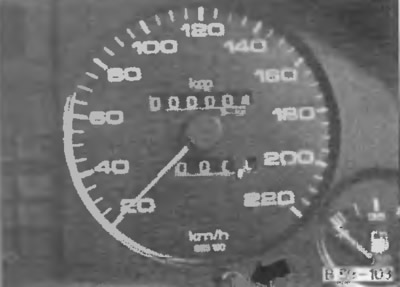
Total and daily mileage counter with reset button.
The last digit of the daily mileage counter after the decimal point corresponds to 100 meters.
The daily mileage counter is reset using the reset button (indicated by an arrow in the figure).
Tachometer
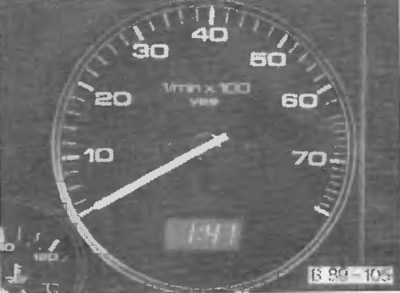
The red sector of the tachometer scale warns that the engine is operating at the maximum permissible crankshaft speed. As soon as the arrow enters this sector, you must release the gas or switch to the next gear.
Timely gear shifting saves fuel and reduces noise.
It is recommended to shift to a lower gear when the engine power is reduced to the maximum, when it no longer pulls in a higher gear.
1 - Instrument lighting
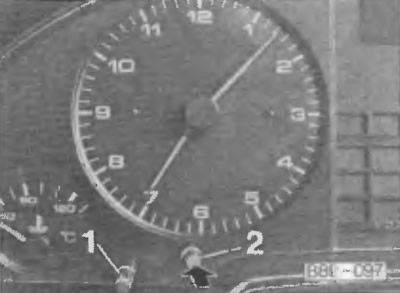
When the lighting is on, the intensity of the instrument and center console illumination is adjusted by a button. Indicated by an arrow.
2 - Mechanical watches (diesel cars)
Corrected by pressing the button under the clock. Indicated by the arrow. By pressing the button briefly, the clock hand moves by one minute. By pressing the button longer, the hour hand slows down, and the minute hand moves faster.
Electronic clock
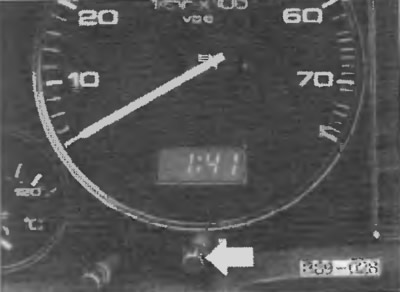
The electronic clock is located at the bottom of the tachometer scale. Time adjustment is performed by turning the regulator to the right or left. The regulator is indicated by an arrow.
Turning to the left sets the hours, turning to the right sets the minutes. For faster adjustments, hold the regulator in the extreme left or right positions, respectively.
The time on an electronic clock can be set to the nearest second. To do this:
- turn the knob to the right and set the appropriate time with a delay of one minute,
- wait for the exact time and once again briefly turn the knob to the right at the moment when the second hand of the exact watch completes a full rotation of a minute or when the exact time signal sounds on the radio.
Fuel gauge
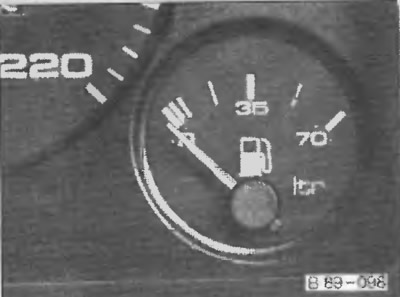
The indicator works only when the ignition is on. The arrow does not set to the working position immediately, but after a short period of time. The fuel tank holds approximately 68 liters of fuel, and the Audi Quattro model holds about 70 liters.
When the arrow enters the "R" sector (fuel reserve) - up to 7 liters of fuel remain in the tank.
Coolant temperature gauge
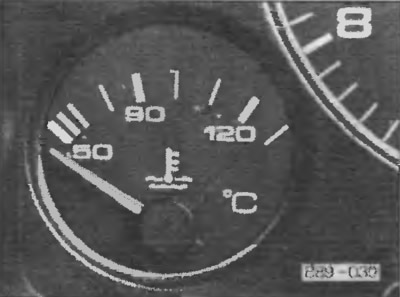
It also works when the ignition is on. The pointer does not take the working position immediately, but after some time.
The left sector of the scale is low temperature
If the arrow is in the left sector of the scale, avoid high revs and do not overload the engine.
The central part of the scale is the normal temperature
The working position of the pointer under normal vehicle operating conditions. Under heavy engine loads, the pointer may move to the right sector. Nothing to worry about, this is normal. Do not pay attention until the coolant temperature indicator lamp flashes.
When the engine load decreases, the arrow will return to the central sector.
Warning symbol of the automatic control system
If the display shows while driving "Auto-Check-System" the coolant temperature symbol is displayed, this means one of two things:
- the liquid temperature is too high,
- the fluid level is critically low. Stop the car slowly, turn off the engine, and find out the cause of the malfunction.
Note: Additional headlights installed in front of the air intakes have a negative effect on the operation of the cooling system. At high air temperatures and high engine loads, there is a risk of overheating. In such a situation, in order to reduce the additional load on the engine, the automatic device switches off the air conditioner. When the coolant temperature drops to the required level, it will start working again.
Voltmeter
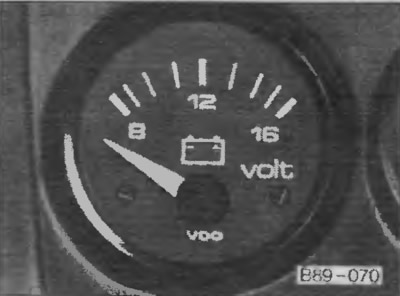
The voltmeter monitors the voltage in the vehicle's electrical system. The normal level is 12 - 15 V.
If the needle deviates into the red sector (below 11 V) when the power consumers are on, this indicates insufficient voltage in the network. The battery charge level should be checked. Such a deviation is acceptable when starting the engine.
Engine oil pressure gauge
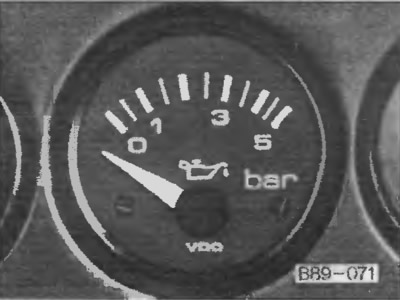
The device monitors the oil pressure in the engine. If during movement the oil pressure drops sharply to 1.8 bar - the control lamp with the symbol will light up on the display and a warning sound signal (buzzer) will sound. In this case - stop the car and turn off the engine.
Check the oil level, top up if necessary. If the oil pressure in the engine is critically low, do not resume driving.
Engine oil temperature gauge
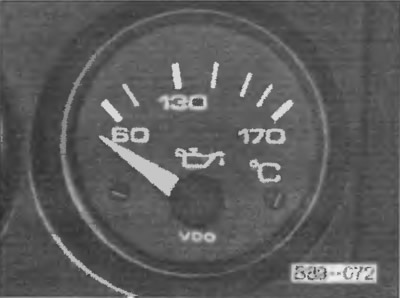
While the oil is cold, do not load the engine at full power. If in rare cases the pointer moves to the upper right sector of the scale, release the gas, reduce the speed, the pointer should return to its normal position.
If it remains in the danger zone, stop the car immediately and turn off the engine, check the oil level. If it is normal, the oil pressure warning light will go out immediately after starting the engine, in this case you can continue driving at low speeds to the nearest service station.