
Repair Chevrolet Repair Toyota Repair Honda Repair AvtoVAZ Repair Mercedes-Benz Repair BMW Repair Opel
Home  |  Contacts  |  Sitemap  |    
English Русский
Български
Беларускі
Український
Српски
Hrvatski
Română
Polski
Slovenský
Magyar
AudiManual.ru


  • AUDI 80
  • AUDI 100
  • AUDI A3
  • AUDI A4
  • AUDI A6
  • AUDI A8
  • AUDI Q
  • OTHER
  • ARTICLES
B8 (2007-2015) B7 (2004-2008) B6 (2000-2006) B6 (2000-2006, petrol) B5 (1994-2001) B5 (1994-2001, petrol)

Checking and replacing spark plugs. Checking the condition of high-voltage wires (Audi A4 B6)

  • Home
  • Audi A4
  • B6 (2000-2006)
  • General information
  • Maintenance
  • Checking and replacing spark plugs. Checking the condition of high-voltage wires
            0
Table of contents: Removal ↓ Engine 2.0 l ↓ Engine 3.0 l ↓ Engine 4.2 l ↓ All engines ↓ Examination ↓ Installation ↓
Please also refer to Section Spark plugs.

Caution: Replace spark plugs only when the engine is cold or slightly warm. If the spark plugs are removed when the engine is hot, the threads of the light metal cylinder head may be stripped.


Before you begin, prepare all the necessary tools. Some spark plug manufacturers supply special tools for measuring the spark plug gap.
  • Spark plug wrench 16 mm, for example, HAZET 4766-1 or AUDI-3122B.
  • If necessary, AUDI T40039 puller for ignition coils.
  • Depending on the number of engine cylinders, the required number of spark plugs. The spark plugs used are listed in Specifications.

The best way to replace spark plugs is to first purchase new plugs, adjust their gap, and replace each plug one at a time. When purchasing spark plugs, it is very important to choose the correct spark plugs for your vehicle's engine. Information about them is provided in Specifications.

With new spark plugs on hand, allow the engine to cool completely before removing the old ones. During this time, you can inspect the new spark plugs for defects and check the spark plug gaps.

Safety precautions: Do not touch high voltage parts. Persons with a pacemaker should not carry out any work on the electronic ignition system.

Removal


1. Turn off the ignition.

2. Remove the top engine cover, refer to Section Removal and installation the upper engine cover/lower engine compartment protection/subframe.


3. Disconnect the spark plug connectors (1) (illustration - 1.6 l engine).
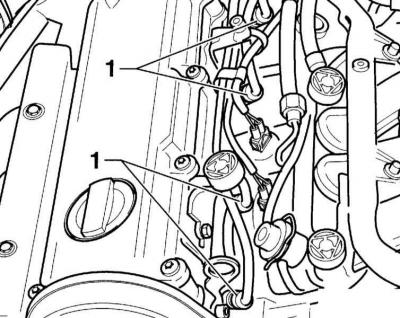
3. Disconnect the spark plug connectors (1) (illustration - 1.6 l engine).


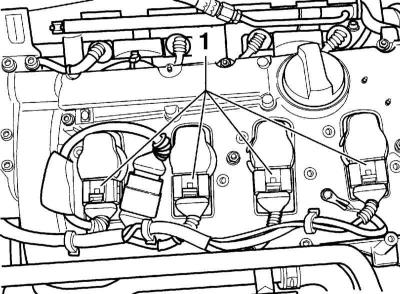
4. Disconnect the connecting plugs (1) of the ignition coils (illustration - 1.6 l engine).

4. Disconnect the connecting plugs (1) of the ignition coils (illustration - 1.6 l engine).

5. Disconnect the rod ignition coils from the spark plugs, for example, using the AUDI T40039 puller.
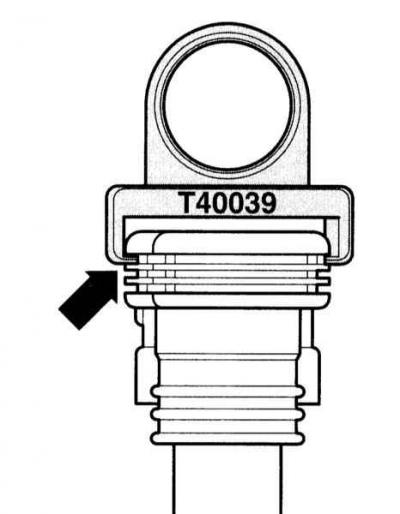
5. Disconnect the rod ignition coils from the spark plugs, for example, using the AUDI T40039…


Warning: Always install the T40039 puller on the top, thickest edge (arrow on the accompanying illustration) ignition coils and pull it up. If installed on the lower edge, it may be damaged.


Engine 2.0 l


1. Remove the bolts (1).
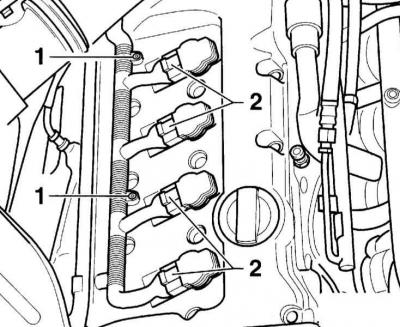
1. Remove the bolts (1).


2. Disconnect the ignition coil connectors (2).

3. Remove the rod ignition coils (3), as on the 1.8 l engine, from the spark plugs, for example, using the T40039 puller.

Engine 3.0 l


1. Remove the upper part of the air filter, refer to Section Removal and installation the air filter.

2. Disconnect the coolant expansion tank from the holder and move it to the side with the hoses attached.

3. Remove the screws (1). The accompanying illustration shows the right row of cylinders.
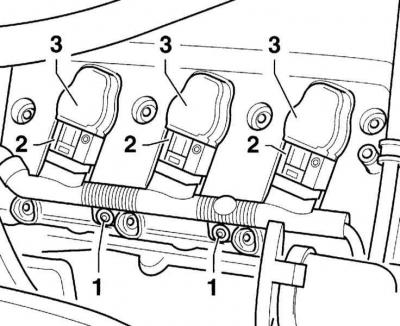
3. Remove the screws (1). The accompanying illustration shows the right row of cylinders.


4. Disconnect the connectors (2) of the ignition coils (3).

5. Disconnect the rod ignition coils (3), as in the 1.8L engine, from the spark plugs, for example using the T40039 puller.

Engine 4.2 l


1. Remove the air filter.


2. Remove the left upper engine compartment cover.

3. Disconnect the coolant expansion tank from the holder and move it to the side with the hoses attached.

4. Remove the screws (1). The accompanying illustration shows the right row of cylinders.
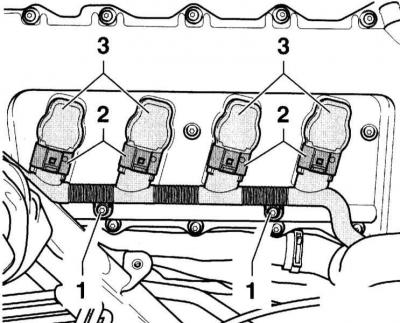
4. Remove the screws (1). The accompanying illustration shows the right row of cylinders.


5. Disconnect the connectors (2) of the ignition coils.

6. Disconnect the rod ignition coils (3), as in the 1.8L engine, from the spark plugs, for example using the T40039 puller.

All engines


1. Remove the spark plugs using a suitable spark plug wrench, such as HAZET 4766-1 or AUDI. Make sure that the spark plug wrench is not tilted. Otherwise, the ceramic insulator may be destroyed.

Examination


1. Compare the removed candle with those shown in the pictures in Chapter Engine electrical systems, this will give you useful information about the general condition of the engine.

2. Check the interelectrode gap with a feeler gauge. The illustrations show a spark plug with one ground electrode. The required gap value is given in Specifications.

Warning: New spark plugs usually have the correct spark gap.


3. To set the distance between the contacts, bend the corresponding ground electrode. To do this, tap it from the side. When bending, lean a small screwdriver against the edge of the thread. Never lean against the central electrode, as it can be damaged.


4. Apply a small amount of copper-based anti-seize compound to the threads of the new spark plug.

Installation


Install the spark plug into the cylinder head and screw it in with your fingers until it stops, then tighten it using the spark plug wrench head.

Warning: To prevent the spark plug from being screwed in incorrectly, place a small piece of rubber hose or plastic tubing on the spark plug stem. The flexible tubing will act as a universal joint, aligning the spark plug with the spark plug socket, and if the spark plug starts to become warped, the hose will slide on it, preventing the threads from being stripped.


If possible, use a torque wrench to tighten the spark plug to ensure it is installed correctly. Spark plug tightening torques are listed in Specifications. If you do not have a torque wrench, tighten new spark plugs by 90°, used spark plugs by 15°. Spark plugs that are tightened too much can damage the threads in the cylinder head when unscrewing. In this case, thread repair is performed using UTC or Heli-Coil inserts.

1. Further installation is carried out in the reverse order of removal.

2. All engines except 1.6L: Install the ignition coils with a slight twist. They should clearly lock into place.

3. 1.6L Engine: Connect the connectors. Then check the reliability of the fastening of the wires and connectors.

4. Reinstall the engine top cover, refer to Section Removal and installation the upper engine cover/lower engine compartment protection/subframe.

(The original article is posted on the resource «AudiManual»)
The article was checked by auto expert Elisey Ermolaev
This article is available at russian, bulgarian, belarusian, ukrainian, serbian, croatian, romanian, polish, slovak, hungarian

Share information:
Previous articles
Audi A4 B6: Maintenance
Next articles

Replacing brake fluid
Replacing the cabin air filter element / carbon air filter
Replacing the emergency power supply battery of the Telematik…
Checking battery condition, care and charging
Replacing the engine air filter element
Replacing the fuel filter
Checking the condition and tension of the toothed belt


Similar articles on other Audi car models:
Replacing/checking generator/voltage regulator brushes Audi 80 B3 (1986-1991)
Checking spark plugs Audi 100 C3 (1982-1990)
Checking and replacing spark plugs Audi A3 Type 8L (1996-2003)
Electrical diagram of high voltage circuit, ignition coil, spark… Audi A6 C5 (1997-2004)
Replacing spark plugs Audi A8 D2 (1994-2002)
Checking the condition and replacing hoses and tubes in the… Audi Q7 Typ 4L (2005-2015, diesel)
Poly V-belt — checking condition (petrol engines) Audi A2 (1999-2005)
Link to this page in different formats


Visitor comments

No comments yet


How much will 22 + 21 =


A4(B8, 2007-2015) 
  • General information
  • Operating instructions
  • Power unit
  • Petrol engines 1.8 l
  • Petrol engines 1.8/2.0 l
  • Petrol engines 3.0 l
  • Petrol engines 3.2 l
  • Fuel system (petrol)
  • Diesel engines 2.0 l (CA*)
  • Diesel engines 2.0 l (CJCB)
  • Diesel engines 2.7/3.0 l
  • Diesel engines 3.0 l
  • Fuel system (diesel)
  • Transmission
  • Manual gearbox 0B1
  • Manual gearbox 0B2
  • Manual gearbox 0B3
  • Manual gearbox 0B4
  • Automatic transmission 0B5
  • Automatic transmission 0B6
  • Automatic transmission 0AW
  • All-wheel drive system
  • Chassis
  • Front suspension
  • Rear suspension
  • Brake system
  • Steering system
  • Body
  • Exterior
  • Interior
  • Seats
  • Doors, locks and windows
  • Security system
  • Heating and air conditioning
  • Electrical equipment
  • Audio system
  • Power devices
  • Equipment and devices
  • Lighting and lamps
  • Electrical circuits
 
A4(B7, 2004-2008) 
  • General information
  • Introduction to manual
  • Troubleshooting
  • Operating instructions
  • Maintenance
  • Power unit
  • Petrol engines 2.0 (ALT)
  • Petrol engines 2.0 (TFSI)
  • Petrol engines 1.8 (MPI)
  • Diesel engines
  • Cooling system
  • Air conditioner
  • Fuel and exhaust system
  • Ignition system
  • Starting and charging
  • Transmission
  • Clutch
  • Manual gearbox
  • Automatic gearbox
  • Drive shafts
  • Chassis
  • Brake system
  • Front suspension
  • Rear suspension
  • Steering
  • Body
  • Exterior
  • Interior
  • Electrical equipment
  • Equipment and devices
  • Lighting and signaling
  • Windscreen wipers and washers
  • Electrical diagrams
  • Electrical diagrams (since 2007)
 
A4(B6, 2000-2006) 
  • General information
  • Vehicle Description
  • User manual
  • Maintenance
  • Power unit
  • Gasoline engine
  • Diesel engine
  • Lubrication system
  • Cooling system
  • Supply system
  • Injection system
  • Exhaust system
  • Ignition and control
  • Transmission
  • Gear box
  • Clutch and drive shafts
  • Chassis
  • Brake system
  • Car suspension
  • Steering
  • Body
  • Heating and ventilation
  • Exterior (external elements)
  • Interior (internal elements)
  • Electrical equipment
  • Power devices
  • Lighting and appliances
  • Electrical circuits
 
A4(B6, 2000-2006, petrol) 
  • General information
  • Introduction to the guide
  • Car care
  • Power unit
  • Engine repair
  • Lubrication system
  • Cooling system
  • Injection and control system
  • Ignition system
  • Power and exhaust system
  • Transmission
  • Clutch and drive shafts
  • Car gearbox
  • Chassis
  • Suspension and wheels
  • Steering
  • Brake system
  • Body
  • Interior
  • Exterior
  • Electrical equipment
  • Equipment and devices
  • Lighting and signaling
  • Power devices
  • Electrical circuits
 
A4(B5, 1994-2001) 
  • General information
  • Introduction to the guide
  • Car care
  • Maintenance (gasoline)
  • Maintenance (diesel)
  • Power unit
  • Gasoline engines
  • Diesel engines
  • Engine overhaul
  • Cooling system
  • Fuel injection (gasoline)
  • Fuel system (diesel)
  • Exhaust system
  • Ignition system
  • Transmission
  • Clutch
  • Mechanical gearbox
  • Automatic gearbox
  • Drive shafts
  • Chassis
  • Brake system
  • Car suspension
  • Steering
  • Body
  • Exterior
  • Interior
  • Doors, locks and windows
  • Heating and ventilation
  • Electrical equipment
  • Power devices
  • Equipment and devices
  • Electrical circuits
 
A4(B5, 1994-2001, petrol) 
  • General information
  • Vehicle description
  • Maintenance
  • Power unit
  • Engine repair
  • Turbocharging
  • Exhaust system
  • Cooling system
  • Ignition system
  • Fuel system
  • Motronic injection system
  • MPI and MPFI injection system
  • Transmission
  • Clutch
  • Gearbox and shafts
  • Chassis
  • Steering
  • Car suspension
  • Brake system
  • Wheels and tires
  • Body
  • Heating and ventilation
  • Body parts
  • Electrical equipment
  • Fuses and relays
  • Power devices
  • Lighting and lamps
  • Tools and devices
  • Electrical circuits
 
AudiManual.ru © 2017-2026 · Mobile version · Feedback · Sitemap: EN BG BY UA RS HR RO PL SK HU · Site search · News and articles
80 B2 · 80 B3 petrol · 80 B3 · 80 B4 · 100 C3 diesel · 100 C3 petrol · 100 C3 · 100 C4 petrol · 100 C4 · A3 Type 8L · A4 B5 petrol · A4 B5 · A4 B6 petrol · A4 B6 · A4 B7 · A4 B8 · A6 C4 · A6 C5 · A6 C5 Allroad · A8 D2 · Q5 Type 8R · Q7 Typ 4L · Audi A2 ·
This site uses cookies 🍪. Click the button to accept this fact.