
Repair Chevrolet Repair Toyota Repair Honda Repair AvtoVAZ Repair Mercedes-Benz Repair BMW Repair Opel
Home  |  Contacts  |  Sitemap  |    
English Русский
Български
Беларускі
Український
Српски
Hrvatski
Română
Polski
Slovenský
Magyar
AudiManual.ru


  • AUDI 80
  • AUDI 100
  • AUDI A3
  • AUDI A4
  • AUDI A6
  • AUDI A8
  • AUDI Q
  • OTHER
  • ARTICLES
B8 (2007-2015) B7 (2004-2008) B6 (2000-2006) B6 (2000-2006, petrol) B5 (1994-2001) B5 (1994-2001, petrol)

Replacing brake fluid (Audi A4 B6)

  • Home
  • Audi A4
  • B6 (2000-2006)
  • General information
  • Maintenance
  • Replacing brake fluid
            0
To carry out the work you will need:
  • Open-end wrench for unscrewing the air bleed nipple.
  • Transparent plastic hose with an internal diameter of 6 mm and a container for collecting brake fluid.
  • The required amount of brake fluid corresponding to the specification.

Warning: Do not reuse used brake fluid. Old brake fluid is significantly darker than fresh fluid. This makes it easy to distinguish between the two.


Brake fluid absorbs moisture through the pores of the brake hoses and the reservoir ventilation hole. As a result, the boiling point of the fluid decreases during operation. Under heavy load on the brakes, this can even lead to vaporization, which reduces the effectiveness of the brakes.

Brake fluid should be replaced every 2 years, preferably in spring. If you frequently drive in mountainous areas, the fluid should be replaced more often.

At the service station, air from the brake system is usually removed using a special device. However, this can be done without using the specified device. In this case, the brake system is bled using the brake pedal. This requires the participation of an assistant.

If the fluid level drops sharply during the process of removing air from the brake system, air is sucked in and enters the ABS pump. In this case, air must be removed at a service station using a special device. When replacing any brake hose, air must also be removed from the system at a service station. Until this is done, the car cannot be used.

Air removal sequence:
  • 1. Rear right support
  • 2. Rear left support
  • 3. Front right support
  • 4. Front left support

Please note the safety precautions when handling brake fluid, refer to Section Bleeding the brake system.


Please note the safety precautions when handling brake fluid, refer to Section Bleeding the brake…


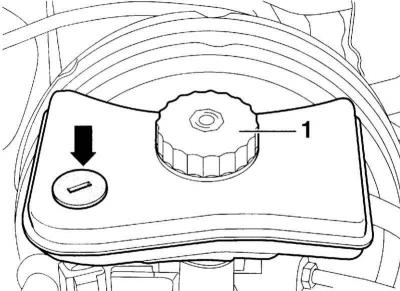
Cover (1) of the brake fluid reservoir and a tube under the screw plug (arrow) for removing brake fluid using a rubber bulb

1. Using a bulb, remove the brake fluid from the reservoir, leaving a layer of liquid approximately 10 mm thick at the bottom of the reservoir. Do not remove all the liquid from the reservoir, otherwise air will enter the brake system.

2. Fill the expansion tank with new brake fluid up to the MAX mark.

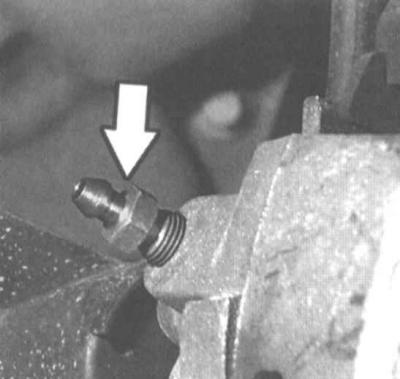
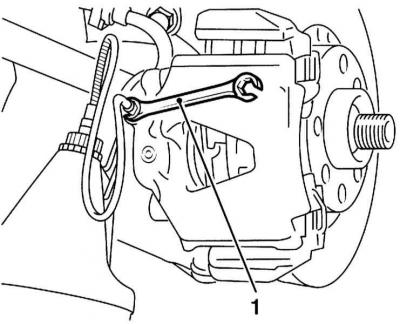
3. Open the air bleed nipple carefully so as not to twist it. It is recommended to treat the nipple with a rust remover 2 hours before bleeding. If the nipple does not open, the operation of bleeding the air from the brake system should be entrusted to a workshop.
3. Open the air bleed nipple carefully so as not to twist it. It is recommended to treat the nipple…


3. Open the air bleed nipple carefully so as not to twist it. It is recommended to treat the nipple…


4. On the right rear disc brake caliper, attach a clean transparent hose to the air bleed nipple and insert it into a suitable container.


5. Ask an assistant to repeatedly press the brake pedal until the counterpressure to pressing the pedal becomes noticeable. Press the pedal and open the air bleed nipple. Close the nipple after the brake pedal rests on the floor of the car body. Remove your foot from the pedal. Repeat this process, pump out approximately 400-500 ml of old brake fluid.

6. Close the air bleed nipple and fill the expansion reservoir with new brake fluid.

7. In the same way, pump out the old brake fluid from the other calipers or wheel brake cylinders, following the sequence indicated above.

Warning: The brake fluid drained must be clean and free of air bubbles. Approximately 400-500 cm³ of old brake fluid must be pumped out of each brake caliper.


8. Dispose of old brake fluid at a special collection point for used fuels and lubricants.

9. Press the brake pedal and check the free travel. It should not exceed 1/3 of the pedal travel.

10. Fill the brake fluid reservoir to the previously existing level.

11. Screw the cap onto the tank.

12. Perform a reliability check:
  • Are the brake lines and hoses secured?
  • Are the brake hoses in the holders?
  • Are the air bleed nipples tightened?
  • Is there enough fluid in the system?

13. With the engine running, check the tightness of the system. To do this, press the brake pedal about 10 times with a force of 200 - 300 N (corresponds to 20 - 30 kg). The brake pedal should not go back. Check all connections for leaks.

14. Finally, check the brakes on a road with light traffic. To do this, you need to make at least one strong braking, checking the ABS operation (a sign of ABS operation is pulsation of the brake pedal when braking).


Warning: Watch out for traffic behind you. The ABS system works best on unpaved roads.


Warning: Do not dispose of brake fluid with household waste or anywhere else.


[The original publication in its entirety is posted on the website: AudiManual.ru]
The article was checked by auto expert Elisey Ermolaev
This article is available at russian, bulgarian, belarusian, ukrainian, serbian, croatian, romanian, polish, slovak, hungarian

Share information:
Previous articles
Audi A4 B6: Maintenance
Next articles

Replacing the cabin air filter element / carbon air filter
Replacing the emergency power supply battery of the Telematik…
Checking battery condition, care and charging
Checking the condition, adjusting and replacing windshield wiper…
Checking and replacing spark plugs. Checking the condition of…
Replacing the engine air filter element
Replacing the fuel filter
Checking the condition and tension of the toothed belt


Similar articles on other Audi car models:
Replacing brake fluid Audi 80 B3 (1986-1991)
Replacing brake fluid Audi 100 C4 (1990-1994, petrol)
Replacing brake fluid Audi A3 Type 8L (1996-2003)
Replacing brake fluid Audi A6 C4 (1994-1997)
Checking the brake fluid level Audi A8 D2 (1994-2002)
Replacing brake fluid, bleeding the brake system Audi Q7 Typ 4L (2005-2015, diesel)
Air filter — cleaning the housing and replacing the filter… Audi A2 (1999-2005)
Link to this page in different formats


Visitor comments

No comments yet


How much will 39 + 23 =


A4(B8, 2007-2015) 
  • General information
  • Operating instructions
  • Power unit
  • Petrol engines 1.8 l
  • Petrol engines 1.8/2.0 l
  • Petrol engines 3.0 l
  • Petrol engines 3.2 l
  • Fuel system (petrol)
  • Diesel engines 2.0 l (CA*)
  • Diesel engines 2.0 l (CJCB)
  • Diesel engines 2.7/3.0 l
  • Diesel engines 3.0 l
  • Fuel system (diesel)
  • Transmission
  • Manual gearbox 0B1
  • Manual gearbox 0B2
  • Manual gearbox 0B3
  • Manual gearbox 0B4
  • Automatic transmission 0B5
  • Automatic transmission 0B6
  • Automatic transmission 0AW
  • All-wheel drive system
  • Chassis
  • Front suspension
  • Rear suspension
  • Brake system
  • Steering system
  • Body
  • Exterior
  • Interior
  • Seats
  • Doors, locks and windows
  • Security system
  • Heating and air conditioning
  • Electrical equipment
  • Audio system
  • Power devices
  • Equipment and devices
  • Lighting and lamps
  • Electrical circuits
 
A4(B7, 2004-2008) 
  • General information
  • Introduction to manual
  • Troubleshooting
  • Operating instructions
  • Maintenance
  • Power unit
  • Petrol engines 2.0 (ALT)
  • Petrol engines 2.0 (TFSI)
  • Petrol engines 1.8 (MPI)
  • Diesel engines
  • Cooling system
  • Air conditioner
  • Fuel and exhaust system
  • Ignition system
  • Starting and charging
  • Transmission
  • Clutch
  • Manual gearbox
  • Automatic gearbox
  • Drive shafts
  • Chassis
  • Brake system
  • Front suspension
  • Rear suspension
  • Steering
  • Body
  • Exterior
  • Interior
  • Electrical equipment
  • Equipment and devices
  • Lighting and signaling
  • Windscreen wipers and washers
  • Electrical diagrams
  • Electrical diagrams (since 2007)
 
A4(B6, 2000-2006) 
  • General information
  • Vehicle Description
  • User manual
  • Maintenance
  • Power unit
  • Gasoline engine
  • Diesel engine
  • Lubrication system
  • Cooling system
  • Supply system
  • Injection system
  • Exhaust system
  • Ignition and control
  • Transmission
  • Gear box
  • Clutch and drive shafts
  • Chassis
  • Brake system
  • Car suspension
  • Steering
  • Body
  • Heating and ventilation
  • Exterior (external elements)
  • Interior (internal elements)
  • Electrical equipment
  • Power devices
  • Lighting and appliances
  • Electrical circuits
 
A4(B6, 2000-2006, petrol) 
  • General information
  • Introduction to the guide
  • Car care
  • Power unit
  • Engine repair
  • Lubrication system
  • Cooling system
  • Injection and control system
  • Ignition system
  • Power and exhaust system
  • Transmission
  • Clutch and drive shafts
  • Car gearbox
  • Chassis
  • Suspension and wheels
  • Steering
  • Brake system
  • Body
  • Interior
  • Exterior
  • Electrical equipment
  • Equipment and devices
  • Lighting and signaling
  • Power devices
  • Electrical circuits
 
A4(B5, 1994-2001) 
  • General information
  • Introduction to the guide
  • Car care
  • Maintenance (gasoline)
  • Maintenance (diesel)
  • Power unit
  • Gasoline engines
  • Diesel engines
  • Engine overhaul
  • Cooling system
  • Fuel injection (gasoline)
  • Fuel system (diesel)
  • Exhaust system
  • Ignition system
  • Transmission
  • Clutch
  • Mechanical gearbox
  • Automatic gearbox
  • Drive shafts
  • Chassis
  • Brake system
  • Car suspension
  • Steering
  • Body
  • Exterior
  • Interior
  • Doors, locks and windows
  • Heating and ventilation
  • Electrical equipment
  • Power devices
  • Equipment and devices
  • Electrical circuits
 
A4(B5, 1994-2001, petrol) 
  • General information
  • Vehicle description
  • Maintenance
  • Power unit
  • Engine repair
  • Turbocharging
  • Exhaust system
  • Cooling system
  • Ignition system
  • Fuel system
  • Motronic injection system
  • MPI and MPFI injection system
  • Transmission
  • Clutch
  • Gearbox and shafts
  • Chassis
  • Steering
  • Car suspension
  • Brake system
  • Wheels and tires
  • Body
  • Heating and ventilation
  • Body parts
  • Electrical equipment
  • Fuses and relays
  • Power devices
  • Lighting and lamps
  • Tools and devices
  • Electrical circuits
 
AudiManual.ru © 2017-2026 · Mobile version · Feedback · Sitemap: EN BG BY UA RS HR RO PL SK HU · Site search · News and articles
80 B2 · 80 B3 petrol · 80 B3 · 80 B4 · 100 C3 diesel · 100 C3 petrol · 100 C3 · 100 C4 petrol · 100 C4 · A3 Type 8L · A4 B5 petrol · A4 B5 · A4 B6 petrol · A4 B6 · A4 B7 · A4 B8 · A6 C4 · A6 C5 · A6 C5 Allroad · A8 D2 · Q5 Type 8R · Q7 Typ 4L · Audi A2 ·
This site uses cookies 🍪. Click the button to accept this fact.