



Table of contents: Air Conditioner Circuit Diagram ↓ Heater body with heat exchanger and… ↓ Elements of the cabin air… ↓ Removal the air conditioner… ↓ Safety precautions when servicing an… ↓
Air Conditioner Circuit Diagram
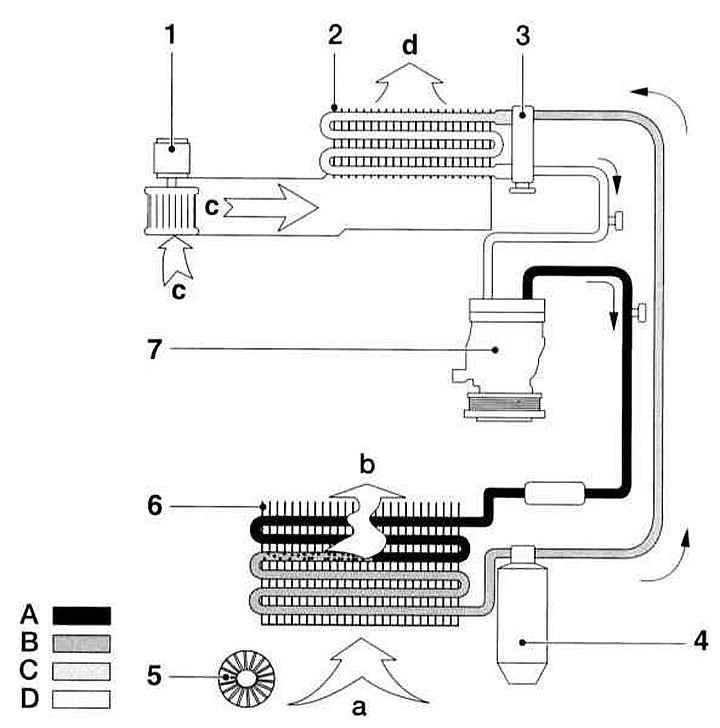
- 1 - Fan
- 2 - Evaporator
- 3 - Expansion valve
- 4 - Reservoir
- 5 — Condenser fan
- 6 - Capacitor
- 7 — Compressor
- a - Outside air for cooling the condenser
- b - Warm air exhausted to the outside
- c - Uncooled air passing through the fan
- d — Cooled air entering the cabin
- A - High pressure, gaseous
- B - High pressure, liquid
- C - Low pressure, liquid
- D - Low pressure, gaseous
Heater body with heat exchanger and additional heater
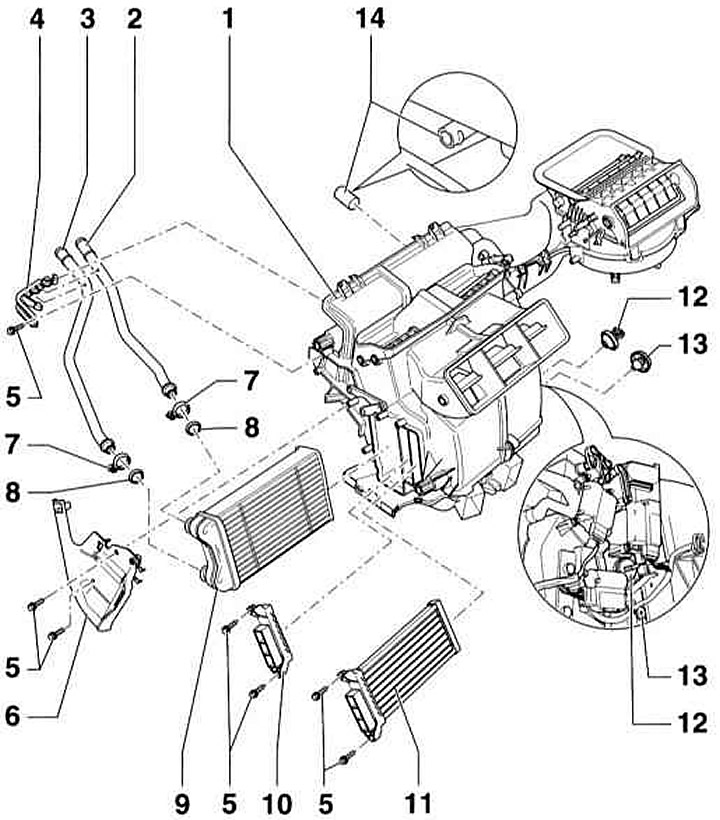
- 1 — Heater
- 2 — Coolant return pipe
- 3 — Coolant supply pipe
- 4 - Coolant pipe holder
- 5 - Bolt
- 6 - Coolant pipe cap
- 7 — Clamps
- 8 - O-ring, be sure to replace
- 9 — Heat exchanger heater
- 10 — Lid (cars without additional heating element). The cover matches the cover of the additional heating element, the passages for the plug are sealed tightly
- 11 — Additional heating element. Only diesel models not equipped with additional fuel-fired heater
- 12 — Cork
- 13 — Cork
- 14 — Plug. Removing condensate from cars with air conditioning
Elements of the cabin air conditioning system
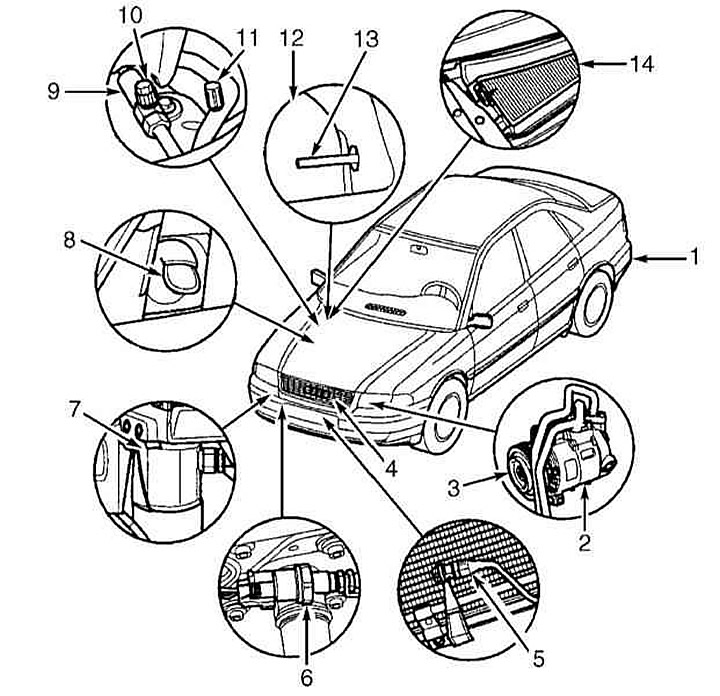
- 1 - Air exhaust fan
- 2 — Compressor K/V
- 3 — K/V coupling
- 4 - Condenser
- 5 — Ambient air temperature sensor
- 6 — K/V pressure sensor
- 7 — Battery
- 8 — Evaporator assembly drain valve
- 9 — Limiter
- 10 — High pressure valve
- 11 — Low pressure valve
- 12 — Air supply/circulation damper
- 13 — Air temperature sensor in the intake air duct
- 14 — Filter
Removal the air conditioner evaporator
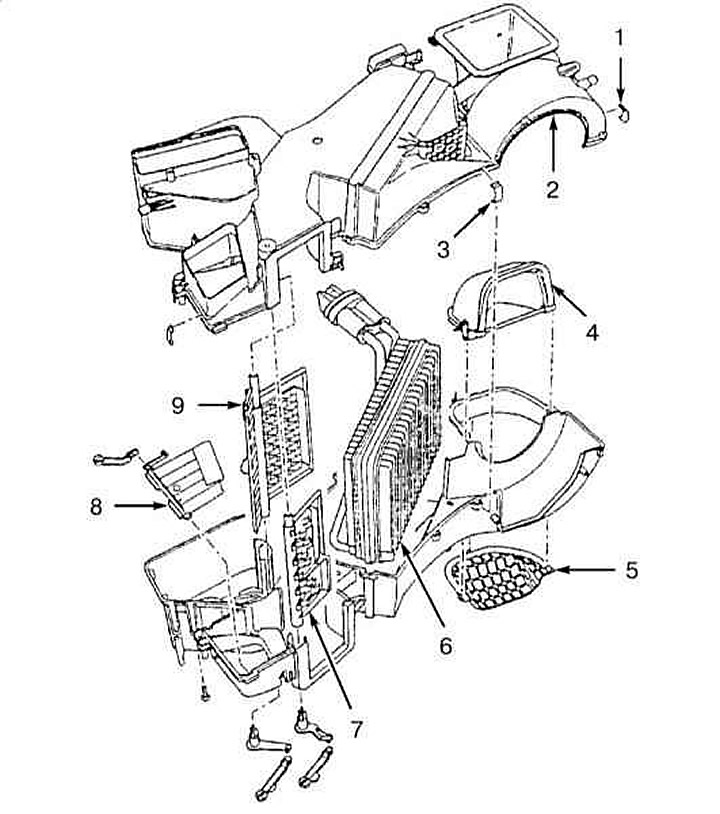
- 1 - Latch
- 2 — Heater housing K/V
- 3 - Latch
- 4 — Air supply/circulation damper
- 5 — Intake air duct mesh
- 6 — Heater radiator
- 7 — Central damper
- 8 — Footwell heating flap
- 9 — Temperature control flap
Please also refer to Section Heater, ventilation and air conditioning.
Work on the air conditioning system must be performed by specialists.
Fresh air for the heating and ventilation system is sucked in by an electric fan. Before entering the cabin, the air is cleaned by coarse and fine filters.
The air conditioner is capable of both heating (in the heater radiator) and cool (in the air conditioner evaporator), and dry the air coming into the cabin. In damp weather, the incoming fresh air is pre-cooled, after which it is heated again to the set temperature. At the same time, condensation of excess moisture in the air occurs, i.e. its drying. This eliminates fogging of the windows.
The air is then distributed through the ventilation nozzles in the vehicle's interior.
Hot coolant from the engine cooling system constantly passes through the heater radiator. To regulate the air flow in the car's interior, the built-in fresh air fan can operate at several stages.
If fresh air from outside should not be sucked in, for example when the air quality is poor, the system can be switched to recirculation mode. In this mode, only the interior air circulates in the cabin. If this continues for a long enough time, the windows inside the cabin will fog up.
The air conditioner consists of a heater and a refrigerator. The air conditioner refrigerator consists of a compressor, condenser, throttle, evaporator, refrigerant tank and pipelines. The system circulates a refrigerant (type R134a), which, depending on the temperature and pressure, can be in a liquid or gaseous state.
Compressor the air conditioner is driven by the engine crankshaft via a ribbed belt. It creates pressure up to 30 atm. in the cooling circuit of the unit, as a result of which the refrigerant, which is a gas, heats up capacitor the refrigerant is cooled by outside air (not coming to the salon).In this case, the heated refrigerant condenses, turning into a liquid. Having high pressure, it is passed through throttle, causing its pressure to drop. The refrigerant then evaporates, cooling down considerably at the same time evaporator the refrigerant takes heat from the air blown through it. The air is cooled. The cooled air enters the car's interior. As a result of heating in the evaporator, the refrigerant turns into gas and enters the compressor under low pressure, after which the circulation process is repeated.
Caution: If additional work is carried out on electrical equipment during the work, it is necessary to disconnect the negative (-) battery cable. To do this, be sure to follow the instructions in Section Replacing the battery.
On diesel models, an additional heating element is installed, which comes into operation at low outside temperatures. The heating element is located directly behind the heat exchanger. After starting the engine, depending on the outside temperature, it heats the cold air entering the car for a few seconds.
If there is a fault in the heater or air conditioning system, it is recorded in the fault memory. The fault reading device can read the information from the memory.
The car can be equipped with an automatic, electronically controlled air conditioner on request, with the driver and front passenger air temperatures regulated separately. Additionally, the refrigeration box, if present in the glove box, can be cooled via a connecting hose running from the air conditioner to the glove box.
The automatic mode automatically maintains the temperature in the cabin and removes moisture from the air. In addition, the air temperature, its quantity and distribution are automatically adjusted and fluctuations in the outside temperature are compensated. In the economy mode, the air conditioner is switched off, but the heater and ventilation system continue to operate. By switching off the air conditioner, the air conditioner compressor does not work, which saves fuel. In diesel engines, additional heating is also switched off. This also leads to fuel savings.
Safety precautions when servicing an air conditioner
The air conditioning system must be serviced only by trained technical personnel who are trained in safe operating practices using the proper equipment, observing depressurization rules, and are familiar with the methods of collecting and storing automotive refrigerant.
- Avoid contact of refrigerant with skin.
- Wear safety glasses when working near the air conditioning system.
- If refrigerant gets on your skin or eyes, do not rub the affected area. Rinse immediately with cold water for at least 15 minutes. Seek immediate medical attention or medical attention. Self-medication is not allowed.
- The refrigerant in a new cylinder is stored under pressure. Store the cylinder at a temperature not exceeding 50°C. Take measures to prevent the cylinder from falling from a height or other situations that may cause damage to it.
- Work should be carried out in a well-ventilated area. The refrigerant evaporates quickly and is odorless. Its accumulation leads to a decrease in oxygen access and difficulty breathing.
- The gaseous refrigerant is heavier than air and should collect relatively quickly at a low level, such as under a car.
- When refrigerant burns, it produces toxic gas. Keep refrigerant away from open flames. Do not smoke. Avoid inhaling smoke when using a flame leak detector.
- When welding near an air conditioning system, exposure to high temperatures or open flames may occur. Overheating may cause pressure in the system to increase and cause a fire.
- Cleaning the condenser or evaporator with water vapor is not permitted. Only cold water or compressed air should be used.