
Repair Chevrolet Repair Toyota Repair Honda Repair AvtoVAZ Repair Mercedes-Benz Repair BMW Repair Opel
Home  |  Contacts  |  Sitemap  |    
English Русский
Български
Беларускі
Український
Српски
Hrvatski
Română
Polski
Slovenský
Magyar
AudiManual.ru


  • AUDI 80
  • AUDI 100
  • AUDI A3
  • AUDI A4
  • AUDI A6
  • AUDI A8
  • AUDI Q
  • OTHER
  • ARTICLES
B8 (2007-2015) B7 (2004-2008) B6 (2000-2006) B6 (2000-2006, petrol) B5 (1994-2001) B5 (1994-2001, petrol)

Bleeding the brake system (Audi A4 B6)

  • Home
  • Audi A4
  • B6 (2000-2006, petrol)
  • Chassis
  • Brake system
  • Bleeding the brake system
            0
If air has entered the brake system, it must be removed. This has to be done, for example, after all work during which brake hoses are removed or brake pipes are opened. As a rule, it is sufficient to remove air only from the brake circuit in which the work was performed.

When bleeding air, you will need fresh brake fluid (specification according to the American standard FMVSS 116 DOT 4) and a transparent hose. In addition, you will need the help of a second person. The car must be on level ground on all four wheels. Attention! During the removal of air, constantly monitor the level of brake fluid in the reservoir! If necessary, add the appropriate amount of fluid to the reservoir. The reservoir must not be empty, otherwise air will get into the system again.

Safety note: If the fluid level in the reservoir drops so low during bleeding that air is sucked in, the air must be bled from the system in a workshop using a special device, as air can get into the hydraulic pump of the anti-lock system. After installing a new brake hose, the air must also be bled in a workshop.

1. If necessary, treat all air valves with rust remover a few hours before bleeding. This reduces the risk of the valves being torn off when loosening.

2. Sequence of operations for removing air: rear right wheel brake cylinder - rear left wheel brake cylinder - front right wheel brake cylinder - front left wheel brake cylinder.

3. Remove the rubber cap from the air valve and clean the valve.
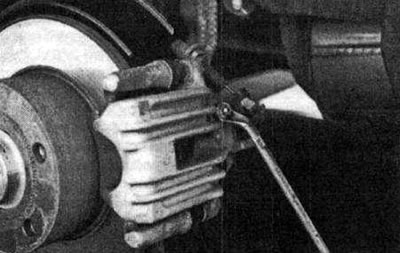
The air valve is best loosened with a ring spanner

The air valve is best loosened with a ring spanner


4. Slide a plastic hose onto the valve and lower the other end of the hose into a container to collect the leaking fluid. The container should be partially filled with brake fluid.
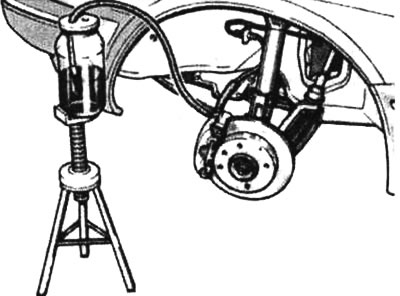
Bleeding the brake system: A transparent hose is attached to the valve. The toxic,…

Bleeding the brake system: A transparent hose is attached to the valve. The toxic, varnish-corrosive brake fluid drains into a container.


5. Use a ring spanner to loosen the valve no more than one turn. At this time, the assistant should slowly press the brake pedal to the floor to pump out the brake fluid and the air contained in it. At the same time, watch the hose and the reservoir - you should see air bubbles. The assistant should hold the pedal to the floor.

6. Close the air valve. Only then can you release the pedal.

7. Repeat this process until no more air bubbles appear. Constantly monitor the fluid level in the reservoir, if necessary, add fluid, but only so much that the initial level is not exceeded. This will prevent a situation where, when the brake pads are replaced later, there is too much brake fluid in the system and the reservoir overflows when the brake cylinder pistons are pressed back. Before performing the next bleeding, wait about three seconds for the master brake cylinder to fill with brake fluid again.


8. After the final pumping, the assistant should hold the pedal to the floor until the air valve is completely closed (do not hit the valve!).

9. Repeat all described operations on other air valves.

10. If the air cannot be completely removed using the method described, close all air valves, start the engine and apply the brake several times. Then repeat the air removal process.

11. Finally, check all brake lines again (are they tightened?), fluid level in the reservoir and brake operation during a test drive. Brake once so that the anti-lock regulation works.
The article was checked by auto expert Alexey Ivanov
This article is available at russian, bulgarian, belarusian, ukrainian, serbian, croatian, romanian, polish, slovak, hungarian

Share information:
Previous articles
Audi A4 B6: Brake system
Next articles

Checking the condition of the brake discs and rotor
Measuring brake lining thickness
Checking the brakes
Checking the brake booster
Brake fluid — description and safety precautions
Replacing brake fluid
Removal and installation the brake fluid reservoir
Brake master cylinder and brake booster


Similar articles on other Audi car models:
Bleeding the brake hydraulic system Audi 80 B2 (1979-1986)
Bleeding the brake system Audi 100 C4 (1990-1994, petrol)
Bleeding the brake system Audi A3 Type 8L (1996-2003)
Bleeding the hydraulic brake system Audi A6 C5 (1997-2004)
Bleeding the hydraulic brake drive Audi A8 D2 (1994-2002)
Replacing brake fluid, bleeding the brake system Audi Q7 Typ 4L (2005-2015, diesel)
Radio or Navigation System Plus — Activating Security Coding Audi A2 (1999-2005)
Link to this page in different formats


Visitor comments

No comments yet


How much will 20 + 49 =


A4(B8, 2007-2015) 
  • General information
  • Operating instructions
  • Power unit
  • Petrol engines 1.8 l
  • Petrol engines 1.8/2.0 l
  • Petrol engines 3.0 l
  • Petrol engines 3.2 l
  • Fuel system (petrol)
  • Diesel engines 2.0 l (CA*)
  • Diesel engines 2.0 l (CJCB)
  • Diesel engines 2.7/3.0 l
  • Diesel engines 3.0 l
  • Fuel system (diesel)
  • Transmission
  • Manual gearbox 0B1
  • Manual gearbox 0B2
  • Manual gearbox 0B3
  • Manual gearbox 0B4
  • Automatic transmission 0B5
  • Automatic transmission 0B6
  • Automatic transmission 0AW
  • All-wheel drive system
  • Chassis
  • Front suspension
  • Rear suspension
  • Brake system
  • Steering system
  • Body
  • Exterior
  • Interior
  • Seats
  • Doors, locks and windows
  • Security system
  • Heating and air conditioning
  • Electrical equipment
  • Audio system
  • Power devices
  • Equipment and devices
  • Lighting and lamps
  • Electrical circuits
 
A4(B7, 2004-2008) 
  • General information
  • Introduction to manual
  • Troubleshooting
  • Operating instructions
  • Maintenance
  • Power unit
  • Petrol engines 2.0 (ALT)
  • Petrol engines 2.0 (TFSI)
  • Petrol engines 1.8 (MPI)
  • Diesel engines
  • Cooling system
  • Air conditioner
  • Fuel and exhaust system
  • Ignition system
  • Starting and charging
  • Transmission
  • Clutch
  • Manual gearbox
  • Automatic gearbox
  • Drive shafts
  • Chassis
  • Brake system
  • Front suspension
  • Rear suspension
  • Steering
  • Body
  • Exterior
  • Interior
  • Electrical equipment
  • Equipment and devices
  • Lighting and signaling
  • Windscreen wipers and washers
  • Electrical diagrams
  • Electrical diagrams (since 2007)
 
A4(B6, 2000-2006) 
  • General information
  • Vehicle Description
  • User manual
  • Maintenance
  • Power unit
  • Gasoline engine
  • Diesel engine
  • Lubrication system
  • Cooling system
  • Supply system
  • Injection system
  • Exhaust system
  • Ignition and control
  • Transmission
  • Gear box
  • Clutch and drive shafts
  • Chassis
  • Brake system
  • Car suspension
  • Steering
  • Body
  • Heating and ventilation
  • Exterior (external elements)
  • Interior (internal elements)
  • Electrical equipment
  • Power devices
  • Lighting and appliances
  • Electrical circuits
 
A4(B6, 2000-2006, petrol) 
  • General information
  • Introduction to the guide
  • Car care
  • Power unit
  • Engine repair
  • Lubrication system
  • Cooling system
  • Injection and control system
  • Ignition system
  • Power and exhaust system
  • Transmission
  • Clutch and drive shafts
  • Car gearbox
  • Chassis
  • Suspension and wheels
  • Steering
  • Brake system
  • Body
  • Interior
  • Exterior
  • Electrical equipment
  • Equipment and devices
  • Lighting and signaling
  • Power devices
  • Electrical circuits
 
A4(B5, 1994-2001) 
  • General information
  • Introduction to the guide
  • Car care
  • Maintenance (gasoline)
  • Maintenance (diesel)
  • Power unit
  • Gasoline engines
  • Diesel engines
  • Engine overhaul
  • Cooling system
  • Fuel injection (gasoline)
  • Fuel system (diesel)
  • Exhaust system
  • Ignition system
  • Transmission
  • Clutch
  • Mechanical gearbox
  • Automatic gearbox
  • Drive shafts
  • Chassis
  • Brake system
  • Car suspension
  • Steering
  • Body
  • Exterior
  • Interior
  • Doors, locks and windows
  • Heating and ventilation
  • Electrical equipment
  • Power devices
  • Equipment and devices
  • Electrical circuits
 
A4(B5, 1994-2001, petrol) 
  • General information
  • Vehicle description
  • Maintenance
  • Power unit
  • Engine repair
  • Turbocharging
  • Exhaust system
  • Cooling system
  • Ignition system
  • Fuel system
  • Motronic injection system
  • MPI and MPFI injection system
  • Transmission
  • Clutch
  • Gearbox and shafts
  • Chassis
  • Steering
  • Car suspension
  • Brake system
  • Wheels and tires
  • Body
  • Heating and ventilation
  • Body parts
  • Electrical equipment
  • Fuses and relays
  • Power devices
  • Lighting and lamps
  • Tools and devices
  • Electrical circuits
 
AudiManual.ru © 2017-2026 · Mobile version · Feedback · Sitemap: EN BG BY UA RS HR RO PL SK HU · Site search · News and articles
80 B2 · 80 B3 petrol · 80 B3 · 80 B4 · 100 C3 diesel · 100 C3 petrol · 100 C3 · 100 C4 petrol · 100 C4 · A3 Type 8L · A4 B5 petrol · A4 B5 · A4 B6 petrol · A4 B6 · A4 B7 · A4 B8 · A6 C4 · A6 C5 · A6 C5 Allroad · A8 D2 · Q5 Type 8R · Q7 Typ 4L · Audi A2 ·
This site uses cookies 🍪. Click the button to accept this fact.