



Table of contents: Brake system ↓ Electronic components of the brake… ↓ The most important parts of the… ↓ What happens when you brake? ↓
Naturally, the A4 needs an effective braking system, because, after all, the maximum speed of the various models ranges from 190 to 245 km/h. The second factor on which the design of the braking system depends is the weight of the car: after all, the kerb weight of an all-wheel drive car with a 3.0-liter engine and Tiptronic gearbox is more than one and a half tons (1,555 kg).
Thus, the brake system cannot do without complex structures, so both the front and rear wheels are equipped with disc brakes. The C54 and FN3 brakes are used as front wheel brakes, and the C38 brakes are used on the rear axle. To improve heat dissipation, the brake discs of the front brakes are ventilated. Good news for car enthusiasts: these brakes do not need to be adjusted.
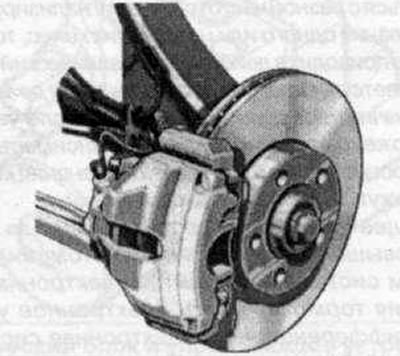
Ventilated brake discs are used at the front
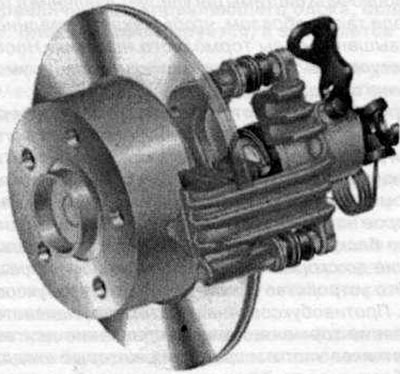
Disc brakes are also installed on the rear axle. The brake caliper has a holder for the handbrake cable
In cars with a petrol engine, the brake booster uses part of the suction pressure generated by the engine. The handbrake acts on the rear wheels via cables.
Brake system
The brake system works as follows. When you press the brake pedal, the push rod, which is connected to this pedal, pushes two pistons located one after the other into the master brake cylinder, which is mounted on the brake booster. The pistons transmit the force of the driver's foot to the brake fluid inside the master brake cylinder. This creates hydraulic pressure, which is transmitted through pipes and hoses to the wheel brake cylinders. On the wheels, the pistons press the brake shoes against the brake discs.
Technical requirements for the operation of non-rail transport stipulate that passenger cars must be equipped with two braking systems that must operate independently of each other. The meaning of this requirement is that if one of the systems fails, the car must be braked by the other system.
This requirement can be met by a dual-circuit braking system with diagonal wheel brakes. In this case, each of the brake circuits is responsible for braking one front and one rear wheel, which is diagonally relative to the front wheel, i.e. on the other side of the car. If one circuit fails, the other front and rear wheels can still be braked by the other circuit. However, in order to achieve the same braking effect as with a functioning brake system, you have to press the brake pedal harder. The pedal is pressed further, and the braking distance increases significantly.
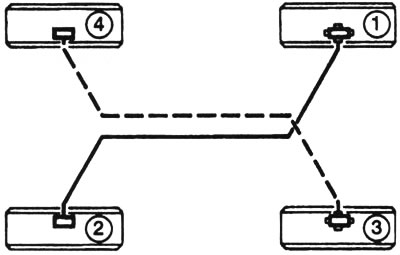
Diagram of a braking system with diagonal arrangement of brake mechanisms: 1 - left front wheel, 2 - right rear wheel, 3 - right front wheel, 4 - left rear wheel.
Electronic components of the brake system
The Audi A4 is equipped with a Bosch 5.7 anti-lock braking system. The anti-lock braking system prevents the wheels from locking during abrupt braking. The advantage of such a system is that the car remains controllable even when fully braking. To this end, the anti-lock braking system distributes the braking force between individual wheels. Braking with wheel locking in its pure form becomes impossible. Malfunctions of the anti-lock braking system do not affect the braking system and the brake booster in any way. The normal braking system continues to operate even without the anti-lock braking system.
The brake force is increased by means of a vacuum brake booster. Thus, when equipped with an anti-lock braking system, the mechanical brake force regulator is no longer needed. A special computer program, according to which the control device operates, ensures the distribution of the brake force on the rear axle. Additional information can be found in the technical dictionary (see the article "Anti-lock braking system in detail").
The most important parts of the braking system
Dual-circuit braking system. Hydraulic system with two brake circuits, each of which acts on one of the front wheels and on the diagonally located rear wheel.
Master brake cylinder. Converts the mechanical force acting on the brake pedal into hydraulic force. Provides a rapid reduction in pressure in the system when the brake is released.
Brake booster. Produces approximately 60 percent of the braking force. In gasoline engines, the required reduced pressure is taken from the intake manifold.
Wheel brake cylinders. The brake fluid pressure here reaches 120 bar. The pistons of the cylinders transmit the pressure to the brake pads (brake pads).
Brake disc. The massive steel wheel is ventilated on the front axle. The brake disc rotates freely in the air flow together with the corresponding front wheel (removes friction heat).
Brake caliper. It sits like a saddle on the brake disc. In the case of a so-called floating caliper brake mechanism, only one brake cylinder piston is needed to press both brake pads against the brake disc.
What happens when you brake?
Pressing the brake pedal. The piston in the brake caliper presses both brake pads against the brake disc (inner and outer brake shoe).
Releasing the brake pedal. The piston seal moves the piston away from the brake disc, and with it the brake caliper. This creates a gap of less than one millimetre between the brake pad and the disc, and the brake disc begins to rotate freely again.