



Table of contents: Hydraulic brake booster ↓ Brake fluid reservoir ↓
The most important recommendations for normal functioning of the system:
New brake pads always require bedding in. This means that during the first 200 km of running, the friction force has not yet reached its maximum level.
Therefore, at this time it is necessary to press harder on the brake pedal.
If necessary, you can brake with the engine, this relieves the brake system to some extent. Braking with the pedal is carried out at short intervals.
When operating a car in rainy weather, when driving through puddles, after washing the car, sometimes in winter conditions, the brake pads and linings need to be dried. To do this, simply press the brake pedal smoothly several times.
This rule also applies to driving on roads sprinkled with technical salt, which after prolonged driving settles on the brake pads and reduces the braking effect.
The wear period of the linings largely depends on the conditions and methods of vehicle operation. Wear increases when driving in the city, over short distances, and when driving in a sporty manner with rapid acceleration and braking.
In such cases, the condition of the brake pads should be checked more often. One of the signs of a brake system malfunction is an increase in the pedal idle travel. If this happens on the road, you can continue driving to the nearest service station under your own power. You just need to take into account the increase in the braking distance and press the pedal harder.
Check the condition and level of the brake fluid regularly. A decrease in the fluid level in the brake system is monitored and warned by a corresponding lamp on the instrument panel.
Hydraulic brake booster
Functions only when the engine is running. Therefore, the car should never coast with the engine off. If the power steering does not work, is faulty, additional physical effort will be required on the brake pedal.
Brake fluid reservoir
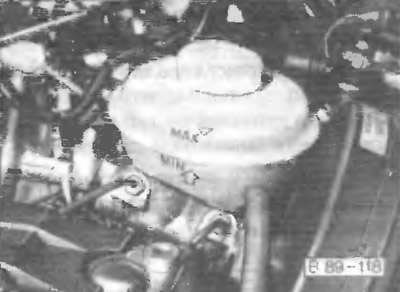
Located in the engine compartment.
Procedure for checking the brake fluid level
The correct brake fluid level is necessary for the normal functioning of the brake system. It should be in an intermediate position between the "max" and "min" marks.
During operation, the liquid gradually decreases to a very small extent. This is a normal phenomenon.
If in a short period of time its level drops noticeably or reaches the "min" mark, the system may be depressurized; you should immediately contact a service station and check the entire system for leaks.
When the brake fluid level is low, the indicator lamp comes on.
Brake fluid
Brake fluid absorbs moisture. Over time, this leads to an increase in the water content, which causes corrosion of the system, reduces the boiling point of the fluid, and in the case of emergency braking, it can evaporate and form vapor locks, reducing the performance and efficiency of the brake system. Therefore, it must be changed every 2 years. The fluid must not be expired and only the specification intended for this model.
[The original publication in its entirety is posted on the website: AudiManual.ru]