Repair Chevrolet Repair Toyota Repair Honda Repair AvtoVAZ Repair Mercedes-Benz Repair BMW Repair Opel
Home  |  Contacts  |  Sitemap  |    
English Русский
Български
Беларускі
Український
Српски
Hrvatski
Română
Polski
Slovenský
Magyar
AudiManual.ru


  • AUDI 80
  • AUDI 100
  • AUDI A3
  • AUDI A4
  • AUDI A6
  • AUDI A8
  • AUDI Q
  • OTHER
  • ARTICLES
B8 (2007-2015) B7 (2004-2008) B6 (2000-2006) B6 (2000-2006, petrol) B5 (1994-2001) B5 (1994-2001, petrol)

Front Body Panel/Lock Bracket — Removal and Installation (Audi A4 B5)

  • Home
  • Audi A4
  • B5 (1994-2001)
  • Body
  • Exterior
  • Front Body Panel/Lock Bracket — Removal and Installation
            0
Table of contents: General information ↓ Removal ↓ Installation ↓ Setting the front panel/lock bracket… ↓

General information


1. The front panel/lock bracket is the name given to the body part mounted in front of the engine compartment. The hood lock mechanism, front bumper, radiator, automatic transmission cooler and headlights are mounted to this body part. The design of the Audi A4 body is such that this body part can be removed without significant disassembly. In addition, the front panel/lock bracket can be moved away from the body a few centimeters, moving it to the "service" position, without disconnecting the various hoses, tubes and wiring that are attached to it. In this position, access to the various components of the engine and engine compartment can be greatly improved.

Removal


2. Disconnect the ground wire from the battery.

Note: If the radio installed in your car has a secret code, make sure you know it before disconnecting the battery. Contact your dealer if in doubt.


3. Remove the front bumper as described in paragraph 3.

4. Loosen the screws and remove the soundproofing panel at the bottom of the engine compartment (Fig. 10.4).
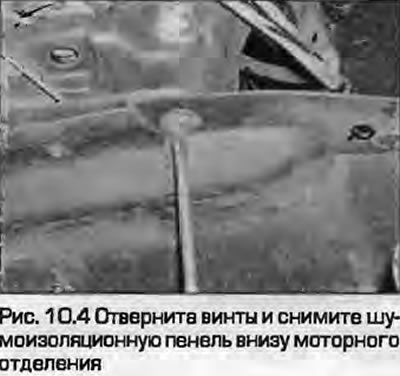

4. Loosen the screws and remove the soundproofing panel at the bottom of the engine compartment…


5. Disconnect the cable from the hood lock as described in paragraph 8.


6. Loosen the mounting screws and disconnect the air intake duct with the grille from the lock bracket (Fig. 10.6).

6. Loosen the mounting screws and disconnect the air intake duct with the grille from the lock…


7. Locate and disconnect the wiring connectors for the headlights, headlight corrector motors, and turn signals in the left corner of the engine compartment (Fig. 10.7). Disconnect the wiring from the outside temperature sensor, which is installed at the lower rear edge of the radiator, closer to the lower hose connection.
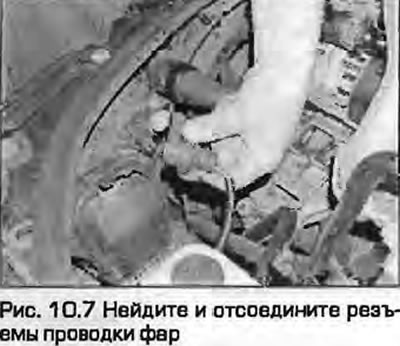
7. Locate and disconnect the wiring connectors for the headlights, headlight corrector motors, and…


8. Drain the coolant as described in the relevant section chapters 1, disconnect the cooling hoses from the radiator as described in paragraph 3 of chapter 3.

9. On models with air conditioning, remove the condenser from the lock bracket and tie it in a suitable place in front of the engine with wire or rope.


Warning: Do not leave the condenser hanging on the tubes to avoid putting stress on them and damaging them.


Caution! Do not disconnect the refrigerant pipes from the condenser (read the warnings in chapter 3, about the dangers of the refrigerant).


10. Remove the power steering fluid cooler and tie it to a suitable location at the bottom of the engine compartment with wire (fig. 10.10). On models with automatic transmission, perform the same operation with the automatic transmission fluid cooler.
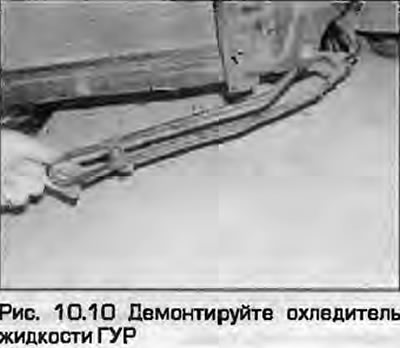
10. Remove the power steering fluid cooler and tie it to a suitable location at the bottom of the…


11. On turbocharged models, remove the mounting screws and remove the intercooler duct from the front panel.

12. Release the front panel seal from both front wings. There is no need to remove the seal from the panel itself.

13. Remove the two bolts securing the front panel to the upper parts of both wings (fig. 10.13).
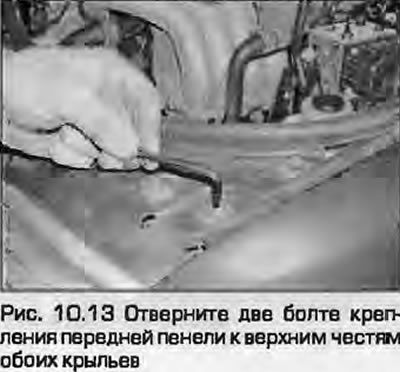
13. Remove the two bolts securing the front panel to the upper parts of both wings (fig. 10.13).


14. Unscrew the bolts (one on each side, located under the front turn signals) panel fastenings to the side of both front fenders (fig. 10.14).
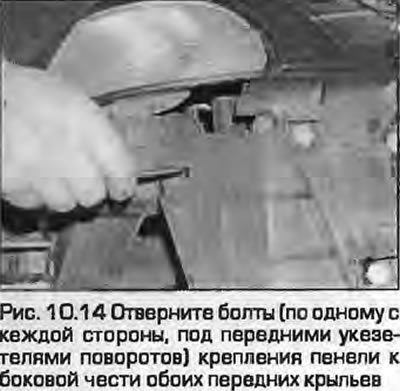


14. Unscrew the bolts (one on each side, located under the front turn signals) panel fastenings to…


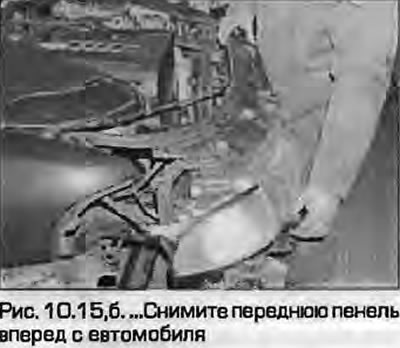
15. For the final stage, you will need an assistant. Unscrew the bolts securing the front bumper mounting pipes (four on the right and three on the left). Remove the front panel forward from the vehicle (fig. 10.15, a, b).
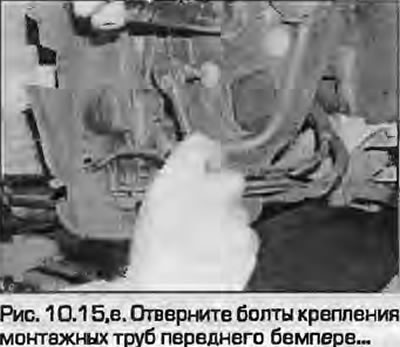
15. For the final stage, you will need an assistant. Unscrew the bolts securing the front bumper…

Installation


16. Installation is the reverse procedure. Check the operation of the front direction indicators, the bonnet lock and the bonnet safety hook. Fill and bleed the cooling system as described in Chapter 1A or 1B. Check the headlight adjustment.


Setting the front panel/lock bracket to the "service" position


Note: To perform this procedure, make two auxiliary studs from a 300 mm long rod and a set of nuts.


17. Disconnect the ground wire from the battery.

Note: If the radio installed in your car has a secret code, make sure you know it before disconnecting the battery. Contact your dealer if in doubt.


18. Remove the front bumper as described in paragraph 9.

19. Unscrew the fasteners and remove the front edge of the noise-insulating panel from the bottom of the front panel. There is no need to remove the panel completely.

20. Loosen the fastening screws and disconnect the air ducts with the grille from the panel.

21. Unscrew the right upper bolt from the right bumper mounting pipe. Screw one of the auxiliary studs into the opened hole and screw a nut onto the end of the stud. Screw the second stud into the hole that is to the left of the left bumper mounting pipe (fig. 10.21).
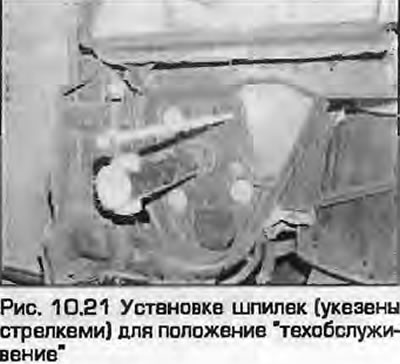
21. Unscrew the right upper bolt from the right bumper mounting pipe. Screw one of the auxiliary…


22. Unscrew the remaining bolts securing the front panel as described in paragraphs 13...15 of the previous section.

23. Carefully pry the front panel away from the engine until the rear two bolts on each side of the top surface of the front panel line up with the first of the two corresponding holes in each fender. Re-tighten the mounting bolts to secure the front panel. Adjust the nuts on the homemade studs so that the panel is secure and does not hang on the top mounting bolts.


24. Installing the panel - reverse procedure. Tighten all threaded fasteners to the specified torques. Check the headlight adjustment.
The article was checked by auto expert Timur Bazhenov
This article is available at russian, bulgarian, belarusian, ukrainian, serbian, croatian, romanian, polish, slovak, hungarian

Share information:
Previous articles
Audi A4 B5: Exterior
Next articles

Rear bumper — removal and installation
Front bumper — removal and installation
Hood lock and lock cable — removal and installation
Hood and air strut — removal, installation and adjustment
Front mudguards — removal and installation
Side mirrors and their components — removal and installation


Similar articles on other Audi car models:
Rear door lock — removal and installation Audi 80 B3 (1986-1991, petrol)
Hood Lock Cable — Removal, Installation and Adjustment Audi 100 C3 (1982-1990, diesel)
Removal and installation the hood lock panel Audi A3 Type 8L (1996-2003)
Instrument panel — removal and installation Audi A6 C5 Allroad (1999-2005)
Removal and installation the engine Audi A8 D2 (1994-2002)
Removal and installation bumpers and trim above the front panel Audi Q7 Typ 4L (2005-2015, diesel)
Removal and installation the trunk lock bracket Audi A2 (1999-2005)
Link to this page in different formats


Visitor comments

No comments yet


How much will 29 + 33 =


A4(B8, 2007-2015) 
  • General information
  • Operating instructions
  • Power unit
  • Petrol engines 1.8 l
  • Petrol engines 1.8/2.0 l
  • Petrol engines 3.0 l
  • Petrol engines 3.2 l
  • Fuel system (petrol)
  • Diesel engines 2.0 l (CA*)
  • Diesel engines 2.0 l (CJCB)
  • Diesel engines 2.7/3.0 l
  • Diesel engines 3.0 l
  • Fuel system (diesel)
  • Transmission
  • Manual gearbox 0B1
  • Manual gearbox 0B2
  • Manual gearbox 0B3
  • Manual gearbox 0B4
  • Automatic transmission 0B5
  • Automatic transmission 0B6
  • Automatic transmission 0AW
  • All-wheel drive system
  • Chassis
  • Front suspension
  • Rear suspension
  • Brake system
  • Steering system
  • Body
  • Exterior
  • Interior
  • Seats
  • Doors, locks and windows
  • Security system
  • Heating and air conditioning
  • Electrical equipment
  • Audio system
  • Power devices
  • Equipment and devices
  • Lighting and lamps
  • Electrical circuits
 
A4(B7, 2004-2008) 
  • General information
  • Introduction to manual
  • Troubleshooting
  • Operating instructions
  • Maintenance
  • Power unit
  • Petrol engines 2.0 (ALT)
  • Petrol engines 2.0 (TFSI)
  • Petrol engines 1.8 (MPI)
  • Diesel engines
  • Cooling system
  • Air conditioner
  • Fuel and exhaust system
  • Ignition system
  • Starting and charging
  • Transmission
  • Clutch
  • Manual gearbox
  • Automatic gearbox
  • Drive shafts
  • Chassis
  • Brake system
  • Front suspension
  • Rear suspension
  • Steering
  • Body
  • Exterior
  • Interior
  • Electrical equipment
  • Equipment and devices
  • Lighting and signaling
  • Windscreen wipers and washers
  • Electrical diagrams
  • Electrical diagrams (since 2007)
 
A4(B6, 2000-2006) 
  • General information
  • Vehicle Description
  • User manual
  • Maintenance
  • Power unit
  • Gasoline engine
  • Diesel engine
  • Lubrication system
  • Cooling system
  • Supply system
  • Injection system
  • Exhaust system
  • Ignition and control
  • Transmission
  • Gear box
  • Clutch and drive shafts
  • Chassis
  • Brake system
  • Car suspension
  • Steering
  • Body
  • Heating and ventilation
  • Exterior (external elements)
  • Interior (internal elements)
  • Electrical equipment
  • Power devices
  • Lighting and appliances
  • Electrical circuits
 
A4(B6, 2000-2006, petrol) 
  • General information
  • Introduction to the guide
  • Car care
  • Power unit
  • Engine repair
  • Lubrication system
  • Cooling system
  • Injection and control system
  • Ignition system
  • Power and exhaust system
  • Transmission
  • Clutch and drive shafts
  • Car gearbox
  • Chassis
  • Suspension and wheels
  • Steering
  • Brake system
  • Body
  • Interior
  • Exterior
  • Electrical equipment
  • Equipment and devices
  • Lighting and signaling
  • Power devices
  • Electrical circuits
 
A4(B5, 1994-2001) 
  • General information
  • Introduction to the guide
  • Car care
  • Maintenance (gasoline)
  • Maintenance (diesel)
  • Power unit
  • Gasoline engines
  • Diesel engines
  • Engine overhaul
  • Cooling system
  • Fuel injection (gasoline)
  • Fuel system (diesel)
  • Exhaust system
  • Ignition system
  • Transmission
  • Clutch
  • Mechanical gearbox
  • Automatic gearbox
  • Drive shafts
  • Chassis
  • Brake system
  • Car suspension
  • Steering
  • Body
  • Exterior
  • Interior
  • Doors, locks and windows
  • Heating and ventilation
  • Electrical equipment
  • Power devices
  • Equipment and devices
  • Electrical circuits
 
A4(B5, 1994-2001, petrol) 
  • General information
  • Vehicle description
  • Maintenance
  • Power unit
  • Engine repair
  • Turbocharging
  • Exhaust system
  • Cooling system
  • Ignition system
  • Fuel system
  • Motronic injection system
  • MPI and MPFI injection system
  • Transmission
  • Clutch
  • Gearbox and shafts
  • Chassis
  • Steering
  • Car suspension
  • Brake system
  • Wheels and tires
  • Body
  • Heating and ventilation
  • Body parts
  • Electrical equipment
  • Fuses and relays
  • Power devices
  • Lighting and lamps
  • Tools and devices
  • Electrical circuits
 
AudiManual.ru © 2017-2026 · Mobile version · Feedback · Sitemap: EN BG BY UA RS HR RO PL SK HU · Site search · News and articles
80 B2 · 80 B3 petrol · 80 B3 · 80 B4 · 100 C3 diesel · 100 C3 petrol · 100 C3 · 100 C4 petrol · 100 C4 · A3 Type 8L · A4 B5 petrol · A4 B5 · A4 B6 petrol · A4 B6 · A4 B7 · A4 B8 · A6 C4 · A6 C5 · A6 C5 Allroad · A8 D2 · Q5 Type 8R · Q7 Typ 4L · Audi A2 ·
This site uses cookies 🍪. Click the button to accept this fact.