



Table of contents: Input signals ↓ Controlling the gear shifting process ↓ Self-diagnosis ↓ Emergency move ↓ Emergency move ↓ Checking the automatic transmission ↓ Evaluation of the gear shifting… ↓
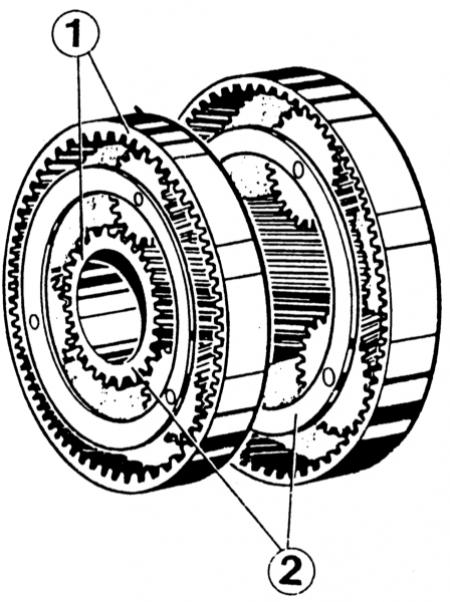
In a planetary gear, all gears are permanently engaged. The various stages of transmission are achieved without interruption of traction by driving or holding the sun wheel, planet gears or the planetary ring gear.
- 1 - parts set in motion;
- 2 - retained parts.
Input signals
The electronic control unit receives information from:
- selector lever with multi-function position switch. The lever setting controls the switching on of the reversing lights, the starter locking mechanism when the gear range is engaged, and also the switching on/off of the speed control device;
- potentiometer of the throttle valve about its position. This unit, known from injection, is used to calculate the points of gear shifting;
- speed sensor in the gearbox to determine the speed of movement, as well as the gear shift points. If this sensor is faulty, then the signal from the Hall sensor is taken;
- sensor on the number of revolutions at the input of the gearbox. Also located on the gearbox and serves to determine the gear shift points;
- accelerator sensor in throttle cable; it gives a signal when the accelerator pedal is fully depressed. After that, you switch to a higher gear or, if necessary, switch down by one or two gear ratio ranges;
- brake light switch to release the electromagnetic lock of the selector lever. The selector lever moves from the "P" or "N" position to one of the gear ratio change ranges only when the brake pedal is pressed;
- aTF temperature sensor in the gearbox. When the engine control unit receives a signal "increased temperature", in certain ranges of gear ratio change, switching to a higher level occurs. This reduces the gap in the torque converter and reduces the ATF temperature - only then does switching to the standard program occur.
Controlling the gear shifting process
When you move the selector lever to position "D", the ATF under pressure flows into the so-called shift flaps in the gearbox, which in turn hydraulically control the multi-plate clutches and brakes. The control unit regulates the pressure via electromagnetic valves and thus determines the moment of shifting up or down as well as the shift transitions. At the same time, there is a connection with the ignition/injection control unit - when shifting up, the ignition timing is slightly delayed to ensure smooth shifting.
The signals from the control unit are then sent to the selector lever lock solenoid, the combined starter lock relay and the reversing lights. If the Audi A4 is equipped with a cruise control system, the automatic transmission control unit supplies voltage to it only when the forward gear ratio range is engaged and a speed of 30 km/h is exceeded for the first time.
Self-diagnosis
The electronic gearbox control unit can recognize emerging defects and store them in the computer. The resulting failures are stored in a long-term memory device. The memory device can be interrogated in the workshop. This is done using a reading device; unfortunately, there is no possibility for an amateur to interrogate the computer. If you suspect a malfunction in the gearbox control, you will only be able to read the computer memory in an Audi workshop.
Emergency move
4-speed automatic transmission
If the control unit has detected a defect that has a significant negative impact on operation, or the control unit itself is faulty, the "emergency running" mode is activated. There are two emergency programs for this:
- If the selector lever is in position "D", "3" or "2", the gearbox hydraulically engages 3rd gear. The selected gear ratio range is only engaged in selector lever positions "1" and "R".
- If the engine speed and speed signal are not received and the accelerator pedal is pressed for the first time above the value ѕ, the gearbox switches to the "N" stage, i.e. there is no more drive. By switching off the ignition and restarting the engine, you can try to reactivate the gearbox.
Emergency move
Gearbox 5-NR-18
The gearbox has different emergency running modes depending on the nature of the fault:
- In case of a minor failure, the movement is carried out using a different gear shift program.
- If there is a defect in the mechanical part of the gear shift unit, the gearbox remains engaged in the 4th gear while driving. Then, after the engine is turned off, only the 3rd gear ratio range is engaged.
Checking the automatic transmission
An automatic transmission leaves almost no room for initiative for the enthusiast. But a targeted check will help to localize the malfunction, which is of interest not least when buying a used car:
- If there is a fault, first check the ATF level in the gearbox.
- If the ATF on the dipstick smells burnt, there is severe damage to the gearbox. In this case, the brake bands or clutch plates may be defective.
- During a test drive, you can check the gear shift points.
- The way the gear shifting process occurs provides information about the state of the gearbox.
- Adjusting the throttle cable with integrated throttle response is essential for perfect operation.
- The same applies to adjusting the selector lever cable.
Evaluation of the gear shifting process
During your test drive, you may want to pay attention to the gear shifting process:
Upshifting: With the accelerator pedal partially depressed, the gear change is barely noticeable; at full throttle or when the accelerator pedal is pressed sharply, the transitions become more distinct, but the higher gear should always engage smoothly. A brief increase in engine speed when changing gear indicates a defect that should be examined more closely.
Downshifting: No Gas (when rolling) barely noticeable at very low speeds. A jolt when shifting into reverse at partial or full throttle is normal. Reverse shifting without throttle using the selector lever lasts one to two seconds. If, when forcibly shifting back using the selector lever, the throttle is simultaneously added, the gear shift occurs without slowing down.
Tip: Cars with automatic transmission should not be towed for more than 50 km, otherwise the gearbox will not be lubricated sufficiently. For the same reason, the speed should not exceed 50 km/h. When towing, the selector lever should be in the "N" position. In case of doubt, choose a more convenient route and load the car.
(The original article is located on the online resource: audimanual)