



Table of contents: Basic principles of operation ↓ Torque converter ↓
The Audi A4 uses two different models of automatic transmission: firstly, the VW-developed "AG-4" transmission for the four-cylinder engine without turbocharging, and secondly, the ZF-designed "5 HP 18" transmission for the six-cylinder engine. As is already clear from the designation, in one case it is a four-speed transmission, in the other case - a five-speed transmission.
Both gearboxes are controlled electronically and hydraulically, and this control works depending on various input parameters (engine speed, travel speed, load, etc.), when the next gear is engaged. In addition, the control recognizes the driver's driving style and sets the gear shift points from "sporty" to "economical" without having to operate a single switch. The entire system is called DSP - Dynamic Schalt-Programm (dynamic gear shift program). In addition, when selecting a gear, the terrain is taken into account - i.e. the automatic transmission selects a gear shift mode on a flat road that differs from driving on a mountain road.
Basic principles of operation
The basic link of all automatic transmissions are the so-called planetary sets. They consist of a pinion around which three other pinions rotate. On top of this there is a ring with internal teeth. Each pair of these elements is connected into a set of toothed pinions and forms its own small two-speed gearbox. The ingenious thing about these gearboxes is the way they shift. The gear shift is carried out by holding or releasing the parts of the planetary set. This is done without interrupting the flow of force. Holding and releasing are provided by plate clutches and plate brakes with hydraulic drive.
To obtain a multi-stage gearbox, two planetary sets are connected in series. With the correct arrangement of gears, a four- or five-speed gearbox with a reverse gear is formed. Coordination of the gear sets is ensured by the gearbox control.
Torque converter
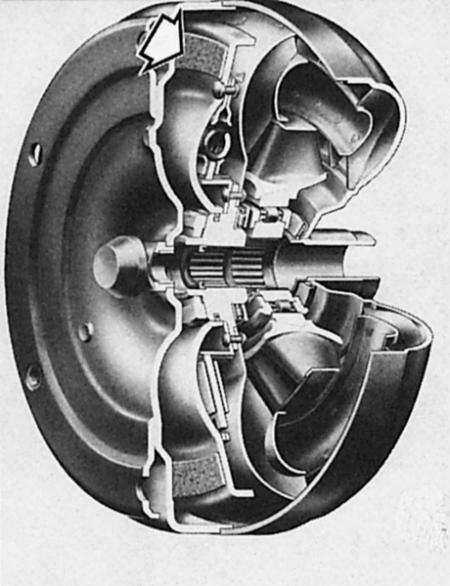
The photo of the torque converter in section clearly shows the turbine and idler blades. The arrow points to the friction lining of the torque converter clutch, which - except when the ATF is cold - switches to hard power transmission from high speeds to prevent "play".
The engine power is transmitted to the gearbox by means of a fluid. The engine drives the turbine in the torque converter. The fluid in the torque converter, set in rotation, can also drive the turbine wheel connected to the gearbox via a vane guide device located between them. There is always a difference in the number of revolutions between the turbine, rotating in accordance with the engine speed, and the turbine wheel at the input of the gearbox. At the beginning of the movement it is the largest, as the speed increases, the difference in the number of revolutions between the pump turbine and the gearbox turbine decreases. But in a traditional automatic gearbox, there is still some "gap". In our gearboxes, the torque converter is bridged in the range of 3rd and 4th gear and in 4th and 5th, i.e. there is a rigid connection between the engine and the automatic gearbox. This helps to reduce fuel consumption.
The original publication in its entirety is posted on the website audimanual.ru