



Thermostat
|
Signs
|
Cause/consequence
|
| A. The temperature rises slowly, operational temperature reached late, insufficient heating effect | The thermostat valve plate is locked in the "open" position (German:. "Offen") (for example, due to sediment); constant flow of liquid to the radiator open. The engine runs too long in a cold state. But for for a short period of time it does not cause harm. Despite this, as soon as possible change the thermostat. |
| B. The temperature indicator arrow is deflected to the right limit, despite the correct coolant level, the control light flashes coolant light. Radiator and lower hose going to radiator, cold. | The thermostat valve plate is locked in the "closed" position (German. "Geschlossen") (for example, due to a defective or leaky box thermostat). Do not continue the trip under any circumstances, otherwise serious heat damage to the engine! Replace the thermostat immediately. |
Advice: If the engine boils on the road due to a faulty thermostat, only towing or complete removal of the thermostat on site will help. If you decide to remove the thermostat, you should first wait until the coolant temperature drops.
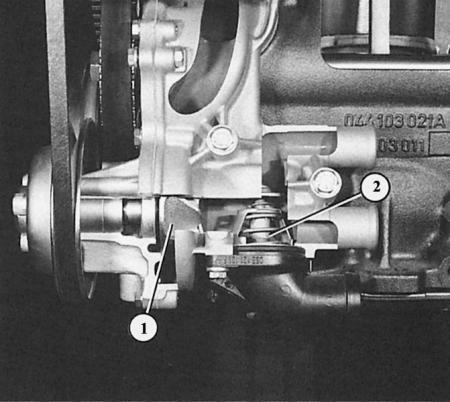
Four-cylinder engine: The internal structure of the water pump and thermostat is shown here (in section). The impeller (1) of the water pump is clearly visible. The thermostat (2) is located nearby.
On a six-cylinder engine, the thermostat housing (arrow) is located on the right side in front of the engine block.
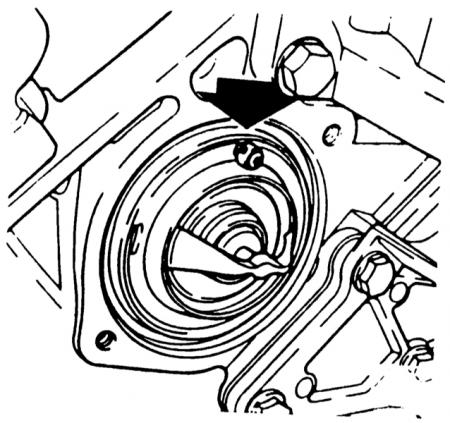
The figure shows the installation position of the thermostat on a four-cylinder engine. The air valve (arrow) must be turned upwards.
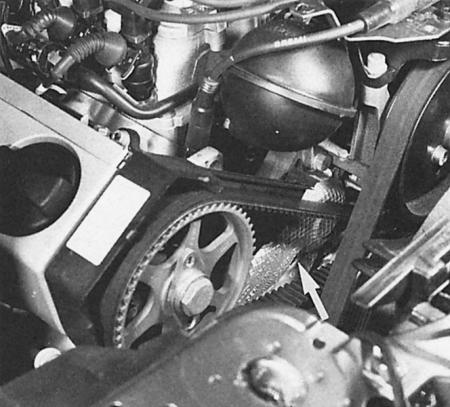
Removal the thermostat
A jammed thermostat is very difficult to remove on the road. It is located quite far down, so you need to drain almost all the coolant. Also, with a hot engine, it will take quite a while before you can start working without the fear of burning your hands. When installing a new thermostat, you also need to replace the sealing ring on the thermostat housing and the water pump.
1. For all models: Drain the coolant completely.
2. Four-cylinder engine: remove the lower engine compartment trim (Chapter Body parts).
3. Unscrew the hose at the bottom of the water pump body (what has already been done to drain the coolant).
4. Unscrew the two bolts at the bottom of the thermostat housing cover.
5. Remove the cover and thermostat.
6. Six-cylinder engine: remove the V-belt, dismantle the tensioner.
7. Remove the timing belt cover (Chapter Engines). The toothed belt itself remains in place.
8. Remove the coolant supply hose to the radiator at the bottom of the hose fitting on the thermostat housing.
9. Unscrew the two bolts on the thermostat housing cover.
10. Carefully lift the timing belt over the thermostat housing bridge and remove the housing.
11. Remove the thermostat.
12. For all models: When installing a new thermostat, its small sealing plate must be facing the engine.
13. For six-cylinder engine only: The air valve in the outer ring of the thermostat must face upward.
14. Replace the sealing ring.
15. Tighten the bolts on the thermostat housing and water pump to a tightening torque of 10 Nm.
Checking the Thermostat
With the built-in thermometer, you can check for yourself whether the thermostat opens at the set temperature.
|
Beginning of the opening
|
End of opening
|
Min. opening stroke
|
|
About 87°C
|
About 102°C
|
About 8 min
|
1. Remove the thermostat.
2. Hang the thermostat in a container of water and heat the water.
3. Check if the valve head rises in the seat when the temperature reaches 87°C.
4. During this check, the end of opening may not be fully reached (as is known, water in an open container boils at approximately 100°C), but it is still visible whether the thermostat opens further.
5. But the total length of the opening stroke is almost reached. But what is visible is already enough to determine a defective thermostat.
6. If there is the slightest doubt about the thermostat's serviceability, replace it.