
Repair Chevrolet Repair Toyota Repair Honda Repair AvtoVAZ Repair Mercedes-Benz Repair BMW Repair Opel
Home  |  Contacts  |  Sitemap  |    
English Русский
Български
Беларускі
Український
Српски
Hrvatski
Română
Polski
Slovenský
Magyar
AudiManual.ru


  • AUDI 80
  • AUDI 100
  • AUDI A3
  • AUDI A4
  • AUDI A6
  • AUDI A8
  • AUDI Q
  • OTHER
  • ARTICLES
B8 (2007-2015) B7 (2004-2008) B6 (2000-2006) B6 (2000-2006, petrol) B5 (1994-2001) B5 (1994-2001, petrol)

Alternating current generator (Audi A4 B5)

  • Home
  • Audi A4
  • B5 (1994-2001, petrol)
  • Electrical equipment
  • Power devices
  • Alternating current generator
            0
Table of contents: Power ↓ Generator Handling and Precautions ↓
Since the Audi cannot pull a wire to supply current, the current must be produced directly in the car. This task is performed by the generator. But not only for the sake of light, as one might assume, but to supply electricity to all equipment in the Audi.

Power


Depending on the engine and configuration, we see generators with a capacity of 70, 90 and 120 A in the Audi A4. The 70-amp generator is installed as standard on cars with four-cylinder engines, the 90-amp generator is included in the standard equipment of cars with six-cylinder engines and the 120-amp generator is included in the special equipment.

To determine the generator power, you need to multiply the specified maximum current by the nominal voltage of 14 V. For example, 90A X 14 V = 1260 W.

You have already noticed: the generator actually supplies 14 V at 12 V in the on-board network. That is, only with such a small difference in voltage can current flow to the battery in order to charge it.

The transmission from the crankshaft belt pulley to the generator belt pulley is selected in such a way that already at idle speed about 2/3 of the generator power can be produced.

Generator Handling and Precautions


The alternator, in addition to its relatively high power, has a decisive advantage: it supplies current already at idle speed. In addition, its graphite brushes can withstand a mileage of significantly more than 80,000 km. As the name suggests, it produces alternating current, which we cannot use in a car, since the battery can, of course, only store direct current. Therefore, three diode rectifiers are built into the alternating current, which convert alternating current into pulsating direct current. These diodes are sensitive to high voltages, and therefore you should consider the following points:


1. When the engine is running, do not remove or connect any wire between the battery and the generator. This can cause the voltage to increase sharply (voltage peaks) and "overheat" the diode.

2. The alternator should not operate without a properly connected and functioning battery. The battery serves as a buffer for the alternator to some extent during voltage peaks.

3. All wire connections between the alternator, battery, and body metal or engine block (ground) must be tight. Even a swinging contact can cause voltage surges.

4. When charging the battery at high speed (cannot be used for charging at home) and when welding on the body, both wires must be disconnected from the battery in order not to damage the generator diodes.
4. When charging the battery at high speed (cannot be used for charging at home) and when welding…


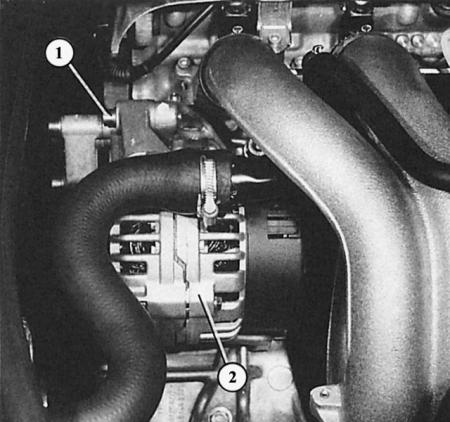
On models with four-cylinder engines, the alternator (2) is located on the left front next to the engine and is accessible from above. The number "1" shows the upper mounting bolt.
On models with four-cylinder engines, the alternator (2) is located on the left front next to the…


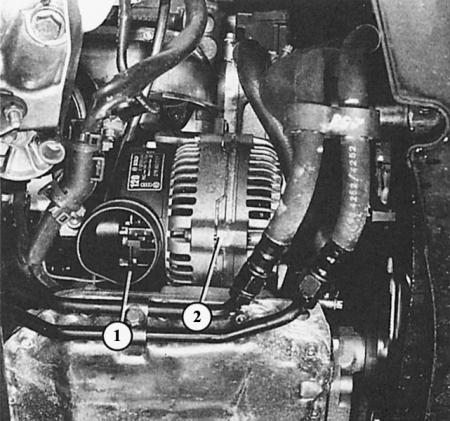
View of a six-cylinder engine from below. The generator (2) is located on the right side at the bottom near the engine. An air duct (1) is connected to cool the generator (here dismantled for the sake of clarity of the image).
The article was checked by auto expert Georgy Rodionov
This article is available at russian, bulgarian, belarusian, ukrainian, serbian, croatian, romanian, polish, slovak, hungarian

Share information:
Previous articles
Audi A4 B5: Power devices
Next articles

Starting an engine with a dead battery
Charging the battery
Checking the battery charge
Checking the acid level in the battery
Charging indicator light
Self-help with generator and voltage regulator
Driving with a faulty generator
V-belt and poly-V-belt


Similar articles on other Audi car models:
Generator — removal and installation Audi 80 B3 (1986-1991, petrol)
Three phase alternating current generator Audi 100 C4 (1990-1994, petrol)
Schedule of current maintenance Audi A3 Type 8L (1996-2003)
Generator Audi A6 C5 (1997-2004)
Removal and installation the generator Audi A8 D2 (1994-2002)
Generator without sliding bushings Audi Q5 Type 8R (2008-2017)
Removal and installation the generator bracket Audi A2 (1999-2005)
Link to this page in different formats


Visitor comments

No comments yet


How much will 41 + 22 =


A4(B8, 2007-2015) 
  • General information
  • Operating instructions
  • Power unit
  • Petrol engines 1.8 l
  • Petrol engines 1.8/2.0 l
  • Petrol engines 3.0 l
  • Petrol engines 3.2 l
  • Fuel system (petrol)
  • Diesel engines 2.0 l (CA*)
  • Diesel engines 2.0 l (CJCB)
  • Diesel engines 2.7/3.0 l
  • Diesel engines 3.0 l
  • Fuel system (diesel)
  • Transmission
  • Manual gearbox 0B1
  • Manual gearbox 0B2
  • Manual gearbox 0B3
  • Manual gearbox 0B4
  • Automatic transmission 0B5
  • Automatic transmission 0B6
  • Automatic transmission 0AW
  • All-wheel drive system
  • Chassis
  • Front suspension
  • Rear suspension
  • Brake system
  • Steering system
  • Body
  • Exterior
  • Interior
  • Seats
  • Doors, locks and windows
  • Security system
  • Heating and air conditioning
  • Electrical equipment
  • Audio system
  • Power devices
  • Equipment and devices
  • Lighting and lamps
  • Electrical circuits
 
A4(B7, 2004-2008) 
  • General information
  • Introduction to manual
  • Troubleshooting
  • Operating instructions
  • Maintenance
  • Power unit
  • Petrol engines 2.0 (ALT)
  • Petrol engines 2.0 (TFSI)
  • Petrol engines 1.8 (MPI)
  • Diesel engines
  • Cooling system
  • Air conditioner
  • Fuel and exhaust system
  • Ignition system
  • Starting and charging
  • Transmission
  • Clutch
  • Manual gearbox
  • Automatic gearbox
  • Drive shafts
  • Chassis
  • Brake system
  • Front suspension
  • Rear suspension
  • Steering
  • Body
  • Exterior
  • Interior
  • Electrical equipment
  • Equipment and devices
  • Lighting and signaling
  • Windscreen wipers and washers
  • Electrical diagrams
  • Electrical diagrams (since 2007)
 
A4(B6, 2000-2006) 
  • General information
  • Vehicle Description
  • User manual
  • Maintenance
  • Power unit
  • Gasoline engine
  • Diesel engine
  • Lubrication system
  • Cooling system
  • Supply system
  • Injection system
  • Exhaust system
  • Ignition and control
  • Transmission
  • Gear box
  • Clutch and drive shafts
  • Chassis
  • Brake system
  • Car suspension
  • Steering
  • Body
  • Heating and ventilation
  • Exterior (external elements)
  • Interior (internal elements)
  • Electrical equipment
  • Power devices
  • Lighting and appliances
  • Electrical circuits
 
A4(B6, 2000-2006, petrol) 
  • General information
  • Introduction to the guide
  • Car care
  • Power unit
  • Engine repair
  • Lubrication system
  • Cooling system
  • Injection and control system
  • Ignition system
  • Power and exhaust system
  • Transmission
  • Clutch and drive shafts
  • Car gearbox
  • Chassis
  • Suspension and wheels
  • Steering
  • Brake system
  • Body
  • Interior
  • Exterior
  • Electrical equipment
  • Equipment and devices
  • Lighting and signaling
  • Power devices
  • Electrical circuits
 
A4(B5, 1994-2001) 
  • General information
  • Introduction to the guide
  • Car care
  • Maintenance (gasoline)
  • Maintenance (diesel)
  • Power unit
  • Gasoline engines
  • Diesel engines
  • Engine overhaul
  • Cooling system
  • Fuel injection (gasoline)
  • Fuel system (diesel)
  • Exhaust system
  • Ignition system
  • Transmission
  • Clutch
  • Mechanical gearbox
  • Automatic gearbox
  • Drive shafts
  • Chassis
  • Brake system
  • Car suspension
  • Steering
  • Body
  • Exterior
  • Interior
  • Doors, locks and windows
  • Heating and ventilation
  • Electrical equipment
  • Power devices
  • Equipment and devices
  • Electrical circuits
 
A4(B5, 1994-2001, petrol) 
  • General information
  • Vehicle description
  • Maintenance
  • Power unit
  • Engine repair
  • Turbocharging
  • Exhaust system
  • Cooling system
  • Ignition system
  • Fuel system
  • Motronic injection system
  • MPI and MPFI injection system
  • Transmission
  • Clutch
  • Gearbox and shafts
  • Chassis
  • Steering
  • Car suspension
  • Brake system
  • Wheels and tires
  • Body
  • Heating and ventilation
  • Body parts
  • Electrical equipment
  • Fuses and relays
  • Power devices
  • Lighting and lamps
  • Tools and devices
  • Electrical circuits
 
AudiManual.ru © 2017-2026 · Mobile version · Feedback · Sitemap: EN BG BY UA RS HR RO PL SK HU · Site search · News and articles
80 B2 · 80 B3 petrol · 80 B3 · 80 B4 · 100 C3 diesel · 100 C3 petrol · 100 C3 · 100 C4 petrol · 100 C4 · A3 Type 8L · A4 B5 petrol · A4 B5 · A4 B6 petrol · A4 B6 · A4 B7 · A4 B8 · A6 C4 · A6 C5 · A6 C5 Allroad · A8 D2 · Q5 Type 8R · Q7 Typ 4L · Audi A2 ·
This site uses cookies 🍪. Click the button to accept this fact.