



Table of contents: Monthly ↓ Work carried out as part of… ↓ Annually or every 15,000 km ↓ Work carried out as part of… ↓ Annually or every 15,000 km ↓ Every two years or every 30,000 km… ↓ Every 2 years ↓ Every 60,000 km ↓ Every 180,000 km ↓
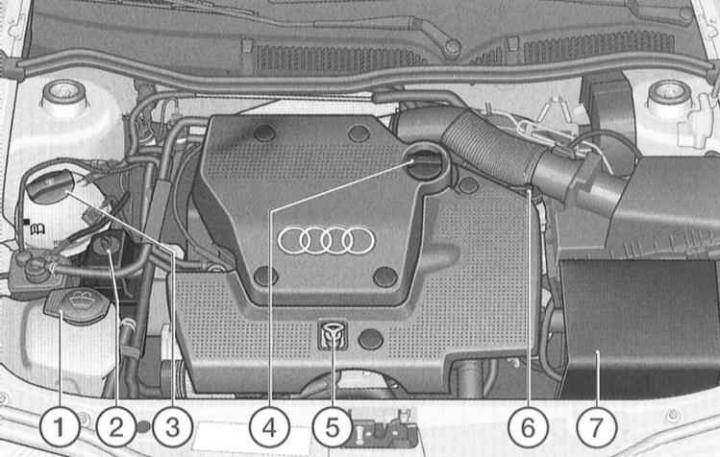
Underhood space. Petrol engine 1.6 l
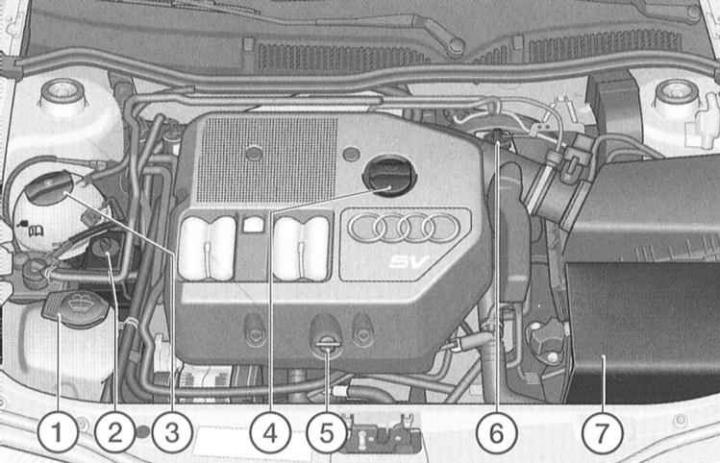
Underhood space. Petrol engine 1.8 l
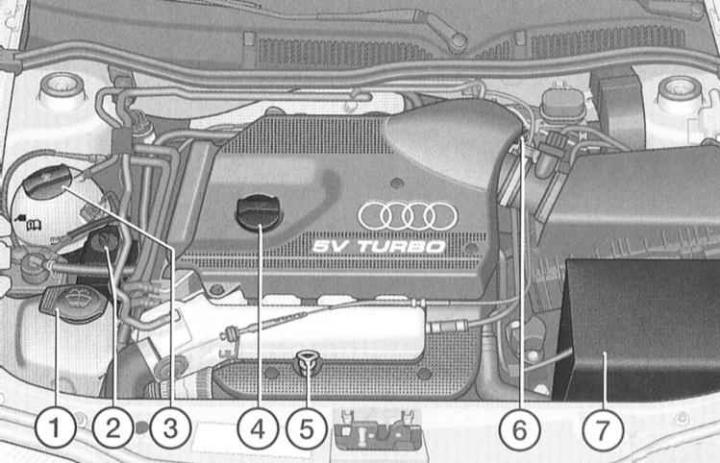
Underhood space. Petrol engine 1.8T
Underhood space. Turbodiesel engine
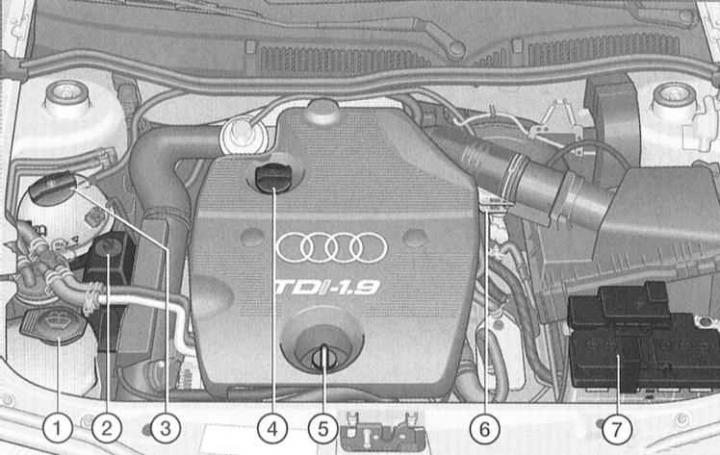
- 1 Windscreen washer reservoir
- 2 Power steering reservoir
- 3 Expansion tank of the cooling system
- 4 Engine oil filler neck
- 5 Engine oil dipstick
- 6 Brake fluid reservoir
- 7 Battery (under the lid)
The suggested recommendations assume that the car owner performs the maintenance procedures on his own, as opposed to the work performed at a service station of the representative branch of the AUDI company. Although this schedule is based on the manufacturer's recommendations, the intervals between most of the procedures can be shortened at the owner's discretion, for example, checking and changing lubricants and fluids should be performed at intervals that ensure maximum service life of the engine or drive. In addition, if the owner is interested in maintaining the car in a state of maximum readiness for operation in case of possible resale, many procedures can be performed more often. We only welcome such an initiative.
Initial servicing and inspection of a new vehicle must be performed at a representative service station to meet the warranty conditions. In most cases, such inspection is free of charge (for further information, please contact the company's representative office).
Monthly
Check the engine oil level (subsection Checking fluid levels, leak control)
Check the engine coolant level (subsection Checking fluid levels, leak control)
Check the brake/clutch fluid level (subsection Checking fluid levels, leak control)
Check the windshield washer fluid level (subsection Checking fluid levels, leak control)
Check the condition of your tires and their pressure (subsection Checking the condition of the tires and their pressure)
Work carried out as part of maintenance "service OIL"
(A message flashes on the dashboard after the engine is started "service OIL")
Annually or every 15,000 km
In difficult operating conditions, such as predominantly urban driving and short distances, frequent driving in mountainous areas, towing a trailer and high dustiness of roads, these operations must be performed more frequently.
All monthly checks, plus:
Replace the engine oil and oil filter (subsection Changing engine oil and oil filter)
Check the thickness of the front and rear brake pads (subsection Checking the brake system).
Reset the service interval indicator to its original position (please refer to the materials presented above).
Diesel engine: Measure the timing belt wear and check for damage.
Work carried out as part of maintenance "service INSP"
(A message flashes on the dashboard after the engine is started "service INSP")
Annually or every 15,000 km
All of the above, plus:
Perform a visual inspection of the engine and engine compartment components for fluid leaks (subsections Checking the condition and replacing engine compartment hoses, localizing leaks, Visual inspection of the gearbox for leaks).
Check the level and frost resistance of the cooling system coolant. Check for leaks and clean the radiator grille from external contaminants (subsection Checking the functioning of the cooling system).
Check the exhaust system for external damage (subsection Checking the condition of the exhaust system).
Check the gearbox, wheel drive shafts, and hinge covers for leaks of lubricants and fluids, and damage (subsections Visual inspection of the gearbox for leaks, Checking the condition of suspension and steering components, Checking the condition of the protective covers of the drive shafts).
Check the steering rod ends for play, reliability of fastening, and damage to the dust boots (subsection Checking the condition of suspension and steering components).
Check the drive shaft joint seals (subsection Checking the condition of the protective covers of the drive shafts).
Check the steering rack protective covers for damage and leaks (subsection Checking the condition of suspension and steering components).
Lubricate door latches and lock cylinders (subsection Lubrication of door latches and lock cylinder).
Check the lines, hoses, brake cylinders and connections of the brake system for leaks and damage (subsections Checking the brake system, Checking the condition and replacing engine compartment hoses, localizing leaks).
Check tread depth, tire pressure, tire wear and damage (including spare tire) (subsection Checking the condition of the tires and their pressure).
Tighten the wheel mounting bolts crosswise with a force of 120 N·m.
Check the operation of all power consumers, controls and indicators.
Check and adjust the headlight beam if necessary.
Check the wiper blades for wear. If the blades move unevenly, check the installation angles (subsection Checking the condition, adjusting and replacing windshield wipers).
Check the operation of the windshield and headlight washers - installation of nozzles, patency of the system tubes.
Check the battery electrolyte level. Check the reliability of the terminals and holders (subsection Checking battery condition, care and charging).
Reset the service interval indicator.
Every two years or every 30,000 km (whichever comes first)
All of the above, plus:
Diesel engine: Replace the fuel filter (subsection Replacing the fuel filter of a diesel engine).
Manual transmission: Check the oil level. If necessary, fill the box (subsection Checking the transmission oil level of the manual transmission).
Check the underbody protection.
Perform a visual inspection of damage to security systems (belts and pillows) (subsection Visual inspection of the seat belt and airbag unit).
Replace the filter element of the fine cabin air filter (subsection Replacing the cabin air filter).
Check the ease of movement of the hatch panel, spray the guide rails with grease G 052 778 A2.
Every 2 years
Replace brake fluid (subsection Replacing brake fluid).
Perform an exhaust system check. First time after 3 years: Measure idle speed, CO concentration, ignition timing, read the contents of the fault memory
Every 60,000 km
Replace spark plugs (subsection Checking and replacing spark plugs).
Replace the element and wash the air filter housing (subsection Replacing the air filter element).
Check the power steering fluid level and top up if necessary (subsection Checking the power steering fluid level).
Automatic transmission: Check the final drive oil level and top up if necessary (section Checking the automatic transmission final drive fluid level).
Replace the V-ribbed belt (subsection Checking the condition of ribbed drive belts).
All-wheel drive models: Replace the Haldex interaxle clutch oil (subsection Changing the oil in the Haldex clutch of all-wheel drive models).
Diesel engine:
Every 180,000 km
AGN, AGU and AQA engines: Replace the timing belt and camshaft drive tension roller.