



Table of contents: Petrol engines ↓ Models with AJQ engines: ↓ Diesel engines ↓ Manual gearbox ↓ Values to check at idle speed ↓ Spark plugs ↓ Current care ↓ Maintenance performed according to… ↓ Resetting the service interval… ↓
Petrol engines
All models except those equipped with AJQ engines:
Unleaded gasoline is not worse than AI-95
It is permissible to use unleaded gasoline no worse than AI-91, but the engine power will decrease.
Models with AJQ engines:
Unleaded gasoline no worse than AI-98. It is allowed to use unleaded gasoline no worse than AI-95, but the engine power will decrease.
Diesel engines
| Diesel fuel according to DIN EN 590 | Cetane number not less than 49 |
| Biodiesel fuel according to DIN 51 606 | RME |
| Fuel tank | |
| Volume | 55 l or 62 l on all-wheel drive models |
| including reserve stock | 7 l or 8 l on all-wheel drive models |
| Windscreen washer | |
| Type | water with concentrate S - in summer, W - in winter or alcohol (no more than 15%) with water |
| Volume | 3 l, 5.5 l with headlight washers |
| Engine oil (See also the materials in the subsection Automotive chemicals, oils and lubricants) | |
| Type | For models from 2000 (MJ 00), the service interval (WIV) has been extended and new AUDI engine oil requirements have been introduced. |
| Petrol engines // Diesel engines | |
| Release | |
| up to 4/99 (MJ 98) | 500 00, 501 01, 502 00 // 500 00 + 505 00 or 501 01 + 505 00 |
| from 5/99 (MJ 00) without WIV | 500 00, 501 01, 502 00 // 500 00 + 505 00, 505 00, 505 01 |
| from 5/99 (MJ 00) with WIV | 503 00, 503 01 // 506 00, 506 01 |
| Audi S3 | 503 01 // – |
| + means that both specifications must be indicated on the oil packaging | |
| It is possible to use SF/SG (diesel CD) oils according to API specification, or A2/A3 according to ACEA specification (diesel B3 or B4) | |
| Viscosity | 5W30 (cold climate), 20W40 (hot climate) |
| Volume, with filter replacement | |
| All engines | 4.5 l |
| The difference between the "max" and "min" marks on the measuring rod | 1 liter |
| Cooling system | a mixture of soft water (60%) and antifreeze concentrate (40%) |
| Antifreeze concentrate | G12 A8D (red color) or TL-VW 774 D specification (do not mix with any other) |
| System volume | |
| Engines 1.6, 1.8 l | 5.0 l |
| The amount of antifreeze added to the cooling system to ensure the required frost resistance (at the same time drain the same amount of coolant), l |
| Measured value,°C. | 0 | –5 | –10 | –15 | –20 | –30 | Capacity |
| Engine 1.6, 1.8 l | Differential
quantity | ||||||
| Required frost resistance | 2.5 | 2.2 | 1.8 | 1.5 | 1.2 | 0.5 | |
| –35° | 5.0 | ||||||
Use only "G12" (red color). "G11" should not be used (green color). Do not mix G11 and G12. This may cause severe engine damage.
Below is an indication of how much antifreeze should be added to provide the desired freeze resistance.
Example: The measurement shows protection against freezing down to a temperature of -10°C. In this case, 2.2 l of liquid must be drained from the cooling system and 2.2 l of pure antifreeze must be added. Then protection is provided up to a temperature of -35°C.
Manual gearbox
| Type | Synthetic G052 SAE 75W90 specification "G 50" |
| Volume | |
| 020 (1.6L engines) | 1.9 l |
| 02A (1.8L engines) | 2.0 l |
| Automatic transmission | |
| Type | ATF ESSO EGL 71 141 or AUDI–ET No. G052 162 A2 (light yellow) |
| Volume | |
| When replacing | 3.0 |
| Total | 5.3 l |
| Automatic transmission main gear oil transmissions | 0.75 l, synthetic oil G052 145…SAE 75W90 |
| Oil haldex clutches for 4WD models | 0.25 l of oil for Haldex clutch specification G 052 175 A1 |
| Steering control | G 002 000 |
| Brake system | 1.5L, FMVSS DOT 4 |
| Lubrication of drive shafts | |
| Type of lubricant | AUDI G 000 grease 603 |
| Lubricant volume | |
| Outer ball and tripod joint | |
| Hinge J 81 mm | |
| General | 80 g |
| Volume in hinge | 40 g |
| Volume in protective case | 40 g |
| Hinge J 90 mm | |
| General | 120 g |
| Volume in the hinge | 80 g |
| Volume in protective case | 40 g |
| Inner joint - ball | |
| Hinge W 94 mm | |
| General | 90 g |
| Volume in the hinge | 40 g |
| Volume in protective case | 50 g |
| Hinge J 100 mm | |
| General | 120 g |
| Volume in the hinge | 50 g |
| Volume in protective case | 70 g |
| Internal hinge - tripod | |
| General | 180 g |
| Front Hinge Volume | 90 g |
| Volume on the back side of the hinge | 90 g |
| Battery Terminal Grease | Bosch Ft 40 v 1 |
Values to check at idle speed
| Idle speed, rpm | |
| AEH, AGN | 760 – 880 |
| AGU, AQA | 800 – 920 |
| 1.9 TDI | 875 – 950 |
| CO level, % | max 0.5 |
| Level CO₂, % | 14.5 – 16.0 |
| O2 level, % | 0.1 – 0.5 |
| Values to check at 2500-2800 rpm | |
| The meaning of lambda | 0.97 – 1.03 |
| CO level, % | 0.3 |
Spark plugs
| Engine designation | Type | Interelectrode gap, mm |
| AEH, AGN | NGK BKUR 6 ET-10 or AUDI 101000033AA | 1.0 |
| AGU | Bosch F7LTCR or AUDI 101000051AA | 1.0 |
| Size under the key | 16 mm |
| Candles incandescent | |
| Beru | GN 855 |
| Bosch | 0 250 202 022 |
| Champion | CH 171 |
| Lucas/CAV | HDS 342 |
| Tire size//Rim size//Press-in depth | |
| 195/65 R15 91H//6J x 15 H2//38 mm | |
| 185/65R15 88Q/T/H M+S//6J x 15 H2//38 mm | |
| 205/65 R15 89H//6J x 15 H2//38 mm | |
| 205/55 R16 91V//6J x 15 H2//44.5 mm | |
| 185/65R15//6J x 15 H2//38 mm | |
| Spare wheel | T125/90 R15 |
| Pressure air in tires of front wheels//rear wheels, bar | |
| Average loading | |
| Tires 195/65 R15, 205/65 R15, 205/55 R16 | 1.8//1.8 |
| Tires 185/65R15, 225/45 R17W | 2.1//2.1 |
| Full load | |
| Tires 195/65 R15, 205/65 R15, 205/55 R16 | 2.2//2.7 |
| Tires 185/65R15, 225/45 R17W | 2.5//2.8 |
| Small size spare wheel | 4.2//4.2 |
| Nominal values air pressure for all factory-installed normal tire sizes (summer tires, all-season tires) are indicated on the sticker on the inside of the fuel filler flap neck. The pressure of the spare emergency tire is indicated on the sidewall of the tire. | |
| Wheel nuts | M14x1.5x27.5, spanner size 17 mm |
| Tire speed category | |
| S | 180 km/h |
| T | 190 km/h |
| H | 210 km/h |
| V | 240 km/h |
| W | 270 km/h |
| ZR | over 270 km/h |
ATTENTION: Word "reinforced" at the end of the tire marking means reinforced performance. | |
| Tightening forces of threaded connections Tightening torques for fasteners are also given in the text and in some illustrations*. | |
| Oil drain plugs in the oil pan | 30 N m |
| Automatic transmission oil filler plug transmissions | 15 H m |
| Oil drain plug haldex clutches for 4WD models | 15 Nm |
| Haldex clutch filler plug models with all-wheel drive | 30 Nm |
| Spark plugs | 30 Nm, 25 Nm (NGK BKR 5 EKUP) |
| Nuts wheels | 120 Nm |
This Chapter has been compiled to help the amateur mechanic maintain his vehicle in a state of maximum performance, economy, safety and reliability. Later in the Chapter you will find a complete schedule of routine vehicle maintenance procedures, as well as Sections devoted to the description of the maintenance of its individual systems. The Sections include descriptions of visual checks, adjustments, component replacement and other useful tips. The location of individual components can be determined by the illustrations with views of the engine compartment and the underbody of the vehicle. By servicing the vehicle in accordance with the mileage and time schedule and following the detailed instructions below, you will receive a clear maintenance program that can ensure a long and reliable service of your vehicle. Remember that this plan is exhaustive, and the implementation of individual points and neglect of others will not give the expected result.
Current care
As you service your vehicle, you'll soon discover that you can—and should—combine many procedures because of the similarities in the steps involved. For example, if the vehicle is raised off the ground to lubricate the chassis, you should inspect the exhaust system, suspension, steering system, and fuel system while you're underneath the vehicle. If the wheels are off for other work, you might want to check the brakes. Finally, suppose you have to borrow or rent a torque wrench. Even if you only need it to tighten the spark plugs, you might as well check the torque on as many critical nuts and bolts as you have time for.
The first step in carrying out a vehicle maintenance program is self-preparation. Carefully study the materials of all Sections related to the upcoming procedures, then prepare all the necessary materials, equipment and tools. If you are afraid of encountering problems when performing some specific work, consult a specialist or a person who has already carried out this work.
Maintenance performed according to the service interval indicator on the instrument panel
Warning: Extended service interval (WIV) is applied for models from 2000 (MJ00) (vehicles with the system "Long–Life–Service"). Vehicles with this system can be identified by the number "QG1" in the service book or by the vehicle data plate. The vehicle data plate is located in the trunk next to the spare wheel well.
For vehicles with the system "Long–Life–Service", thanks to careful operation and gentle conditions of use, the service interval of 15,000 km or 12 months can be doubled. The maximum service interval is therefore 30,000 km or 24 months, with the service due date indicated by the service interval indicator on the instrument panel. The driver is warned by the indicator approximately 3,000 km in advance "service in 3000 km" ("service after 3000 km") after each ignition switch-on. After the service period determined by the control unit has been reached, the message appears "service" "service jetzt" ("service now"). After this, the service must be carried out immediately. For vehicles that have traveled less than 3,000 km during the service interval, this warning appears without a prior signal.
Under very severe operating conditions, maintenance is required for vehicles with the system "Long–Life–Service" can be carried out after 15,000 km or every 12 months.
Maintenance necessarily includes oil change and related work.
Vehicles with the following characteristics may be equipped with the system "Long–Life–Service":
1. Special ("flexibel") indicator of service intervals.
2. Low engine oil level sensor.
3. Brake pad wear indicator.
4. Long-life engine oil AUDI–Norm 503 00 (petrol) or 506 00 (diesel).
5. Low-maintenance lead-calcium battery.
Warning: For vehicles with the system "Long–Life–Service", in which the system is filled with oil other than AUDI-Norm 503 00 or 506 00, the service interval indicator must be set to 15,000 km or 12 months. This is done by resetting the indicator using the reset button on the instrument panel.
For cars without a system "Long–Life–Service" it is necessary to carry out oil changes and maintenance in accordance with the maintenance schedule.
Vehicle service intervals depend on the time elapsed since the last service and the mileage.
If service is required, after the ignition is turned on and the engine is started, the service indicator signal appears for one minute instead of the mileage reading on the tachometer counter.
At the same time, one or both indicators flash: service OIL (oil change and related work) or service INSP (inspection service).
The scale for calculating service cycles is the time or distance traveled since the last reset of the indicator to its original position. In this case, 1000 km or 10 days between the appearance of the indicator and the service are taken into account. Additional factors are not taken into account.
If the service has been carried out, the service indicator must be reset to its original (zero) position.
Warning: AUDI service stations additionally, during each service, read data from the fault memory of the electronic control units of the engine, ABS, airbag and anti-theft system using the VAG 1551 fault memory interrogation device. For this purpose, it is recommended to contact the service station at certain intervals. It should be borne in mind that some faults, such as failed engine control system sensors, do not lead to a noticeable decrease in the vehicle's performance. The control units have an emergency operation mode or operate on reserve parameters, which cannot be detected by the driver. The fault memory interrogation is carried out via the diagnostic connector.
For vehicles with or without the system "Long–Life–Service", the service interval indicator must be reset after a service or oil change. If this is done using the setting buttons on the instrument panel, the indicator is set to "nicht flexibel". In this case, the vehicle is subject to the normal maintenance plan, according to the period and the distance traveled. If the indicator is set to "flexibel", it must be reset using a fault reader or vehicle diagnostic system at a service station.
Resetting the service interval indicator
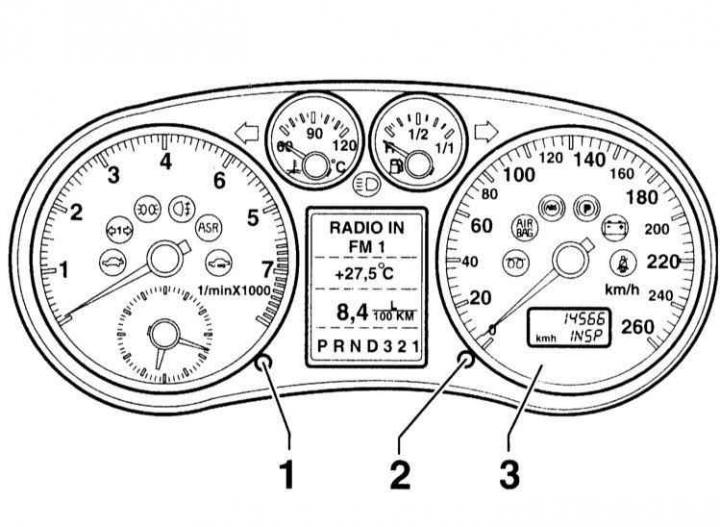
- 1 - adjustment button
- 2 - mileage meter button
- 3 - mileage indicator
The service interval indicator can be reset in two different ways: in service stations, the VAG 1551 fault memory interrogation device is used for this purpose, connected to the diagnostic connector on the center console.
If the specified device is not available, the indicator can be reset to its original position using the odometer and clock reset button on the instrument panel as follows:
Warning: In this case, the service indicator, set to "flexibel" (flexible) is set to "nicht flexibel" (not flexible).
Execution order
1. Turn off the ignition, the ignition key is in the zero position.
2. Press and hold the –2– trip meter key.
3. Turn on the ignition. The trip indicator –3– shows the message "service OEL". Release the –2– key.
4. Pull the –1– clock button for about 2 seconds. This way the message is reset "service OEL". Depending on the date of the index, the message is saved "service OEL" or three dashes (– – –) appear.
5. Press the –2– key again and release it. This switches to the message "service INSP".
6. Pull out the adjustment button –1– next to the tachometer for about 2 seconds. The service indicator is reset. Depending on the date of the indicator, a message is saved "service OEL" or three dashes (– – –) appear.
7. Turn off the ignition.
Warning: When the battery is disconnected, the gauge readings are retained.