
Repair Chevrolet Repair Toyota Repair Honda Repair AvtoVAZ Repair Mercedes-Benz Repair BMW Repair Opel
Home  |  Contacts  |  Sitemap  |    
English Русский
Български
Беларускі
Український
Српски
Hrvatski
Română
Polski
Slovenský
Magyar
AudiManual.ru


  • AUDI 80
  • AUDI 100
  • AUDI A3
  • AUDI A4
  • AUDI A6
  • AUDI A8
  • AUDI Q
  • OTHER
  • ARTICLES
B8 (2007-2015) B7 (2004-2008) B6 (2000-2006) B6 (2000-2006, petrol) B5 (1994-2001) B5 (1994-2001, petrol)

Doors — dismantling and adjustment (Audi A4 B5)

  • Home
  • Audi A4
  • B5 (1994-2001, petrol)
  • Body
  • Body parts
  • Doors — dismantling and adjustment
            0
Table of contents: Door Seal Maintenance ↓ Door dismantling ↓ Correct door adjustment ↓ Door fitting ↓
Doors — dismantling and adjustment


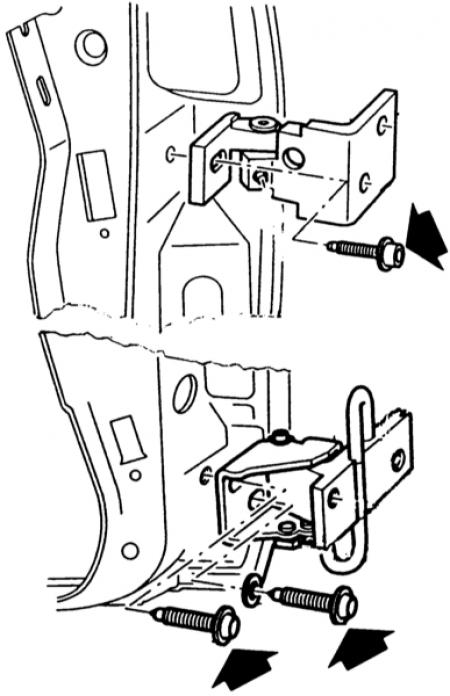
The doors are screwed to the hinges as a whole with three TORX bolts (arrows).
The doors are screwed to the hinges as a whole with three TORX bolts (arrows).


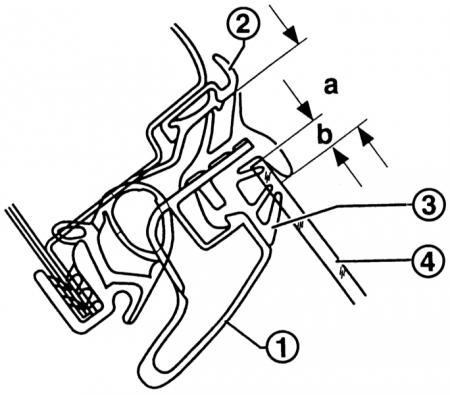
Installation control dimensions of the "door mounting unit support" (1). The outer seal (3) must fit along its entire length to the front door pillar and to the decorative strip (2) of the roof. The distance between the decorative strip of the roof and the lower edge of the seal (3) must be a = 18.3 mm. The door glass (4) must be immersed in the seal by b = 5 mm.
Installation control dimensions of the «door mounting unit support» (1). The outer seal (3) must…


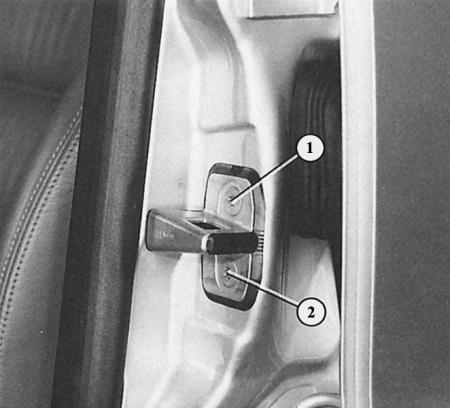
By loosening the TORX bolts (1 and 2), the lock plate can be moved for lateral adjustment at the rear of the door.


Audi traditionally uses two-piece doors. The inner part of the door, the "door mounting support," is attached to the outer part of the door, the "door base," with four bolts. This allows the outer part to be replaced in the event of minor damage, without the hassle of dismantling the window lift and release mechanisms.

Door Seal Maintenance


External seals, which are in the same plane as the doors, require special care in the Audi A4, since cracks in them cause not only leaks, but also increased noise generation during movement. The best means of caring for seals is deer fat. It has a pleasant side effect: in winter, it prevents the seal from freezing to the body, which eliminates the burdensome warming up of it with a hair dryer.

Door dismantling


1. To disconnect the plug connectors of the speakers in the door, the electric drive for adjusting the mirror or the windows, you need to remove its trim as described in this chapter. The same applies to the wires and hoses of the central lock.

2. Remove the bellows between the door and the door post from the clamps and pull the disconnected wires out of the door.

3. Unscrew one TORX bolt in the upper hinge, two such bolts in the lower hinge, remove the door. The hinges remain on the body.

4. After installation, adjust the door (next section).

Tip: The door can be removed together with all the hinges. In this case, you need to remove the trim of the front door pillar and disconnect the plug connector located underneath it. This is the only way to get to the bolt of the lower hinge screwed in from the inside.


Correct door adjustment


1. When adjusting the doors, the Audi A4 must be horizontal on the ground with all four wheels. When the car is raised, the body may bend slightly, so the door alignment will not be correct.

2. Adjustment is carried out according to the following criteria:

3. The dimensions of the gaps at the front and rear edges of the door should be as follows: wing at the front door 4 mm, front door at the rear door 5 mm, rear door to the side piece 3.5 mm. Install the doors correctly.

4. The contour of the body must be maintained: the longitudinal bearing is to ensure that the metal edges of the doors do not stand out on the contour of the body as a step or that the door is not installed too high or too deep.

5. Wind noise should be avoided. This can be achieved by adjusting the door correctly: to do this, first of all, the window frame with its gasket should fit tightly against the door opening. This is achieved by adjusting the "support of the door mounting units".

Door fitting


This describes the adjustment of the front doors. Of course, this also applies to the rear doors.

Sequence: start with adjusting the rear door if both doors are removed. If the rear door has not been removed and is still correctly adjusted, then you can start with the front door.

1. Longitudinal adjustment to set the door gap: slightly loosen the door/door hinge screws so that the door can still be slid.

2. Close the door and level the gap.

3. Carefully open the door and tighten the hinge screws.

4. Height adjustment (contour): loosen the screws between the hinge and the door as mentioned above. Slide the door up or down.


5. Tighten the screws again.

6. Lateral adjustment, front edge of the door (wind noise): not adjustable – if necessary, make intermediate plates out of metal and insert between the door and the hinge in order to extend the door further outward.

7. Lateral adjustment, rear edge of door (wind noise):

8. Slightly loosen the plate that the door lock fits into.

9. Close the door and press it into the opening according to the outer contour.

10. Open the door, tighten the lock plate.

11. Check in the passenger compartment whether the door fits evenly against its rubber seal.

12. Adjusting the window frame: If the door base is adjusted correctly, now check whether the window frame sits cleanly in the door opening. The outer door seal should not protrude above the roof strip.

13. If adjustment is required, remove the door trim and loosen the four "door mounting support" mounting screws.

14. Close the door.

15. Have your assistant press the frame from the outside into the doorway – it is better to press it a little further, as the rubber door seal exerts counter pressure.

16. In order for the seals to fit tightly, you must simultaneously press the frame up and forward.

17. If the adjustment is correct, you can tighten both upper bolts and the rear lower bolt from the inside. Tightening torque: 30 Nm.

18. Please note additionally: the installation wedge at the bottom bolt must always be placed in front. Before tightening the bolt, it must be moved upwards so that it is slightly jammed.

19. There is an additional option for adjusting the rear edge of the door with a setting wedge: due to the deeper latch of the wedge, the lower edge of the door goes inward, and the upper one goes outward. Pulling the wedge more strongly causes the opposite reaction.
The article was checked by auto expert Georgy Rodionov
This article is available at russian, bulgarian, belarusian, ukrainian, serbian, croatian, romanian, polish, slovak, hungarian

Share information:
Previous articles
Audi A4 B5: Body parts
Next articles

Side planks
Wings and mudguards
Hood — dismantling and adjustment
Front of the car
Dismantling doors
External view mirror
Trunk lid — dismantling and adjustment
Rear bumper — dismantling


Similar articles on other Audi car models:
Removal and installation/adjustment of doors Audi 80 B3 (1986-1991)
Dismantling doors Audi 100 C4 (1990-1994, petrol)
Removal, installation and adjustment of the hood Audi A3 Type 8L (1996-2003)
Door frame adjustment Audi A6 C5 (1997-2004)
Car doors Audi A8 D2 (1994-2002)
Timing chain covers, valve 1 of timing phase adjustment «N205» Audi Q5 Type 8R (2008-2017)
Headlights — checking adjustment, adjusting if necessary Audi A2 (1999-2005)
Link to this page in different formats


Visitor comments

No comments yet


How much will 41 + 15 =


A4(B8, 2007-2015) 
  • General information
  • Operating instructions
  • Power unit
  • Petrol engines 1.8 l
  • Petrol engines 1.8/2.0 l
  • Petrol engines 3.0 l
  • Petrol engines 3.2 l
  • Fuel system (petrol)
  • Diesel engines 2.0 l (CA*)
  • Diesel engines 2.0 l (CJCB)
  • Diesel engines 2.7/3.0 l
  • Diesel engines 3.0 l
  • Fuel system (diesel)
  • Transmission
  • Manual gearbox 0B1
  • Manual gearbox 0B2
  • Manual gearbox 0B3
  • Manual gearbox 0B4
  • Automatic transmission 0B5
  • Automatic transmission 0B6
  • Automatic transmission 0AW
  • All-wheel drive system
  • Chassis
  • Front suspension
  • Rear suspension
  • Brake system
  • Steering system
  • Body
  • Exterior
  • Interior
  • Seats
  • Doors, locks and windows
  • Security system
  • Heating and air conditioning
  • Electrical equipment
  • Audio system
  • Power devices
  • Equipment and devices
  • Lighting and lamps
  • Electrical circuits
 
A4(B7, 2004-2008) 
  • General information
  • Introduction to manual
  • Troubleshooting
  • Operating instructions
  • Maintenance
  • Power unit
  • Petrol engines 2.0 (ALT)
  • Petrol engines 2.0 (TFSI)
  • Petrol engines 1.8 (MPI)
  • Diesel engines
  • Cooling system
  • Air conditioner
  • Fuel and exhaust system
  • Ignition system
  • Starting and charging
  • Transmission
  • Clutch
  • Manual gearbox
  • Automatic gearbox
  • Drive shafts
  • Chassis
  • Brake system
  • Front suspension
  • Rear suspension
  • Steering
  • Body
  • Exterior
  • Interior
  • Electrical equipment
  • Equipment and devices
  • Lighting and signaling
  • Windscreen wipers and washers
  • Electrical diagrams
  • Electrical diagrams (since 2007)
 
A4(B6, 2000-2006) 
  • General information
  • Vehicle Description
  • User manual
  • Maintenance
  • Power unit
  • Gasoline engine
  • Diesel engine
  • Lubrication system
  • Cooling system
  • Supply system
  • Injection system
  • Exhaust system
  • Ignition and control
  • Transmission
  • Gear box
  • Clutch and drive shafts
  • Chassis
  • Brake system
  • Car suspension
  • Steering
  • Body
  • Heating and ventilation
  • Exterior (external elements)
  • Interior (internal elements)
  • Electrical equipment
  • Power devices
  • Lighting and appliances
  • Electrical circuits
 
A4(B6, 2000-2006, petrol) 
  • General information
  • Introduction to the guide
  • Car care
  • Power unit
  • Engine repair
  • Lubrication system
  • Cooling system
  • Injection and control system
  • Ignition system
  • Power and exhaust system
  • Transmission
  • Clutch and drive shafts
  • Car gearbox
  • Chassis
  • Suspension and wheels
  • Steering
  • Brake system
  • Body
  • Interior
  • Exterior
  • Electrical equipment
  • Equipment and devices
  • Lighting and signaling
  • Power devices
  • Electrical circuits
 
A4(B5, 1994-2001) 
  • General information
  • Introduction to the guide
  • Car care
  • Maintenance (gasoline)
  • Maintenance (diesel)
  • Power unit
  • Gasoline engines
  • Diesel engines
  • Engine overhaul
  • Cooling system
  • Fuel injection (gasoline)
  • Fuel system (diesel)
  • Exhaust system
  • Ignition system
  • Transmission
  • Clutch
  • Mechanical gearbox
  • Automatic gearbox
  • Drive shafts
  • Chassis
  • Brake system
  • Car suspension
  • Steering
  • Body
  • Exterior
  • Interior
  • Doors, locks and windows
  • Heating and ventilation
  • Electrical equipment
  • Power devices
  • Equipment and devices
  • Electrical circuits
 
A4(B5, 1994-2001, petrol) 
  • General information
  • Vehicle description
  • Maintenance
  • Power unit
  • Engine repair
  • Turbocharging
  • Exhaust system
  • Cooling system
  • Ignition system
  • Fuel system
  • Motronic injection system
  • MPI and MPFI injection system
  • Transmission
  • Clutch
  • Gearbox and shafts
  • Chassis
  • Steering
  • Car suspension
  • Brake system
  • Wheels and tires
  • Body
  • Heating and ventilation
  • Body parts
  • Electrical equipment
  • Fuses and relays
  • Power devices
  • Lighting and lamps
  • Tools and devices
  • Electrical circuits
 
AudiManual.ru © 2017-2026 · Mobile version · Feedback · Sitemap: EN BG BY UA RS HR RO PL SK HU · Site search · News and articles
80 B2 · 80 B3 petrol · 80 B3 · 80 B4 · 100 C3 diesel · 100 C3 petrol · 100 C3 · 100 C4 petrol · 100 C4 · A3 Type 8L · A4 B5 petrol · A4 B5 · A4 B6 petrol · A4 B6 · A4 B7 · A4 B8 · A6 C4 · A6 C5 · A6 C5 Allroad · A8 D2 · Q5 Type 8R · Q7 Typ 4L · Audi A2 ·
This site uses cookies 🍪. Click the button to accept this fact.