



Table of contents: Wheel alignment ↓ Wheel alignment ↓ Transverse inclination of kingpin ↓ Longitudinal inclination of kingpin ↓
To ensure safe driving and reliable operation of the vehicle's chassis, the front wheels must be installed at a certain angle.
Wheel alignment
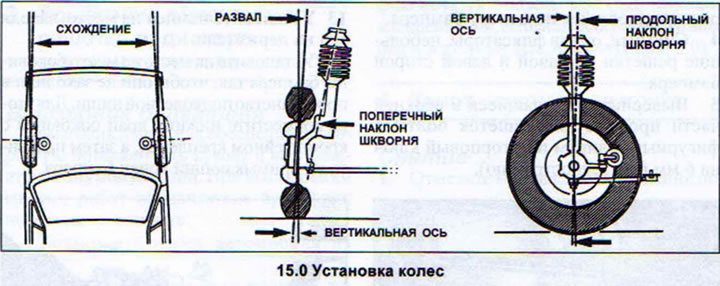
The front wheels of the AUDI 80 are mounted so that they are closer to each other at the front than at the rear. This toe-in is called positive. The friction force between the wheel and the road surface tends to push the left wheel to the left, and the right wheel to the right. This is counteracted by the driving force coming from the engine to the front drive wheels. The driving force coming to the wheels tends to bring them together. As a result, the opposing forces are balanced. When turning, the positive toe-in changes to negative, due to the trapezoid shape of the steering rods. The wheel going along the inner radius of the turn is pushed to the side more strongly than the wheel going along the outer radius.
Wheel alignment
The camber of the wheels is the angle of deviation of the plane of the wheel along the vertical. The front wheels of the AUDI 80 cars in their upper part (in the wheel well) are spaced closer together than the bottom one, which touches the road surface. Experts call this negative camber.
Transverse inclination of kingpin
The transverse inclination of the kingpin is related to the concept of "Wheel camber". The transverse inclination of the kingpin is a slight tilt of the axis of the steering knuckle relative to its vertical. Wheel camber and transverse inclination of the kingpin prevent wheel vibration. In addition, they facilitate wheel turning.
Longitudinal inclination of kingpin
The longitudinal inclination of the kingpin is understood as the displacement of the steering knuckle axis from the vertical from the direction of travel. The corresponding angle of the longitudinal inclination of the kingpin stabilizes the movement of the wheels in a straight line, facilitates the return of the steering mechanism to the middle position after turning, and also prevents wheel vibration.
We recommend that wheel alignment be performed only on a special stand. The tire pressure must correspond to the prescribed one, the car must be unloaded, the suspension shock absorbers must be normal, and the suspension and steering mechanism must not have any play.
Wheel alignment should be checked in the event of a collision (running into) a curb, in the event of one-sided wear of the tire tread, and in other cases that suggest incorrect wheel installation. These are:
- impossibility of symmetrical positioning of the steering wheel when driving in a straight line;
- car pulling to the side;
- failure of the steering mechanism to return to the center position after a turn has been made;
- wheel disc deformation.
(Content source: the specified website: Audimanual.ru)