



Note: All bolts on chassis components with silent blocks must be tightened with the suspension in a static position (the car is not loaded). Silent blocks have a limited working range of twisting. Therefore, the axle elements with silent blocks must be moved to the position in which they are during movement before tightening (suspension position without load). Otherwise, internal stresses will occur in the silent block, which will result in a reduction in the service life of this part. By lifting the corresponding wheel suspension with an engine and gearbox lift and the "T10149" support mount, this position on the lift can be simulated. Before starting work, measure, for example, with a tape measure, the dimension "a" from the center of the wheel to the lower edge of the wheel arch. Take the measurement with the suspension in a static position (unloaded state). Record the obtained value. It will be necessary for the final tightening of the bolts and nuts. Before lifting the suspension of the corresponding wheel, the car must be secured to the brackets of the lift using the tension belts "T10038". If the car is not secured, it may slip off the lift! Remove the wheel. Turn the hub so that one of the holes for the wheel bolt is at the top. Attach the support "T10149" with the wheel bolt to the wheel hub. Final tightening of the corresponding bolts/nuts should be performed only after reaching the dimension "a" measured before starting work between the center of the wheel hub and the lower edge of the wing.
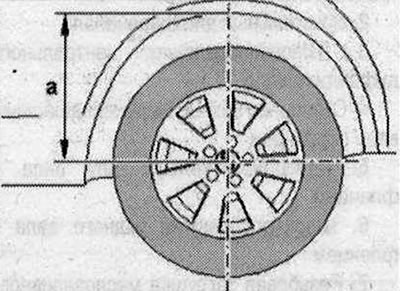
Raise the hub bearing housing using an engine and transmission lift until dimension "a" is reached.
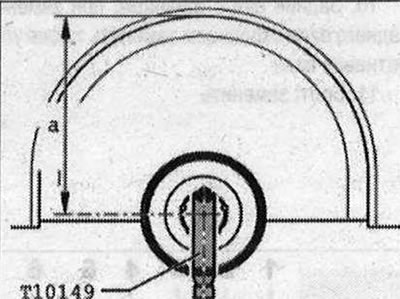
Tighten the appropriate bolts/nuts completely. Lower the wheel bearing housing. Remove the engine and gearbox lift from under the car. Remove the support mount "T10149".
[The original publication in its entirety is posted on the website: AudiManual]