



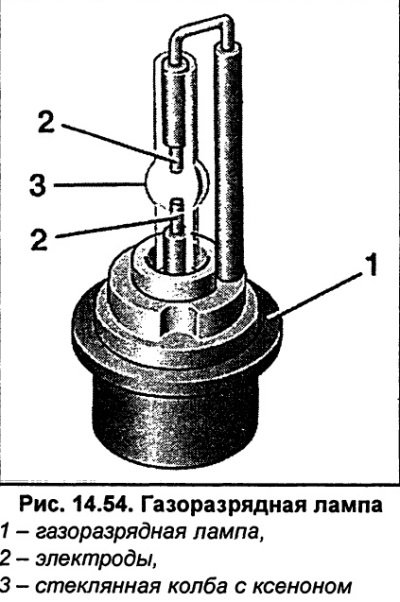
A gas discharge lamp is a glass bulb filled with xenon, in which two electrodes are installed at a certain distance (see fig. 14.54). When voltage is applied to the lamp electrodes, an arc discharge occurs. To ensure normal operation of the gas-discharge lamp, an electronic control device and a high-voltage unit are used. In order for an arc discharge to form, it is necessary to supply a voltage of about 28,000 V to the lamp. A gas-discharge lamp provides twice the light intensity of a halogen lamp with a power of 55 V, while the lamp power is 35 V. Gas-discharge lamps have a very long service life.
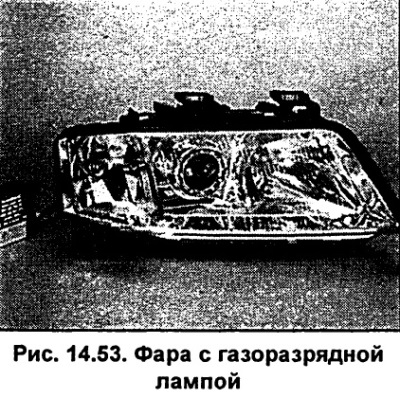
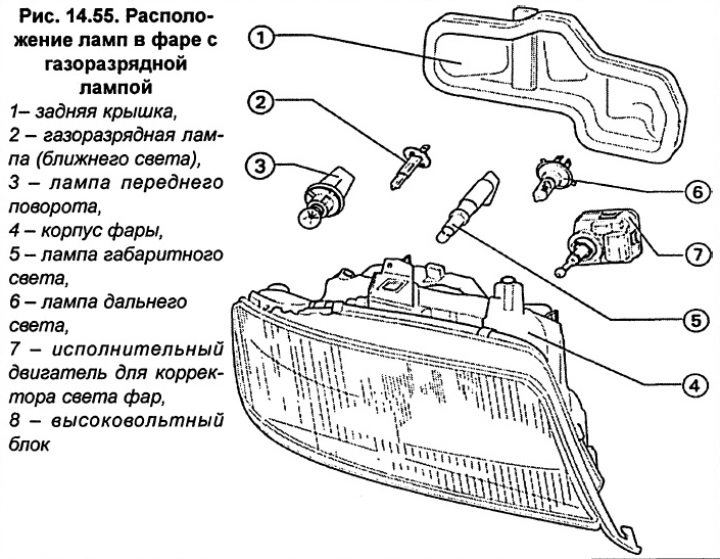
Cars with gas-discharge headlights have dynamic adjustment of the headlight beam in the vertical plane, which quickly responds to the tilt of the car body.
Sensors located at the front and rear of the vehicle react to changes in vehicle installation height. Based on the information from the sensors, the control unit sends signals to the actuators, which change the position of the headlight reflectors. This ensures constant and uniform illumination of the road while the vehicle is moving. Manual adjustment of the headlight beam is not provided. If a defect occurs in the headlight range adjustment system, the headlight beam is set to the lowest position.
[This article was copied from the website: AudiManual]