



Table of contents: ABS/ESP system Bosch 8.1 ↓ Audi Start Assist (AHA) ↓ Removal and installation the start… ↓
The tables below contain a breakdown of the equipment codes. The information presented in them reflects the technical characteristics of the brakes. calipers/discs and pads. Brake system: dual-circuit brake. a diagonal system equipped with ABS, EBV, EDS, ASR, ESP, ECD and UP systems.
Information about the type of brakes installed on the vehicle is contained on the vehicle data sticker in the corresponding equipment code (PR.-Nr.) -A and B-.
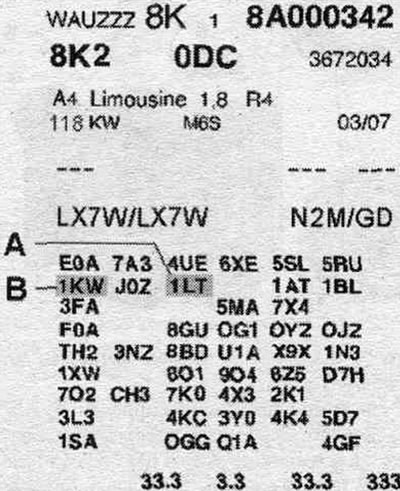
Front brakes
| Equipment code (Pr.-Nr.) | 1LT | 1LA | 1LJ |
| Brake caliper | FN3 16" | FBC 16" | FBC 17" |
| Brake discs, ventilated, diameter, mm | 314 | 320 | 345 |
| Brake disc thickness, mm | 25 | 30 | 30 |
| Brake disc, min. permissible thickness, mm | 23 | 28 | 28 |
| Thickness of brakes. pads, including support plate and noise-insulating screen, mm | 20,3 | 20,3 | 20,3 |
| Wear limit, including support plate and noise-insulating screen, mm | 10 | 10 | 10 |
Rear brake. mechanism
| Equipment code (Pr.-Nr.) | 1KW | 1KE |
| Brake caliper | CII - 43 ERV(16") | CII - 43 ERV(17") |
| Brake disc diameter, mm | 300 | 330 |
| Non-ventilated brake. disk, thickness, mm | 12 | — |
| Ventilated brake. disk, thickness, mm | — | 22 |
| Minimum permissible brake thickness. disks, mm | 10 | 20 |
| Brake caliper, piston, diameter, mm | 43 | 43 |
| Thickness of brakes. pads, including support plate and noise-insulating screen, mm | 17,5 | 17,5 |
| Wear limit, including support plate and noise-insulating screen, mm | 7 | 7 |
ABS/ESP system Bosch 8.1
The Bosch ESP 8.1 electronic system has the following functions: Anti-lock braking system ABS, Traction control system (ASR), electronic brake distribution system. effort (EBV), EDS (electronic differential lock), electronic Stability Program (ESP), FBS (Fading Brake Support) Compensation for the loss of brake efficiency when heated, NVA (hydr., brake assistant), MSR (engine torque adjustment), emergency brake signal, brake cleaning. disks, road train stabilization. The braking system is designed on a diagonal principle. The braking force is increased by means of a pneumatic system. via a vacuum brake booster. ABS malfunctions do not affect the operation of the brakes. brake booster and system. Regular brake. the system remains operational even if the ABS fails. If the ABS fails, the brake ratio will change. efforts on the axles. If the ABS malfunctions, indicated by the corresponding indicator light, the rear wheels will lock prematurely when braking! By combining these components into a single module, the number of potential malfunctions is reduced. The hydraulic control unit cannot be repaired, and if a malfunction occurs in one of the systems, it is replaced as a whole.
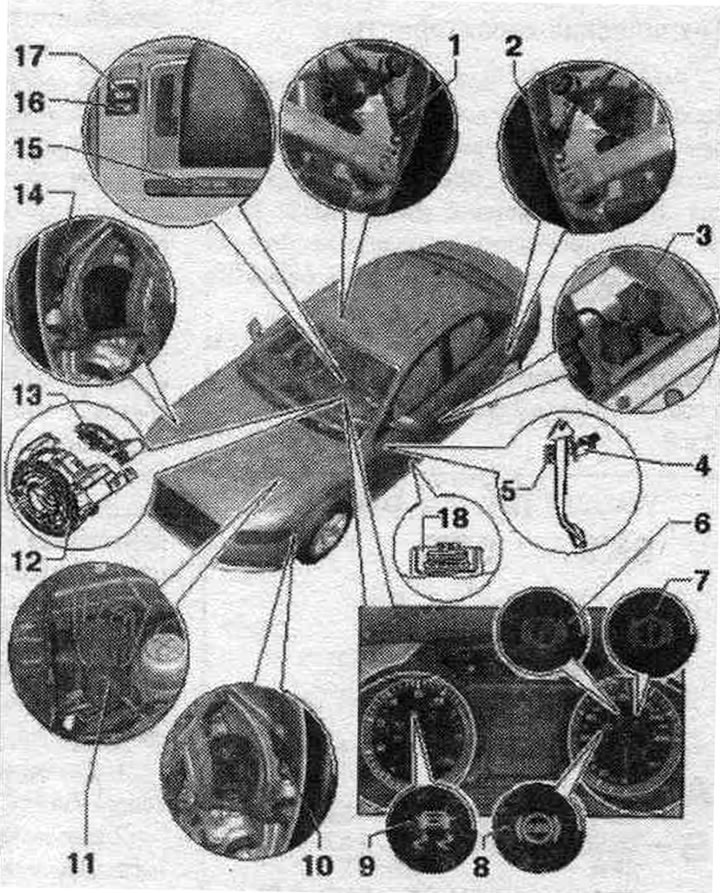
1. Rear wheel speed sensor. right wheel "G44".
2. Rear wheel speed sensor. left wheel "G46".
3. ESP sensor unit "G419"; installation location: under the left front seat; 9 Nm; combined lateral acceleration sensor "G200", vehicle yaw rate sensor "G202" and longitudinal acceleration sensor "G251"; install in accordance with the direction of movement indicated by the arrow.
4. Brake light switch; installation location: on the brake pedal; after removal, reinstallation is permitted.
5. Brake pedal: with a socket for installing a brake light switch.
6. Electric control lamp. mechanical parking brake: installation location in the speedometer; lights up when the parking light is on. brake and ignition on; lights up when the parking light is on. brake within 20 seconds after turning off the ignition; blinks when parking is turned on. brakes with insufficient braking. force to reliably keep the car from rolling away.
7. Brake malfunction indicator lamp. system "K118"; installation location - in the speedometer; lights up together with the ABS warning light when the system fails. ABS; flashes when brake level is low. liquids; flashes when there is a brake malfunction. syst.; when you press the "SET" button in the instrument cluster, a detailed description of the fault appears.
8. Anti-lock braking system indicator lamp. (ABS) "K47": the control lamp signals the status of ABS and electronic differential lock (EDS); installation location - in the speedometer; lights up when the ignition is turned on for a few seconds and goes out after the system self-diagnosis. ABS if there are no errors in it; there is a system malfunction. ABS, if the control lamp: does not light when the ignition is turned on, does not go out after a few seconds, lights up while driving; ABS malfunctions do not affect the operation of the brakes. system, the change in the nature of braking should be taken into account; the electronic differential lock (EDS) and the ABS system work together; if the EDS fails, the ABS warning light comes on.
9. Electronic system control lamp. electronic Stability Program (ESP/ASR) "K155"; installation location: in the tachometer; flashes while driving, when the system is operating. ESP/ASR; lights up when the ignition is turned on and goes out after a short self-diagnosis; lights up when there is a system malfunction. ESP; lights up when there is a system malfunction. ABS, since ESP and ABS work together; lights up when the system is turned off. ASR; lights up during the adaptation process, if; the battery is disconnected and reconnected, the car is started using an external source, the battery is discharged; once the adaptation process is complete, the ESP lamp goes out after a short distance has been traveled.
10. Front left wheel speed sensor "G47"; can be checked in the "Guided Fault Finding" mode using the "VAS 50518" or "VAS 5052" tester.
11. Hydraulic unit N55 with control unit J 104.
12. Slip ring.
13. Steering angle sensor. "G85"; location: The sensor is installed on the steering column contact ring.
14. Front right wheel speed sensor "G45".
15. ASR and ESP deactivation button "E256"; installation location: on the center console; turns ASR on and off.
16. Audi start assist switch; installation location: on the center console.
17. Parking switch. brakes "F234": installation location: on the center console.
18. Diagnostic connector: installation location: trim in the driver's footwell area.
Audi Start Assist (AHA)
Depending on the model, the vehicle may be equipped with Audi start assist. This function assists the driver if the vehicle must be frequently or for extended periods of time held stationary while the engine is running. When this function is activated, the stopped vehicle is held by the Audi start assist (AHA). The driver can release the brake pedal. In this case, all four wheels of the car are held by the pressure of the system. ESP. To prevent overheating of the electromagnetic valves of the system. ESP during long-term parking upon reaching the temp. 200°C for braking the electric brake is switched on. mechanical parking brake of the rear wheels. The automatic brake deactivation torque is calculated on the basis of the following data: engine torque, roll angle, engaged gear, on vehicles with manual gearbox, clutch pedal travel on the basis of the clutch pedal sensor signal, on vehicles with automatic gearbox. On the basis of the torque converter lock-up signal. To prevent the car from rolling, the brake is released only when the engine reaches sufficient torque.
Activation: To activate the "stand by" function, the following conditions must be met: the driver is wearing a seat belt, the engine must be running, the driver's door is closed, there are no errors in the system. ESP and electronic parking. brake. It is activated using switch "2" on the center console.
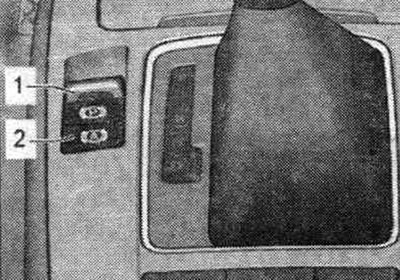
The switch displays the operating modes: off, the LED in the switch is not lit; standby, the LED in the switch is on; turned on, the LED in the switch is lit and the "P" indicator in the instrument cluster is lit green.
The braking function is transmitted from the system. The ESP parking brake is activated only if the "P" indicator in the instrument cluster lights up green and one of the following conditions is met: the temperature of the solenoid valves has reached 200°C, the driver's door is open, the seat belt is unfastened, the engine is turned off, the ignition is turned off, the switch is pressed, the brake or accelerator pedal is pressed, the Audi start assist (AHA) switch is pressed, without pressing the brake pedal. When the braking function is transferred from the ESP to the electromechanical parking brake, the indicator in the instrument cluster changes from a green "P" to a red "P".
Removal and installation the start assist switch
Remove the center console. Remove the Audi start assist (AHA) switch "2".
Installation in reverse order.
The original version of the article is posted on the website AudiManual.ru