



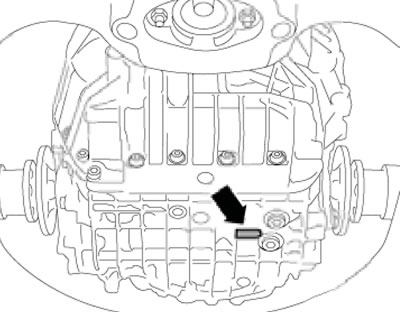
11.1 CVT Identification Data
The continuously variable transmission CTV is a transmission with a smoothly changing gear ratio, which ensures not only the efficient use of engine power, but also good dynamics and comfort of driving. The main element of the CVT is a V-chain variator, with the help of which the gear ratios change smoothly from the start of movement to the highest gear. Thanks to this, the engine, regardless of the driving mode (economical or sporty), works in its corresponding optimal mode. The variator consists of two bevel pairs connected to each other by a plate chain. Since each pair of disks shifts the conical disk by an electrohydraulic drive, the working diameter of the chain and, as a result, the gear ratio changes smoothly. In addition, the CVT uses an oil-cooled clutch, which eliminates not only the typical disadvantages of the AT torque converter, but also provides various options for starting the movement. The option is selected by the electronic control system in accordance with the driver's desire, which is recognized by the nature of the gas pedal movement. In addition, the electronically controlled clutch implements a stable "creeping" movement mode, which is an element of comfort when driving in a traffic jam. The specified program, based on the nature of the gas pedal movement, determines whether the driver wants to move in a dynamic or economical mode.
In manual mode, 6 fixed gear ratios stored in the control unit memory can be smoothly shifted using the selector lever or the buttons on the steering wheel. A description of the CVT control is given in Chapter "Controls and operating techniques".
Troubleshooting is carried out in the same way as for AT (see Section 2).
[The original article is available on the online resource Audimanual.ru]